
Blade Application Guides / Application Guide / Electrical equipment manufacturing
Polyimide-Mica Insulation Laminate Cut-to-Size Blades
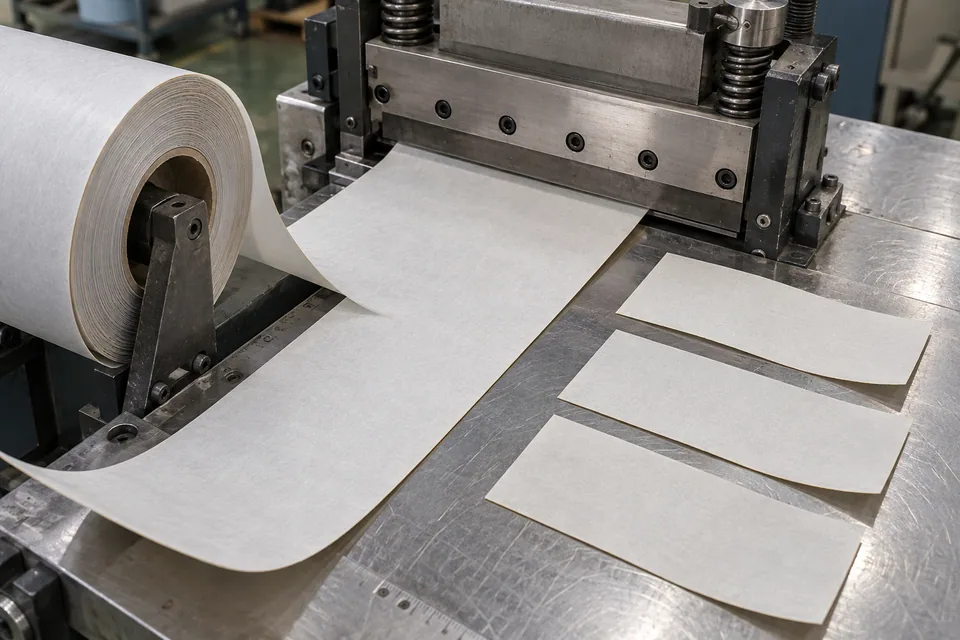
MAFEL identifies an NKN laminate with a polyimide film and mica-containing Nomex outer layers, available in cut pieces and rolls. Hauler & Hermann describes flat cut parts made from roll or sheet and includes NKN among converted laminates. This guide concerns a buyer-drawn rectangular blank with defined length and width, not a shaped phase barrier or a narrow longitudinal strip alone. The material may be a flat-fed sheet or a previously slit roll, but the grade and layer stack must be confirmed before choosing support and blade. A crosscut can disturb the mineral-bearing paper faces or leave a polyimide lip at the end. Dimensional and layer checks are converting evidence; motor insulation approval belongs to the manufacturer of the completed winding.
Updated
Where This Cutting Application Appears
Build the rectangular size schedule
Take the developed flat dimensions from the slot-cover or phase-insulation drawing. Mark paper face, polyimide direction and any later fold line. Count each size separately, because a short blank may be impossible to position correctly in a long slot.
Trial a restrained transverse cut
Feed a real sheet or slit roll over a smooth support and hold it flat at blade entry. Observe whether the exit-side mineral paper tears or the center film stretches past the face. Examine both the outgoing blank and the starting end left for the next cut.
Measure after handling
Check length, squareness and curl on a flat fixture. Inspect both cut ends for mica-containing particles, paper pullout, polyimide whiskers and adhesive lift. Retain early and late specimens to reveal feeder slip and tool wear.
Keep the blanks ready for forming
Stack pieces with interleaf or trays that avoid scratching the paper face. Identify grade, lot and direction. The buyer should check fold or insertion survival and final dielectric behavior on its real motor assembly.
Define the Required Cut Result
- Produce released rectangular insulation blanks.
- Maintain both end edges without mineral-paper shedding.
- Control polyimide lip, squareness and curl.
- Preserve grade and face orientation for forming.
Problems to Diagnose Before Changing the Knife
Exit-side paper frays
- Review blade support and grade condition.
- Compare upper and lower faces.
Length is inconsistent
- Inspect feed slip and registration.
- Measure consecutive pieces.
Corners delaminate during stacking
- Review cut damage and handling pressure.
- Separate blade defects from packing defects.
Knife Forms That May Be Considered
| Possible knife form | When it may be considered | What must be confirmed |
|---|---|---|
| Supported transverse shear | For straight rectangular pieces from a validated NKN-type roll or sheet. | Check both-end layer integrity, dimensions and flatness. |
| Guided sheet crosscutter | For flat-fed NKN-type stock requiring repeated rectangular lengths. | Inspect both ends and the next piece’s leading edge for paper debris and film lip. |
Information to Send for Technical Review
You do not need to know the exact blade name. Send the available workpiece, machine, current-knife and cut-result information so the application can be reviewed against a drawing or sample.
- Exact NKN-type grade and layer stack
- Sheet or roll supply condition
- Blank dimensions and machine direction
- Fold or insertion allowance
- Allowed mineral debris and film projection
- Feed, hold-down and shear details
- Stack and label plan
- Motor assembly qualification
Questions About This Cutting Application
Does cut to size create a finished motor liner?
No. It creates flat rectangles for later forming or insertion.
Why examine the center film?
It may project beyond apparently clean paper faces at the cut end.
Can all mica laminates share one blade setup?
No. Binder, backing and grade construction vary.
Does dimensional acceptance prove dielectric life?
No. The completed equipment requires its own tests.
What should be supplied for trials?
Send a grade datasheet, sample sheet and developed blank drawing.
Public references and scope
These public sources provide material, cutting-method or safety context for this guide. Supplier pages describe their own materials or equipment; they do not establish a MEIRENTE blade specification or performance claim. Confirm the actual grade, machine setup and required cut with a drawing or sample.
Related product and service information
- Polyimide-Mica Insulation Laminate Precision-Trimming Blades - polyimide-mica insulation laminate · precision trimming
- NMN Motor-Insulation Laminate Cut-to-Size Blades - NMN motor-insulation laminate · cut to size
- Transformer Electrical Pressboard Cut-to-Size Blades - transformer electrical pressboard · cut to size
Request a Custom Cutting-Knife Review
Send the workpiece details, machine or holder information, current knife photos or sample, required quantity and examples of the present cut problem. Final dimensions, material, edge geometry and tolerances are confirmed from the approved requirements.