
Blade Application Guides / Application Guide / Electrical equipment manufacturing
Transformer Electrical Pressboard Contour-Cutting Blades
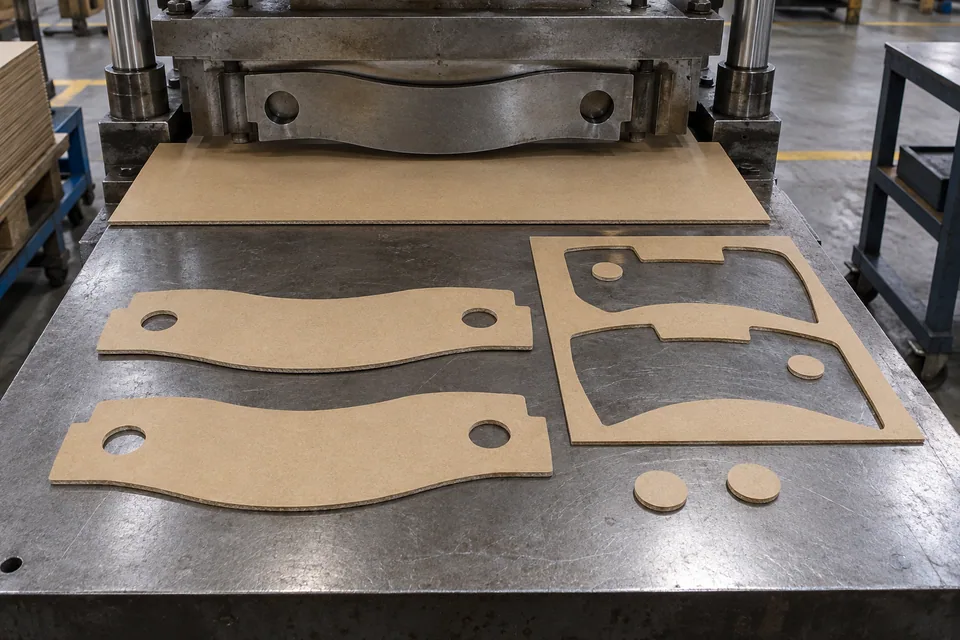
Hauler & Hermann describes pressboard transformed into stamped parts, discs and formed parts to customer drawings. Vantape lists pressboard sheets cut, punched, drilled or machined into spacers, washers, barriers and supports. These direct manufacturer descriptions support shaped parts from a specified board, but not a single universal blade setting across calendered and pre-compressed grades. This guide addresses a released flat contour with a hole, radius or slot cut from transformer electrical pressboard sheet. The design owner must identify material grade, thickness and moisture condition. A supported die, routing or other profile-cutting route should be trialed for edge quality and dust collection. The completed transformer requires its own mechanical, drying and dielectric validation.
Updated
Where This Cutting Application Appears
Confirm the exact function of the shaped piece
Read the transformer barrier or spacer drawing and mark conductor clearances, oil duct openings, bolt holes and edge radii. Identify whether the part is a flat barrier or a blank that will later be formed. Preserve any directional requirement from the pressboard supplier rather than treating the sheet as packaging board.
Trial the most demanding feature
Choose the buyer-approved punch, die or routed contour method on actual grade and thickness. Start with the narrowest bridge or smallest hole. Inspect whether the cut compresses the cellulose edge, lifts internal layers or produces chips that can remain in the transformer insulation area.
Inspect the part and its scrap
Measure hole-to-edge, contour and flatness after the board rests under the customer’s conditioning method. Examine both faces and the interior edge of apertures for frayed fibers or delamination. Keep offcuts and dust out of accepted parts, and retain first and later specimens for wear comparison.
Hand off to assembly and drying
Pack the shaped parts with grade and lot identification under the specified moisture-control process. Fit the component in a representative winding or barrier fixture. The transformer maker owns subsequent oil, drying, compression and electrical tests; a sound cut contour alone does not demonstrate service performance.
Define the Required Cut Result
- Make the released contour and holes in identified pressboard.
- Limit crushed fibers, delamination and loose cellulose dust.
- Preserve web and spacer dimensions through handling.
- Keep shaped-part identity for transformer assembly.
Problems to Diagnose Before Changing the Knife
A narrow bridge cracks
- Review grade, feature width and cut support.
- Compare incoming sheet quality.
Hole edges shed cellulose dust
- Check punch or router condition and collection.
- Inspect both face and bore edge.
The blank warps after cutting
- Review sheet moisture, residual stress and packing.
- Measure after buyer-defined conditioning.
Knife Forms That May Be Considered
| Possible knife form | When it may be considered | What must be confirmed |
|---|---|---|
| Matched profile punch and die | For a tested pressboard grade and repeatable released outline. | Confirm holes, edge fibers and slug removal. |
| Guided router or profile cutter | When thick or complex board geometry needs another route. | Check dust collection, edge finish and dimensions. |
Information to Send for Technical Review
You do not need to know the exact blade name. Send the available workpiece, machine, current-knife and cut-result information so the application can be reviewed against a drawing or sample.
- Pressboard grade, thickness and lot
- Flat contour and hole drawing
- Material conditioning and moisture criteria
- Required oil ducts, bridge widths and radii
- Allowed fiber damage and delamination
- Chosen tool and support method
- Dust and slug collection
- Transformer fit and dielectric test owner
Questions About This Cutting Application
Can the same die work on every pressboard grade?
No. Density, thickness and conditioning must be trialed on the specified sheet.
How is contour cutting different from cut to size?
It makes holes, curves or notches beyond a simple rectangle.
Why keep aperture dust out?
Loose cellulose particles can contaminate an insulation assembly.
Does the shaped part certify transformer insulation?
No. Equipment-level tests follow assembly and conditioning.
What should an RFQ include?
Send the named board sample, contour drawing and edge acceptance examples.
Public references and scope
These public sources provide material, cutting-method or safety context for this guide. Supplier pages describe their own materials or equipment; they do not establish a MEIRENTE blade specification or performance claim. Confirm the actual grade, machine setup and required cut with a drawing or sample.
Related product and service information
- Transformer Electrical Pressboard Cut-to-Size Blades - transformer electrical pressboard · cut to size
- NMN Motor-Insulation Laminate Contour-Cutting Blades - NMN motor-insulation laminate · contour cutting
- Polyimide-Mica Insulation Laminate Contour-Cutting Blades - polyimide-mica insulation laminate · contour cutting
Request a Custom Cutting-Knife Review
Send the workpiece details, machine or holder information, current knife photos or sample, required quantity and examples of the present cut problem. Final dimensions, material, edge geometry and tolerances are confirmed from the approved requirements.