
Blade Application Guides / Application Guide / Electrical equipment manufacturing
NMN Motor-Insulation Laminate Contour-Cutting Blades
BEVI states that NMN can be punched or cut to a desired shape and that die cutting needs a die tool. Coveme describes its Nomex/PET/Nomex construction for slot closure and phase separation. These facts support a contour trial for a specific laminate and drawing, not a standard shape for every motor. This guide covers a loose flat NMN sheet or pre-cut blank entering a shaped knife or die to produce a phase barrier, slot-liner end or other approved profile. Curves, notches and tongues require attention to layer registration and paper-fiber tearing. Tool choice depends on feature geometry and batch route. The motor builder must confirm the shaped part fits and survives assembly and electrical testing.
Updated
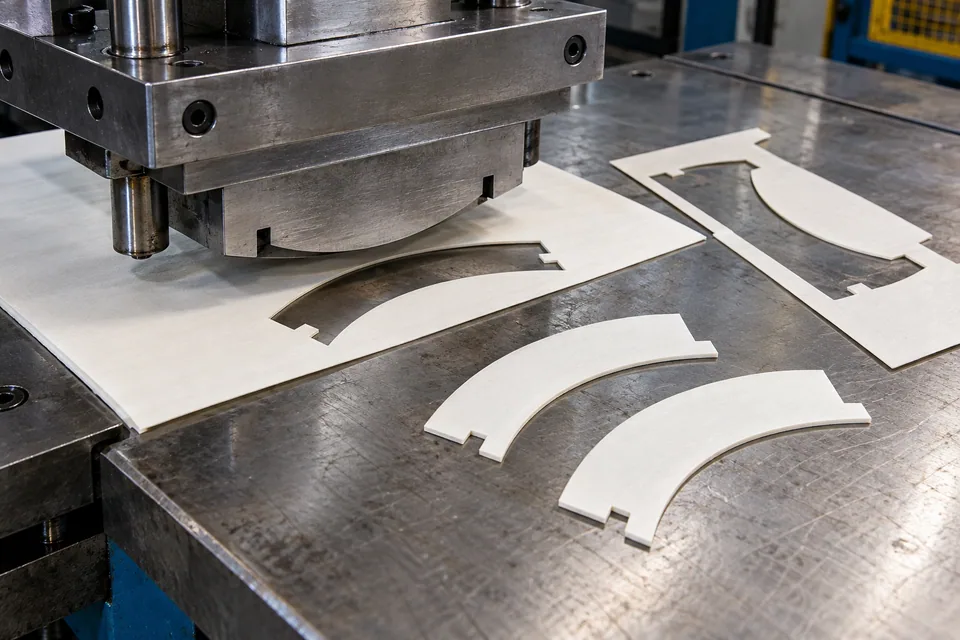
Where This Cutting Application Appears
Locate features against a real assembly drawing
Mark slot tabs, bend lines, winding-head clearance and any indexing notch. Identify which aramid face will contact conductors and which edge is exposed after forming. Nest profiles so the three-layer stack remains supported around narrow tongues.
Trial the tightest internal feature
Cut a limited quantity with the intended die or guided contour tool. Inspect inside corners, notches and narrow bridges for PET necking, aramid fuzz and delamination. A straight-edge sample cannot reveal the damage that appears at a small radius or repeated punch entry.
Check scrap ejection and orientation
Keep slugs and skeleton pieces from dragging over the useful paper face. Compare top and bottom edges; one side may show more film lip or torn fiber. Measure contour-to-notch and notch-to-bend-line positions on a relaxed part.
Fit the cut part before approval
Try the profile in the customer’s slot or phase mock-up with its forming sequence. Watch whether a notch starts a tear or an edge catches wire insulation. Die-cut appearance is only an intermediate acceptance; the motor maker owns insulation-system testing.
Define the Required Cut Result
- Match the released NMN contour and feature positions.
- Prevent fiber tears and film necking at small features.
- Control skeleton scrap and surface damage.
- Preserve part orientation for assembly.
Problems to Diagnose Before Changing the Knife
A narrow tongue separates between plies
- Review die support and incoming bond.
- Compare tongue direction to laminate machine direction.
An inside corner starts a tear
- Check radius, blade sharpness and part handling.
- Inspect cut and formed samples.
Slug scraps remain on the part
- Review die ejection and skeleton removal.
- Look for abrasion on the conductor-contact face.
Knife Forms That May Be Considered
| Possible knife form | When it may be considered | What must be confirmed |
|---|---|---|
| Matched punch and die | For a repeatable approved NMN outline with small features. | Check contour, notch position and three-layer edge integrity. |
| Guided low-volume contour knife | For trial parts whose geometry or quantity does not justify a die. | Compare feature quality and handling survival against production intent. |
Information to Send for Technical Review
You do not need to know the exact blade name. Send the available workpiece, machine, current-knife and cut-result information so the application can be reviewed against a drawing or sample.
- Exact NMN grade and sheet state
- Part drawing with curves, notches and bend lines
- Ply-face and machine-direction orientation
- Allowed fiber tear, PET lip and bond lift
- Die or guided-knife support
- Scrap and slug removal
- Assembly mock-up and packaging
- Motor insulation validation plan
Questions About This Cutting Application
Can any NMN sheet be punched identically?
No. Grade, thickness, adhesive and feature geometry require trial.
Why is a contour cut different from rectangular sizing?
It produces tabs, curves or notches tied to a motor assembly drawing.
Which feature should be piloted first?
The smallest notch or narrowest supported tongue often reveals failure first.
Can the die certify slot fit?
No. Fit must be checked in the actual motor geometry.
What starts a useful quotation?
Send the laminate sample, drawing, face convention and defect limits.
Public references and scope
These public sources provide material, cutting-method or safety context for this guide. Supplier pages describe their own materials or equipment; they do not establish a MEIRENTE blade specification or performance claim. Confirm the actual grade, machine setup and required cut with a drawing or sample.
Related product and service information
- NMN Motor-Insulation Laminate Cut-to-Size Blades - NMN motor-insulation laminate · cut to size
- Polyimide-Mica Insulation Laminate Contour-Cutting Blades - polyimide-mica insulation laminate · contour cutting
- Transformer Electrical Pressboard Contour-Cutting Blades - transformer electrical pressboard · contour cutting
Request a Custom Cutting-Knife Review
Send the workpiece details, machine or holder information, current knife photos or sample, required quantity and examples of the present cut problem. Final dimensions, material, edge geometry and tolerances are confirmed from the approved requirements.