
Blade Application Guides / Application Guide / Electrical equipment manufacturing
Transformer Crepe Insulation Paper Contour-Cutting Blades
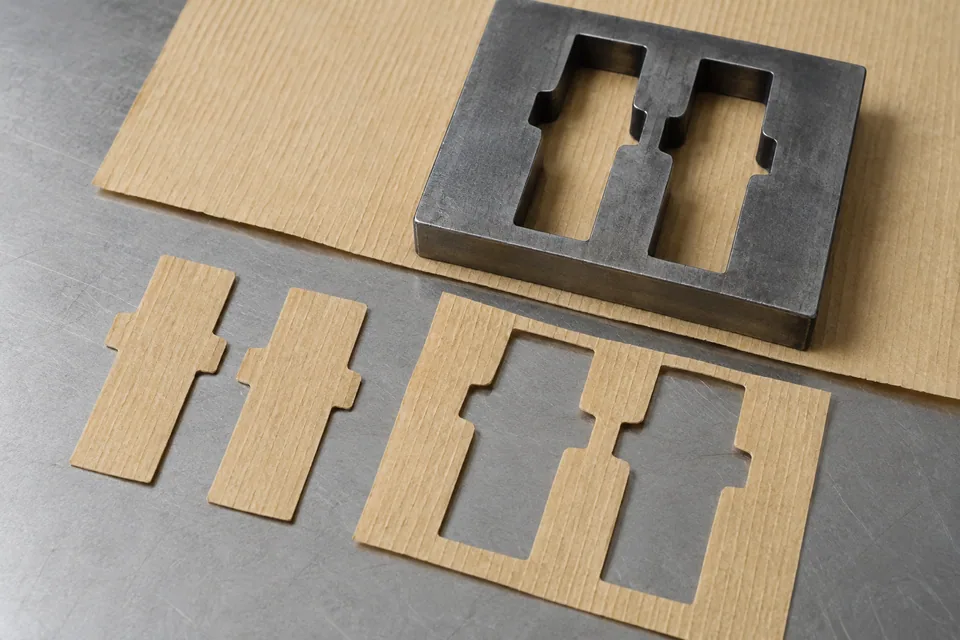
GBS offers die-cut transformer crepe insulation paper parts and custom slit widths. Weidmann describes the material’s ability to conform to irregular transformer surfaces. Those sources support a shaped-part trial only when a buyer actually requires a notch, curved end or lead-exit relief; many lead wraps remain simple narrow strips. This guide cuts a flat crepe-paper profile before winding or assembly, not a finished paper tube or a structural pressboard barrier. A matched die or supported guided knife must preserve the intended crepe direction and avoid creating a tear starter at an inside corner. The transformer owner sets the drawing, wrap sequence and final electrical acceptance.
Updated
Where This Cutting Application Appears
Locate the contour on a lead drawing
Mark bend areas, terminal exit and any relief notch against the real conductor path. State the paper’s crepe direction and how much extension is expected during wrapping. Avoid placing a deep notch where wrapping tension will open it into a tear.
Pilot the tightest feature
Try the actual die or guided cutter on a short run. Inspect the inside corner, narrow bridge and curved end while the piece is relaxed. Watch whether the tooling flattens ridges near the edge or pulls fibers out of the paper.
Inspect part and skeleton
Measure notch location and contour in the specified relaxed state. Collect scraps so loose cellulose cannot cling to the useful face. Keep both the shaped part and web skeleton as evidence of incomplete separation or tearing.
Wrap on the real geometry
Ask the transformer maker to wrap trial pieces around its actual lead or bus shape. Observe whether the contour improves coverage without leaving a gap. The equipment maker then performs its drying and dielectric tests; cut shape alone does not prove insulating duty.
Define the Required Cut Result
- Cut a released lead-wrap contour from flat crepe stock.
- Avoid notches that propagate tears during wrapping.
- Preserve useful crepe stretch at the cut edge.
- Keep loose cellulose scrap away from parts.
Problems to Diagnose Before Changing the Knife
A notch extends into a tear
- Review feature radius and crepe direction.
- Trial under actual wrapping tension.
Die flattens crepe at the perimeter
- Check contact pressure and support.
- Compare to an uncut control.
Skeleton scrap clings to useful parts
- Review ejection and collection.
- Inspect both faces before packing.
Knife Forms That May Be Considered
| Possible knife form | When it may be considered | What must be confirmed |
|---|---|---|
| Matched profile die | For an approved repeatable crepe-paper shape. | Check feature position, ridge condition and scrap release. |
| Guided contour knife | For a small prototype or revised lead geometry. | Compare cut and wrapped-part performance. |
Information to Send for Technical Review
You do not need to know the exact blade name. Send the available workpiece, machine, current-knife and cut-result information so the application can be reviewed against a drawing or sample.
- Named crepe paper grade
- Lead geometry and released contour
- Crepe direction and expected extension
- Notch radii and retained overlap
- Allowed fiber tear and flattened ridges
- Die support and scrap removal
- Relaxed-state inspection method
- Transformer wrap and electrical-test owner
Questions About This Cutting Application
Does every transformer lead need a shaped paper blank?
No. Use a contour only when the drawing calls for one.
Why trial the inside corner?
A notch can become a tear starter during wrapping.
Can paper be stretched to make a cut pass?
Do not use arbitrary extension; inspect in the buyer’s defined state.
Does a die-cut shape prove insulation coverage?
No. Wrap and test on the actual lead.
What should the quotation include?
Send the grade, lead drawing, paper sample and defect criteria.
Public references and scope
These public sources provide material, cutting-method or safety context for this guide. Supplier pages describe their own materials or equipment; they do not establish a MEIRENTE blade specification or performance claim. Confirm the actual grade, machine setup and required cut with a drawing or sample.
Related product and service information
- Transformer Crepe Insulation Paper Cut-to-Size Blades - transformer crepe insulation paper · cut to size
- NMN Motor-Insulation Laminate Contour-Cutting Blades - NMN motor-insulation laminate · contour cutting
- Polyimide-Mica Insulation Laminate Contour-Cutting Blades - polyimide-mica insulation laminate · contour cutting
Request a Custom Cutting-Knife Review
Send the workpiece details, machine or holder information, current knife photos or sample, required quantity and examples of the present cut problem. Final dimensions, material, edge geometry and tolerances are confirmed from the approved requirements.