
Blade Application Guides / Application Guide / Electronic metal converting
Tin-Plated Copper Strip Edge-Trimming Blades
Sumitomo Metal Mining supplies reflow-tin-plated copper strip and describes dedicated slitting equipment for plated stock. A single-edge trim is a narrower decision: it removes an outside margin without splitting the whole web into several lanes. This guide applies only after the buyer identifies a bad mill edge, coating irregularity or required retained width. Another blade pass can expose copper and disturb tin at the new boundary, so an already acceptable supplied edge should remain untouched. A rotary shear pair is a trial candidate, while the material owner must confirm whether edge exposure, debris and retained width meet the later connector process. Electrical contact quality cannot be inferred from an attractive trimmed line.
Updated
Where This Cutting Application Appears
Measure the original plated-edge problem
Map chips, uneven tin, burr or handling marks along the parent coil and note which face carries the issue. Compare defect depth with the approved retained width. If the flaw extends inside that width, a constant trim cannot rescue the coil.
Keep the good plated face away from scrap
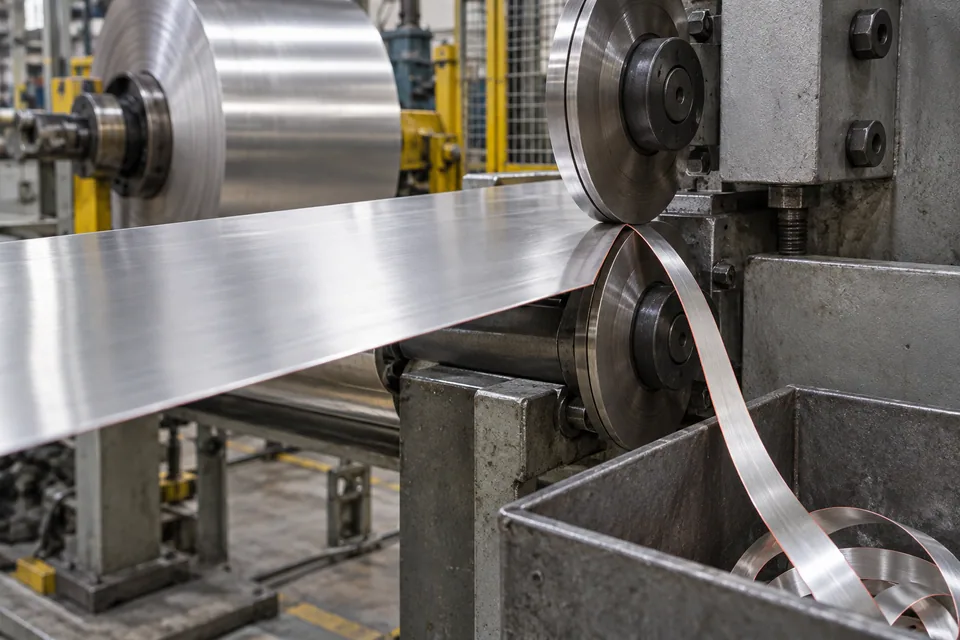
Place one paired shear at the identified outside edge and guide from the sound side. Plan a continuous waste path so the thin plated trim does not whip over useful strip. Collect a before-and-after sample from the same coil position.
Check what the new cut has exposed
Look at the new edge on both faces and under magnification. Record tin smear, lifted plating, copper exposure, burr direction and metal particles. Measure retained width at several locations after rewind; a good-looking cut is still unacceptable if it narrows the connector feed below drawing.
Approve the later contact route separately
Mark which original edge was removed and which plated face remains functional. Provide a small trimmed coil to the stamper for feed and forming trials. Contact resistance, solder wetting and environmental performance are decisions for the completed component.
Define the Required Cut Result
- Remove only the specified outer defect margin.
- Maintain minimum usable conductor width and finish orientation.
- Prevent tin smear, loose debris and unacceptable exposed copper.
- Document original and new edge specimens.
Problems to Diagnose Before Changing the Knife
Trim scrap snaps near the shear
- Check scrap width and takeoff tension.
- Look for pre-existing edge tears.
New edge shows lifted tin
- Review tool sharpness and knife engagement.
- Section both the good edge and waste side.
Width falls below the feed drawing
- Check incoming-width map and guide position.
- Sample across reel length.
Knife Forms That May Be Considered
| Possible knife form | When it may be considered | What must be confirmed |
|---|---|---|
| Single rotary shear pair | For a documented defective edge outside a released retained-width line. | Confirm waste takeoff, coating edge and width. |
Information to Send for Technical Review
You do not need to know the exact blade name. Send the available workpiece, machine, current-knife and cut-result information so the application can be reviewed against a drawing or sample.
- Coil grade, temper and tin finish
- Which original edge and face is affected
- Defect photos and depth map
- Minimum retained width and trim allowance
- Permitted exposed copper and tin smear
- Shear and scrap-removal trial setup
- Before-and-after edge samples
- Downstream connector-feed acceptance
Questions About This Cutting Application
Must a plated edge be trimmed?
No. Only a measured defect or released width change justifies the extra cut.
Can trimming restore tin on a bare edge?
No. A shear makes a new cross section; it does not replate exposed copper.
Why use one shear station?
The job removes one waste margin, not several longitudinal lanes.
What if damage extends across the cut line?
Hold the coil for material disposition rather than claiming the trim repaired it.
What is needed for quotation?
Send the bad-edge map, retained-width drawing and plating acceptance criteria.
Public references and scope
These public sources provide material, cutting-method or safety context for this guide. Supplier pages describe their own materials or equipment; they do not establish a MEIRENTE blade specification or performance claim. Confirm the actual grade, machine setup and required cut with a drawing or sample.
Related product and service information
- Ultra-Thin Stainless-Steel Foil Cut-to-Length Blades - ultra-thin stainless-steel foil · cut to length
- Rolled-Annealed Copper Foil Strip Edge-Trimming Blades - rolled-annealed copper foil · strip edge trimming
- Nickel-Clad Copper Strip Edge-Trimming Blades - nickel-clad copper strip · strip edge trimming
Request a Custom Cutting-Knife Review
Send the workpiece details, machine or holder information, current knife photos or sample, required quantity and examples of the present cut problem. Final dimensions, material, edge geometry and tolerances are confirmed from the approved requirements.