
Blade Application Guides / Application Guide / Electronic metal converting
Tin-Plated Copper Strip Cut-to-Length Blades
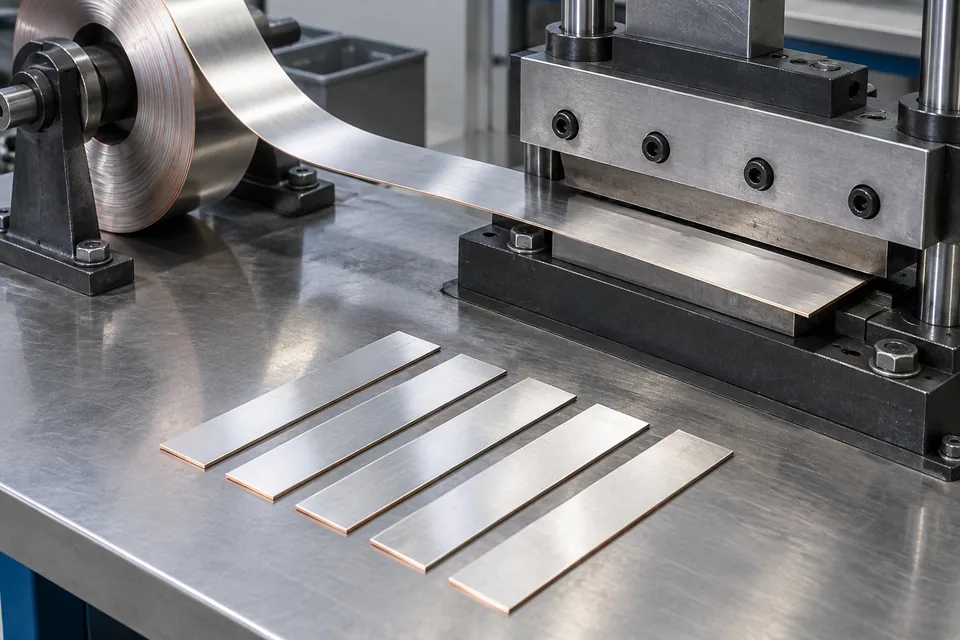
Sumitomo Metal Mining confirms tin-plated copper strip is supplied for electronic terminal work; a foil-cutting equipment maker also lists tin-plated copper foil among roll-fed transverse cut materials. Those references support a trial for a buyer-specified thin strip, not a universal machine gauge or cutting tolerance. This page concerns a straight crosscut to make flat intermediate lengths from a narrow coil. It is distinct from longitudinal slitting and from punching a final connector profile. The customer must identify whether plating precedes the crosscut, since a newly cut copper end may differ from a plated external face. The part owner decides whether exposed cut metal is acceptable in the later joining or storage route.
Updated
Where This Cutting Application Appears
Set a length schedule and face convention
Record the starting coil width, tin-coated faces, rolling direction and exact rectangular blank length. If a connector process requires staggered feed blanks, list each length and its stack count. State which surfaces may contact packaging so a delicate finish is not rubbed between pieces.
Restrain the strip at blade entry
Trial a supported transverse shear with feed registration on actual plated stock. Inspect the outgoing blank end and the remaining coil end after the same stroke. Watch for tail kick, curling, foldover or tin pickup on the hold-down and blade.
Inspect the fresh copper boundary
Measure length and squareness after pieces relax. Compare cross sections and both faces for raised burr, smeared tin and exposed substrate. Do not call the cut edge corrosion protected merely because the broad faces were tin plated before cutting.
Keep lots sorted for the next process
Stack blanks with orientation and lot identity, using interleaf if the buyer needs face protection. Sample from run start, middle and end to catch feed drift or blade wear. The downstream stamper or assembler validates the finished joint and any required surface test.
Define the Required Cut Result
- Make straight flat lengths to the buyer’s drawing.
- Protect tin faces while controlling burr and end squareness.
- Identify any newly exposed copper at the crosscut.
- Preserve lot and rolling-direction traceability.
Problems to Diagnose Before Changing the Knife
Blank tails curl after shearing
- Check hold-down support and coil set.
- Compare both ends and reverse-side appearance.
Tin smears near one cut face
- Inspect blade condition and contact surfaces.
- Compare pre-cut plating with the new edge.
Lengths drift within a stack
- Review feeder slip and registration.
- Measure across a full sample sequence.
Knife Forms That May Be Considered
| Possible knife form | When it may be considered | What must be confirmed |
|---|---|---|
| Supported transverse shear pair | For straight rectangular pieces cut from verified thin plated strip. | Check two-end burr, squareness, length and tin-face condition. |
Information to Send for Technical Review
You do not need to know the exact blade name. Send the available workpiece, machine, current-knife and cut-result information so the application can be reviewed against a drawing or sample.
- Copper alloy and temper
- Tin-plating method, coverage and sequence
- Coil gauge, width and rolling direction
- Length, squareness and flatness criteria
- Permitted exposed substrate at fresh ends
- Hold-down, feed and shear plan
- Stacking and coating protection
- Later forming, soldering and electrical test owner
Questions About This Cutting Application
Does crosscutting create finished terminals?
No. It makes plain rectangular feed blanks unless a separate contour operation is specified.
Why inspect the parent-coil end?
It becomes the leading edge of the next blank and may carry a different burr.
Is the new end necessarily tin plated?
No. If plating occurred before cutting, substrate may be exposed at the cross section.
Can a dimensionally correct blank certify a solder joint?
No. The joint and surface must be tested after the buyer’s later operations.
What should a sample request include?
Provide a plated coil sample, blank-length drawing and exposed-edge acceptance criteria.
Public references and scope
These public sources provide material, cutting-method or safety context for this guide. Supplier pages describe their own materials or equipment; they do not establish a MEIRENTE blade specification or performance claim. Confirm the actual grade, machine setup and required cut with a drawing or sample.
Related product and service information
- Tin-Plated Copper Strip Precision Blanking Blades - tin-plated copper strip · precision blanking
- Rolled-Annealed Copper Foil Cut-to-Length Blades - rolled-annealed copper foil · cut to length
- Ultra-Thin Stainless-Steel Foil Cut-to-Length Blades - ultra-thin stainless-steel foil · cut to length
Request a Custom Cutting-Knife Review
Send the workpiece details, machine or holder information, current knife photos or sample, required quantity and examples of the present cut problem. Final dimensions, material, edge geometry and tolerances are confirmed from the approved requirements.