
Blade Application Guides / Application Guide / Electronic metal converting
Rolled-Annealed Copper Foil Cut-to-Length Blades
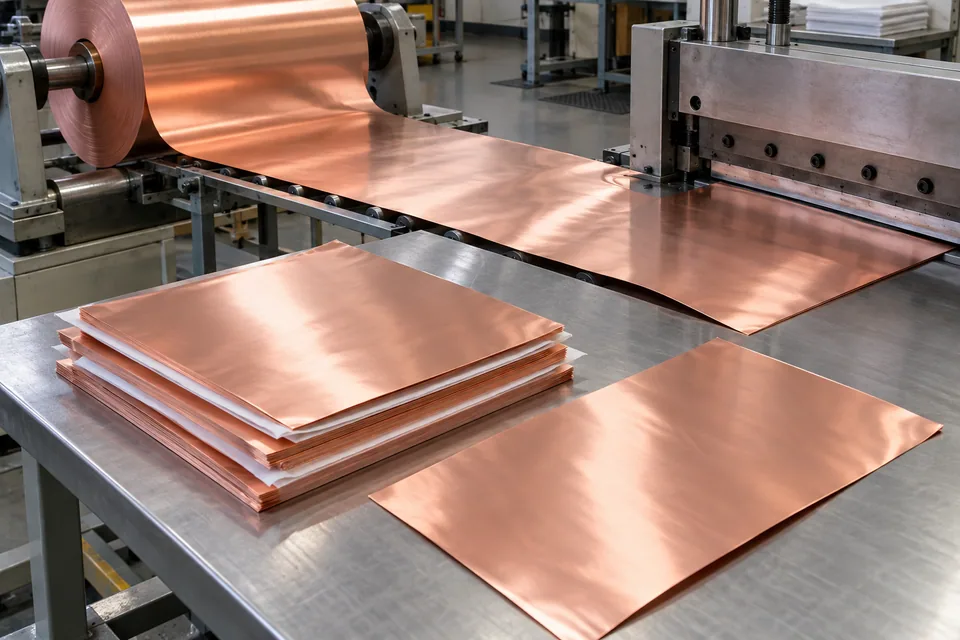
Tex Technology identifies rolled-annealed copper foil as a flexible-circuit material; CIVEN shows it supplied in different widths and tempers. Takachi documents rolled copper foil in discrete EMI shielding sheets, establishing a second legitimate destination for finite lengths. This page addresses transverse cutting of a bare RA foil coil into rectangular sheets or feed blanks before lamination, adhesive coating or die conversion. It does not describe cutting traces out of an assembled flexible circuit. A thin foil tail can curl at the shear and a flat sheet can kink during takeoff, so cutting and handling must be trialed together. A dimensionally correct blank does not automatically meet the final shielding or flex-circuit specification.
Updated
Where This Cutting Application Appears
Define why the foil is sheeted
For flexible-circuit work, use the laminate panel schedule and mark rolling direction and treated face. For a separate shield-sheet route, use the enclosure outline and any later adhesive or die-cut allowance. Do not mix those two end uses simply because the copper looks alike.
Control the transverse cut
Unwind through a low-contact feed path and support the foil across the full knife line. Compare both cut ends for lifted burrs and folded corners. Verify the first end of the next blank too; a single shear stroke creates two usable edges.
Measure after release
Check length and squareness on a supported fixture after web tension relaxes. Inspect broad faces for roller scratches, fingerprint marks or displaced surface treatment. A curl that flattens under the gauge can reappear in a buyer’s lamination stack.
Stack and protect the blanks
Use agreed interleaf, tray and orientation labels so parts are not dragged metal-on-metal. Track source reel position and lot through each package. Let the buyer validate resin bond, etched trace behavior or shield continuity under its actual build and service tests.
Define the Required Cut Result
- Make drawing-controlled rectangular RA foil lengths.
- Keep both crosscut ends free from harmful lips and tears.
- Avoid kinks, face scratches and mixed orientation.
- Deliver labeled flats to the receiving process.
Problems to Diagnose Before Changing the Knife
Corners fold during cutoff
- Check blade support and discharge path.
- Compare the two ends and foil tempers.
Length varies through the reel
- Examine feed slip and changing reel drag.
- Sample after relaxation at several coil positions.
Sheets acquire contact marks in a stack
- Inspect interleaf and pickup tools.
- Compare first and last stacked sheet surfaces.
Knife Forms That May Be Considered
| Possible knife form | When it may be considered | What must be confirmed |
|---|---|---|
| Supported transverse shear blades | For straight rectangular sheets on the released RA foil. | Confirm length, squareness, both-end edge and flatness. |
Information to Send for Technical Review
You do not need to know the exact blade name. Send the available workpiece, machine, current-knife and cut-result information so the application can be reviewed against a drawing or sample.
- Copper foil alloy, RA temper and surface treatment
- Source roll thickness, width and face map
- Sheet length and squareness drawing
- Cut-edge burr and curl examples
- Feed, support and discharge fixture
- Interleaf and protective package instructions
- Rolling direction and source-lot traceability
- Downstream lamination or shielding test owner
Questions About This Cutting Application
Is this an etched circuit operation?
No. It makes flat feed lengths from a foil coil.
Why inspect both ends of a cut?
The outgoing sheet and remaining coil can receive different lips.
Can the sheet be judged while clamped flat?
It also needs inspection after release because curl can return.
Do RA foil sheets always need an adhesive?
No. The receiving design specifies whether they are bonded, laminated or used another way.
What should the buyer send first?
A labeled foil sample and rectangular-sheet handling drawing.
Public references and scope
These public sources provide material, cutting-method or safety context for this guide. Supplier pages describe their own materials or equipment; they do not establish a MEIRENTE blade specification or performance claim. Confirm the actual grade, machine setup and required cut with a drawing or sample.
Related product and service information
- Rolled-Annealed Copper Foil Precision Blanking Blades - rolled-annealed copper foil · precision blanking
- Ultra-Thin Stainless-Steel Foil Cut-to-Length Blades - ultra-thin stainless-steel foil · cut to length
- Nickel-Clad Copper Strip Cut-to-Length Blades - nickel-clad copper strip · cut to length
Request a Custom Cutting-Knife Review
Send the workpiece details, machine or holder information, current knife photos or sample, required quantity and examples of the present cut problem. Final dimensions, material, edge geometry and tolerances are confirmed from the approved requirements.