
Blade Application Guides / Application Guide / Aerospace composite manufacturing
Thermoplastic PEEK Composite Tape Precision Trimming Blades
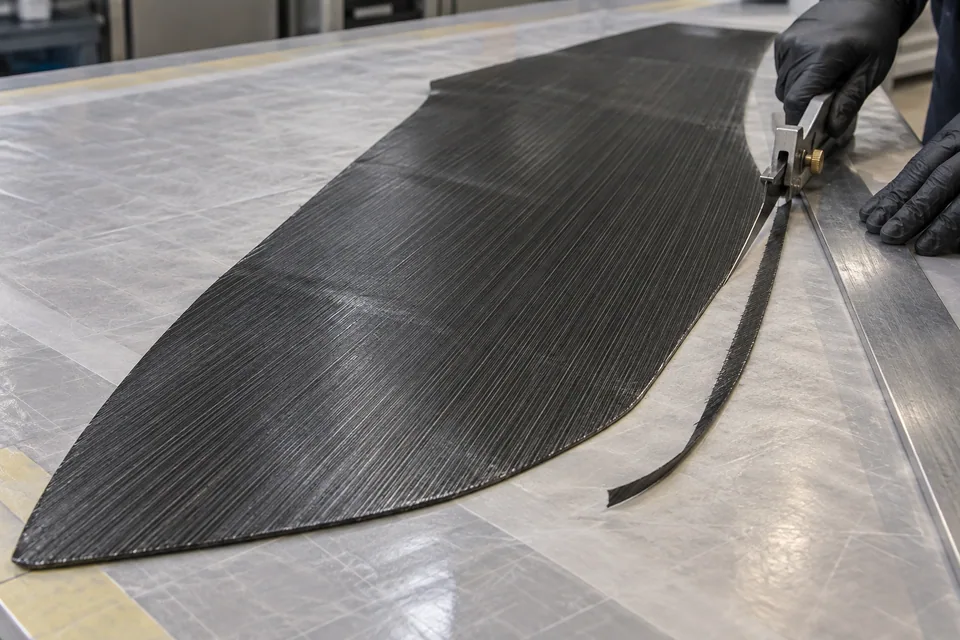
Toray and Syensqo describe carbon-reinforced PEEK tape supplied for subsequent composite fabrication. Precision trimming in this guide means removing a small, buyer-designated allowance from that raw tape or a flat ply after its initial size cut. It does not cover machining a formed composite structure. The useful edge may become a layup datum, so a narrow offcut must be removed without pulling continuous fibers from the retained blank. Web Industries’ composite-formatting services support the broader practice of slitting and ply cutting, while the exact trim route still depends on the buyer’s supplied material and tooling trial.
Updated
Where This Cutting Application Appears
Define a real sacrificial margin
Mark the incoming factory edge, damaged zone and final ply datum separately. If no extra material is provided, an edge trim may simply make the blank undersize. Confirm the intended retained width and the fiber direction in the buyer’s drawing before a knife is placed.
Stabilize the narrow offcut
A thin strip can snag, curl or draw fibers away from a carbon/PEEK ply. Support both sides of the cut and collect scrap so it does not contact the finished surface. Observe whether the resin holds cut fibers or leaves an exposed bundle.
Compare incoming and trimmed edges
Inspect the old and new boundaries at matched magnification for fiber protrusion, matrix chipping and surface scoring. Measure width in a stated tension and temperature condition. Record where the first defect appears, since material handling after trimming can add fray.
Use the new datum in placement
Trial the trimmed ply in the buyer’s fixture or tape-placement feed. Check that reference edges and any notch remain usable through transfer. Consolidation quality and service performance require separate customer testing.
Define the Required Cut Result
- Remove only an approved narrow ply margin.
- Keep fiber bundles in the retained stock intact.
- Create a stable reference edge for placement.
- Document raw-cut quality apart from formed-part performance.
Problems to Diagnose Before Changing the Knife
Offcut tugs a fiber bundle
- Inspect scrap extraction direction.
- Check blade sharpness and edge support.
- Compare fiber-axis alignment.
Useful width falls below drawing
- Recheck trim allowance and original stock width.
- Measure under repeatable tension.
- Verify cutter datum before run.
Fray appears after packaging
- Compare samples at knife and unpacking.
- Review interleaf and bag contact.
- Check transfer handling method.
Knife Forms That May Be Considered
| Possible knife form | When it may be considered | What must be confirmed |
|---|---|---|
| Guided narrow-trim edge | For a straight approved margin on wide tape or ply stock. | Prove retained width and low fiber pullout. |
| Supported flat-ply knife path | For a margin that follows a short shaped edge. | Inspect scrap lift-off and reference features on actual stock. |
Information to Send for Technical Review
You do not need to know the exact blade name. Send the available workpiece, machine, current-knife and cut-result information so the application can be reviewed against a drawing or sample.
- Supplier and PEEK composite grade
- Initial and retained edge drawings
- Fiber direction and stock width
- Allowed sacrificial margin
- Material face and release film
- Edge image acceptance samples
- Waste capture and packaging plan
- Buyer placement fixture and consolidation test
Questions About This Cutting Application
Does precision trimming mean post-forming machining?
No. This guide is for raw tape or flat ply material before final consolidation.
Why can a narrow scrap strip be troublesome?
It may pull continuous fibers or recontact a useful surface when removed.
Can every stock edge be improved by trimming?
Only where sufficient buyer-approved allowance exists.
What makes the new edge useful?
It must meet retained width, fiber condition and layup reference needs.
Does edge appearance prove structural quality?
No. The buyer evaluates the consolidated component separately.
Public references and scope
These public sources provide material, cutting-method or safety context for this guide. Supplier pages describe their own materials or equipment; they do not establish a MEIRENTE blade specification or performance claim. Confirm the actual grade, machine setup and required cut with a drawing or sample.
Related product and service information
- Thermoplastic PEEK Composite Tape Sheet Slitting Blades - thermoplastic PEEK composite tape · sheet slitting
- Cyanate-Ester Prepreg Precision Trimming Blades - cyanate-ester prepreg · precision trimming
- Lightning-Strike Protection Mesh Precision-Trimming Blades - lightning-strike protection mesh · precision trimming
Request a Custom Cutting-Knife Review
Send the workpiece details, machine or holder information, current knife photos or sample, required quantity and examples of the present cut problem. Final dimensions, material, edge geometry and tolerances are confirmed from the approved requirements.