
Blade Application Guides / Application Guide / Aerospace composite manufacturing
Lightning-Strike Protection Mesh Precision-Trimming Blades
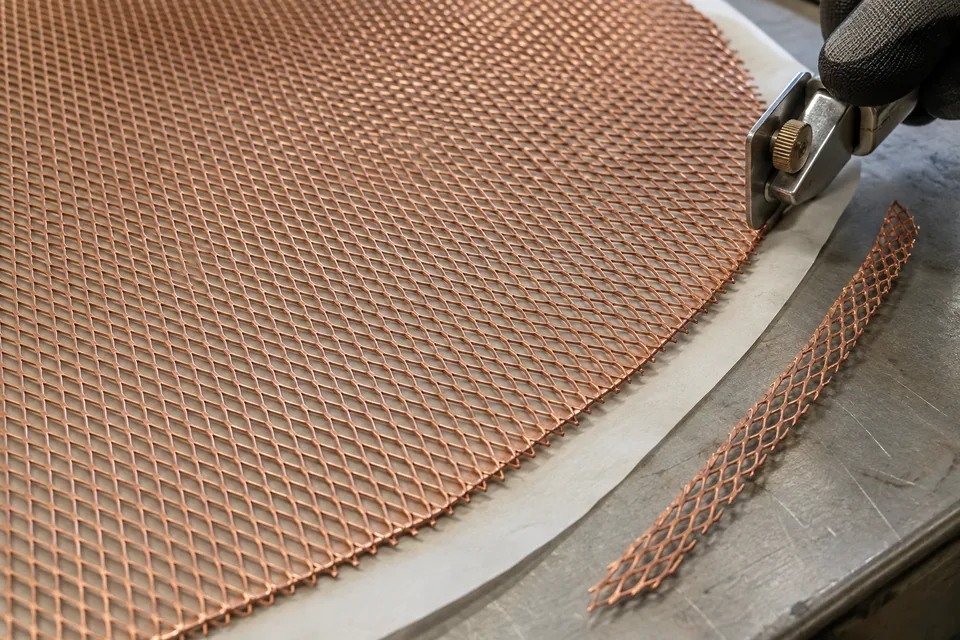
An expanded aluminum lightning-protection foil can be supplied in rolls and handled with ply-cutting equipment when paired with surface films, according to Gill. Precision trimming here means removing a narrow, drawing-authorized margin from an already cut pre-layup mesh ply. It is not the initial contour that creates a whole ply, and it is not a repair cut on a cured aircraft structure. The same product evidence supports workpiece feasibility, while the trimming method remains subject to coupon trials.
Updated
Where This Cutting Application Appears
Identify the original edge and the final line
Place the previously cut ply on its defined carrier and register it to the engineering datum. Mark the small stock allowance to be removed; if no trimming allowance exists, the part should not be casually recut. Check any overlap edge separately from a cosmetic free edge, because removing metal from an overlap can change the intended conductive path in the finished laminate.
Control narrow offcuts
A slim strip of expanded foil may break into short metallic pieces during trimming. Determine how the strip will be lifted, captured and accounted for before production. Trial the chosen tool while the main ply is supported; do not pull the waste across the retained mesh, where hooks can stretch cells or lift a coating.
Inspect the retained edge
Compare before and after edge photographs at the same scale. Search for strand stubs, folds, scratches in the surface film, burr-like tails and detached fragments. The trim should leave the retained mesh geometry stable instead of merely producing a straight-looking boundary. Check that small local corrections do not make a scalloped or undercut edge.
Return the ply to controlled layup
Record the as-trimmed outline against the approved drawing, note scrap disposition and protect the ply from handling damage. Any question about remaining coverage, bond quality or electrical performance goes to the composite design and qualification team. A dimensional trim report cannot make that determination by itself.
Set a trim stop rule
Inspect a sample before and after removing the narrow margin, then agree which strand irregularities can be accepted, repaired or rejected. A second trim pass is not automatically harmless: it may remove the last continuous mesh row at an overlap. Record the maximum permitted correction and how the team verifies the remaining border. If a defect falls outside that limit, hold the ply for composite engineering review rather than continuing to cut.
Define the Required Cut Result
- Remove only the approved narrow stock margin.
- Capture metallic slivers and keep the retained ply flat.
- Preserve edge strand geometry and coatings.
- Keep conductive overlap regions within the laminate drawing.
Problems to Diagnose Before Changing the Knife
Waste strip tears into fragments
- Review strip width relative to mesh cell geometry.
- Change capture and removal direction.
- Count loose metallic pieces after trimming.
Retained mesh edge stretches
- Check clamping and carrier contact.
- Review tool approach relative to expansion direction.
- Compare datum position before and after lifting.
Knife Forms That May Be Considered
| Possible knife form | When it may be considered | What must be confirmed |
|---|---|---|
| Guided shear or die trim | For a supported straight or repeated small-edge correction. | Prove retained strand condition and capture of metal offcuts. |
| Programmed profile cutter | For a curved local margin where a released path exists. | Confirm it follows the prior part datum without cutting protected overlap. |
Information to Send for Technical Review
You do not need to know the exact blade name. Send the available workpiece, machine, current-knife and cut-result information so the application can be reviewed against a drawing or sample.
- Original and final approved ply drawings
- Explicit trim allowance and overlap limits
- Foil alloy, expansion geometry and coating
- Carrier and hold-down method
- Edge microscopy and foreign-object-debris criteria
Questions About This Cutting Application
How is this different from contour cutting?
Trimming corrects a limited edge allowance on an already shaped ply; contour cutting forms its initial outline.
Can the trimmer remove a damaged edge freely?
Only within a released drawing or documented engineering disposition.
Why capture the offcut?
Narrow expanded foil can leave metal fragments near a composite layup.
Does trimming qualify the electrical joint?
No. The laminate and joint require the owner’s separate validation.
Public references and scope
These public sources provide material, cutting-method or safety context for this guide. Supplier pages describe their own materials or equipment; they do not establish a MEIRENTE blade specification or performance claim. Confirm the actual grade, machine setup and required cut with a drawing or sample.
Related product and service information
- Lightning-Strike Protection Mesh Sheet Slitting Blades - lightning-strike protection mesh · sheet slitting
- Thermoplastic PEEK Composite Tape Precision Trimming Blades - thermoplastic PEEK composite tape · precision trimming
- Cyanate-Ester Prepreg Precision Trimming Blades - cyanate-ester prepreg · precision trimming
Request a Custom Cutting-Knife Review
Send the workpiece details, machine or holder information, current knife photos or sample, required quantity and examples of the present cut problem. Final dimensions, material, edge geometry and tolerances are confirmed from the approved requirements.