
Blade Application Guides / Application Guide / Aerospace composite manufacturing
Cyanate-Ester Prepreg Precision Trimming Blades
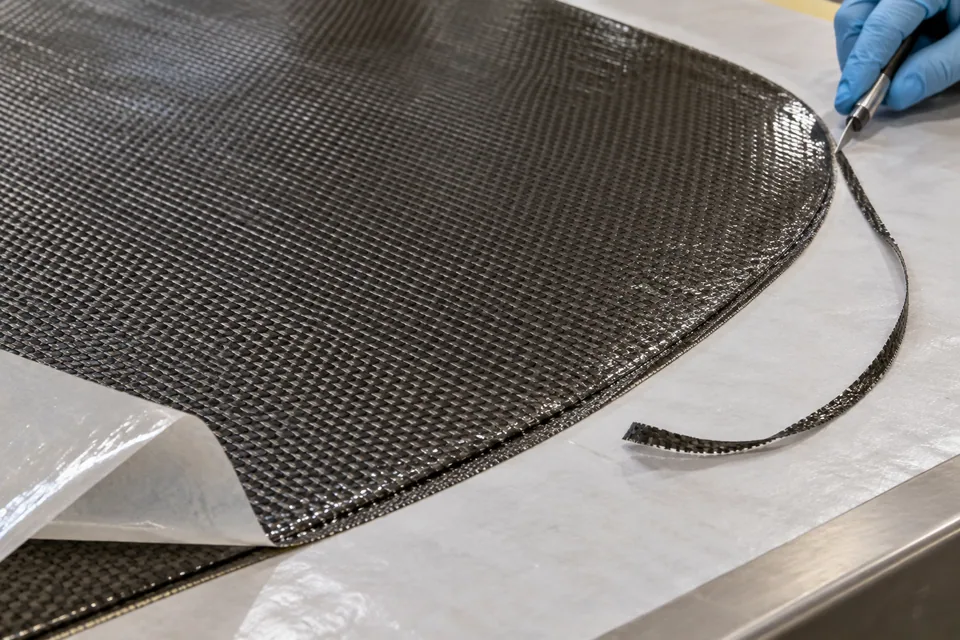
Hexcel’s cyanate-ester prepregs are supplied for composite fabrication, and Toray’s cyanate-prepreg guidance stresses storage and moisture handling before cure. Precision trimming here means removing an approved narrow margin from a flat, uncured ply after initial sheet or contour cutting. It may create a registration edge for layup or clear damaged material, but it cannot repair moisture uptake or expired material exposure. The cut is distinct from finishing a cured composite panel. A good trim requires enough sacrificial material, a stable backing and a controlled way to lift sticky waste without pulling reinforcement from the useful ply.
Updated
Where This Cutting Application Appears
Map the allowance and useful fibers
Compare the incoming edge to the ply-book net line. Identify scrim, UD fibers or woven yarns that must remain inside the retained profile. If the buyer provides no trim margin, stop: an apparently neat cut could make the ply undersized.
Keep tack and moisture history visible
Record opening, thaw and rebagging events according to the grade instructions. A resin-rich edge may feel different after exposure, but a cutter should not infer chemistry acceptance from tactile or visual appearance alone.
Control a small scrap strip
Support the entire ply, make a trial narrow cut, and draw scrap away from the retained surface. Look for resin strings, detached yarns and liner tearing. Check whether repeated knife contact transfers tacky material into the next blank.
Verify the layup datum
Measure the retained profile under the buyer’s stated condition, then place the sample in a template. Preserve an image of the trimmed edge and its lot record. The buyer still qualifies cured dimensions, bond quality and end-use performance.
Define the Required Cut Result
- Remove only a buyer-approved pre-cure allowance.
- Leave reinforcement intact at the net edge.
- Prevent sticky waste from recontacting useful plies.
- Preserve grade-specific exposure records.
Problems to Diagnose Before Changing the Knife
Useful fibers follow the offcut
- Check cut position against fiber path.
- Inspect blade sharpness and support.
- Review scrap pull direction.
Resin residue transfers between pieces
- Inspect blade cleaning and grade tack state.
- Check whether a carrier is missing.
- Compare first and later cuts.
Retained ply measures undersize
- Recheck original allowance and datum.
- Measure in the stated condition.
- Review tool offset against net line.
Knife Forms That May Be Considered
| Possible knife form | When it may be considered | What must be confirmed |
|---|---|---|
| Supported narrow-trim knife | For a straight uncured ply margin with enough stock. | Confirm retained profile and low reinforcement pullout. |
| Programmable perimeter-finishing path | For a short nonstraight allowance after initial cutting. | Verify close path accuracy and clean waste removal. |
Information to Send for Technical Review
You do not need to know the exact blade name. Send the available workpiece, machine, current-knife and cut-result information so the application can be reviewed against a drawing or sample.
- Prepreg supplier, resin and reinforcement grade
- Ply-book net profile and trim allowance
- Fiber orientation and layer face
- Storage, thaw and exposure record
- Release film and table support
- Accepted resin string and fiber criteria
- Waste collection and cleaning plan
- Buyer layup and cured-part checks
Questions About This Cutting Application
Does trimming restore an overexposed prepreg?
No. The supplier’s handling limits and buyer disposition control material acceptance.
Can a narrow margin be removed from any ply?
Only if the drawing includes enough material beyond the net edge.
Why photograph the offcut and kept ply?
Together they show whether reinforcement or liner was pulled during separation.
Is this the same as routing a cured panel?
No. This is flat uncured prepreg before cure.
What test comes after edge inspection?
The buyer checks ply fit and then the cured composite under its specification.
Public references and scope
These public sources provide material, cutting-method or safety context for this guide. Supplier pages describe their own materials or equipment; they do not establish a MEIRENTE blade specification or performance claim. Confirm the actual grade, machine setup and required cut with a drawing or sample.
Related product and service information
- Cyanate-Ester Prepreg Sheet Slitting Blades - cyanate-ester prepreg · sheet slitting
- Thermoplastic PEEK Composite Tape Precision Trimming Blades - thermoplastic PEEK composite tape · precision trimming
- Lightning-Strike Protection Mesh Precision-Trimming Blades - lightning-strike protection mesh · precision trimming
Request a Custom Cutting-Knife Review
Send the workpiece details, machine or holder information, current knife photos or sample, required quantity and examples of the present cut problem. Final dimensions, material, edge geometry and tolerances are confirmed from the approved requirements.