
Blade Application Guides / Application Guide / Aerospace composite manufacturing
Thermoplastic PEEK Composite Tape Sheet Slitting Blades
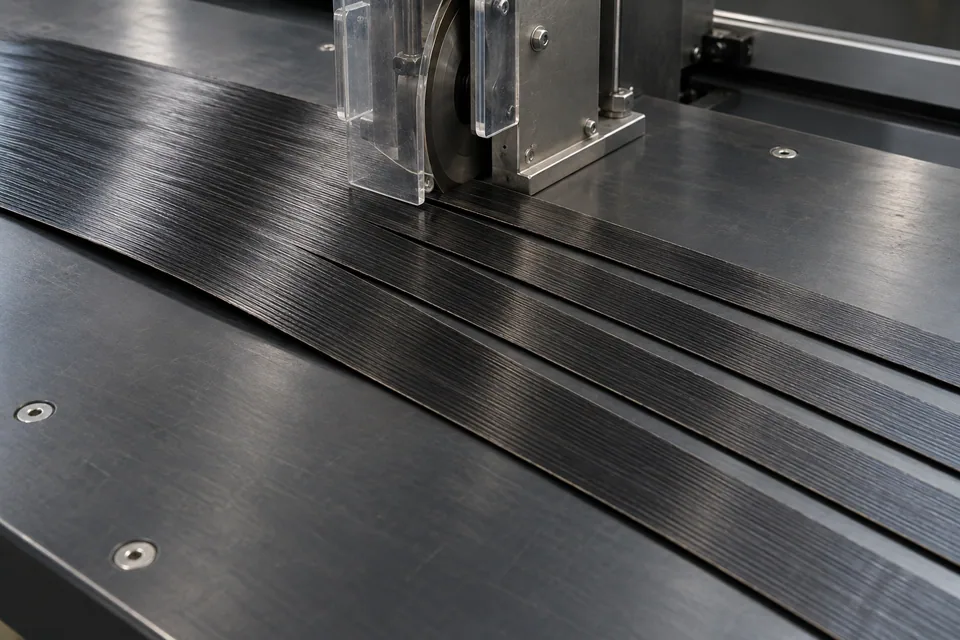
Toray identifies PEEK-based Cetex TC1200 in unidirectional tape and other thermoplastic composite forms, while Syensqo lists APC-2 carbon/PEEK tape. Web Industries describes formatting PEEK thermoplastic prepreg and precision slitting of composite tapes. The workpiece in this guide is a wide, unformed unidirectional tape or flat ply stock supplied for further cutting; it is not a formed structural laminate. Sheet slitting produces straight narrower strips along the tape direction for later placement. The exact resin, fiber architecture, backing and incoming width must be confirmed before selecting a knife, because cutting an already narrow supplied tape again may have no value.
Updated
Where This Cutting Application Appears
Establish fiber-direction and width map
Mark the fiber axis and buyer placement width on the original spool or flat sheet. Nest strips so the cut remains parallel to the intended continuous fibers; an angled split can produce an unstable ribbon and alter the later layup path. Record whether the incoming construction has any release film or glass scrim.
Support the PEEK tape through the straight cut
Trial the actual grade at the intended temperature and feed tension. Thermoplastic resin can hold fibers together differently from tacky thermoset prepreg, but a cut can still expose filaments or splinter a brittle edge. Observe strip width and edge condition at entry, knife and collection.
Inspect both sides of each strip
Use consistent magnification to compare a new edge with an untouched factory edge. Record fiber pullout, resin-only lips and width changes under repeatable tension. The buyer should set acceptable exposed-fiber limits; no universal edge specification follows from the polymer name.
Prove placement compatibility
Feed trial strips through the buyer’s automated tape-laying or manual layup path if applicable. Check winding direction, spool build and any splice or liner transfer. Final consolidation and structural performance remain buyer qualifications.
Define the Required Cut Result
- Create straight fiber-parallel strips at buyer width.
- Avoid loose carbon fibers and excessive resin lips.
- Keep lane identity and winding orientation traceable.
- Provide samples for the buyer’s placement and consolidation trials.
Problems to Diagnose Before Changing the Knife
Filaments fray along the new edge
- Check fiber alignment to the knife.
- Inspect edge wear and support.
- Compare with the incoming factory edge.
Strip width differs after winding
- Measure at stated tension.
- Check web guide and spool winding.
- Review incoming width variation.
Release layer lifts at the slit
- Inspect material stack-up.
- Check blade penetration and peel angle.
- Trial supplier-approved backing support.
Knife Forms That May Be Considered
| Possible knife form | When it may be considered | What must be confirmed |
|---|---|---|
| Guided straight slit knife | For a wide UD PEEK tape approved for narrow-strip conversion. | Confirm full separation and fiber-parallel edge. |
| Supported shear pair | If the web is stable enough for opposed rotary edges. | Compare exposed fibers and resin lips on actual stock. |
Information to Send for Technical Review
You do not need to know the exact blade name. Send the available workpiece, machine, current-knife and cut-result information so the application can be reviewed against a drawing or sample.
- PEEK composite maker and exact grade
- Fiber type, orientation and areal construction
- Incoming width and target strip map
- Release liner or scrim details
- Cutting temperature and tension state
- Accepted fiber-fray and width criteria
- Spool and winding specification
- Buyer layup and consolidation trial
Questions About This Cutting Application
Is PEEK tape the same as a finished PEEK laminate?
No. This article covers unformed tape or flat ply stock before layup and final consolidation.
Why slit parallel to the fibers?
Placement tape is normally designed around continuous fibers along its length; a diagonal edge can expose or pull them.
Can any wide tape be slit to a narrower format?
Only if the supplier and buyer approve the construction and resulting edge.
What does a blade trial prove?
It can qualify strip width, edge and handling, not final structural properties.
What should be included with an RFQ?
Provide a grade-labeled sample, fiber direction, width map and placement machine requirements.
Public references and scope
These public sources provide material, cutting-method or safety context for this guide. Supplier pages describe their own materials or equipment; they do not establish a MEIRENTE blade specification or performance claim. Confirm the actual grade, machine setup and required cut with a drawing or sample.
Related product and service information
- Crop-Cover Nonwoven Roll Slitting Blades - crop-cover nonwoven · roll slitting
- Cyanate-Ester Prepreg Sheet Slitting Blades - cyanate-ester prepreg · sheet slitting
- Lightning-Strike Protection Mesh Sheet Slitting Blades - lightning-strike protection mesh · sheet slitting
Request a Custom Cutting-Knife Review
Send the workpiece details, machine or holder information, current knife photos or sample, required quantity and examples of the present cut problem. Final dimensions, material, edge geometry and tolerances are confirmed from the approved requirements.