
Blade Application Guides / Application Guide / Aerospace composite manufacturing
Thermoplastic PEEK Composite Tape Cut-to-Size Blades
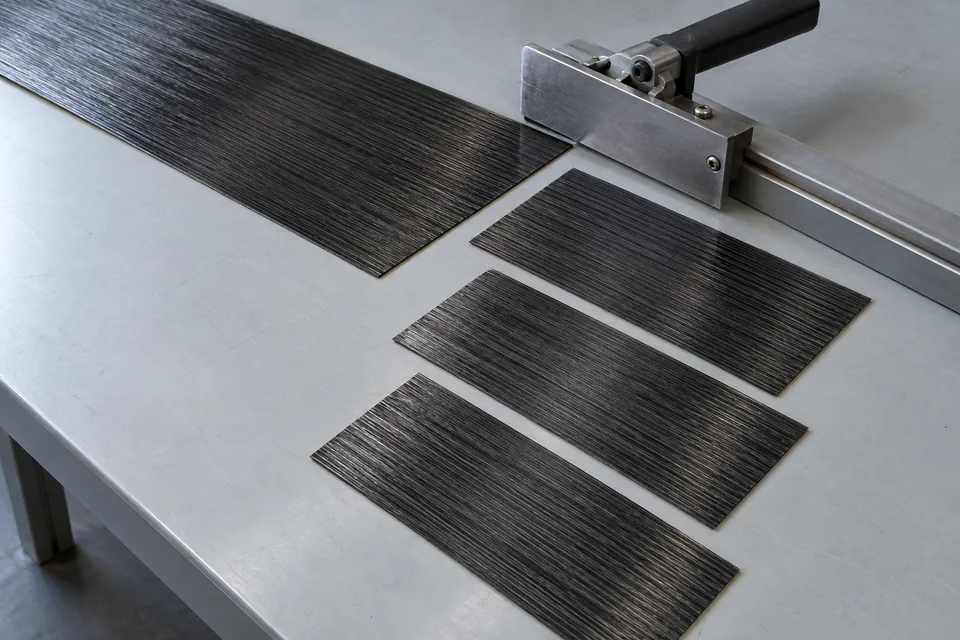
Unidirectional PEEK composite tape can be supplied as carbon-fiber prepreg for automated placement or flat layup. Toray describes its TC1200 PEEK in UD tape form, and Syensqo documents APC-2 carbon/PEEK prepreg. Composite formatters such as Web Industries cut and kit plies for downstream build. Cut to size here means making specified discrete tape lengths or rectangular blanks across the tape direction, not machining a formed composite component. Because the transverse knife necessarily crosses continuous fibers, the acceptance plan should focus on complete fiber severance, controlled end shape, and the buyer’s later overlap or placement registration.
Updated
Where This Cutting Application Appears
Derive length from the actual layup path
Use the ply book or automated-placement program to set each blank length. Include only the buyer-approved leader, overlap and trim allowance; a length that appears correct on the bench may shift in a heated placement head. Mark fiber direction and face orientation on the kit record.
Choose a controlled cross-cut support
Support the tape on both sides of the transverse cut and observe whether a blade drags bundles out of the resin. If a release film is present, clarify whether it must be cut with the tape or retained as a carrier. Qualify the blade on actual grade rather than assuming a generic guillotine setting.
Inspect end fibers and dimensions
Look at both cut ends for long whiskers, split bundles and resin flakes. Measure length in a stated tension and conditioning state, then compare to a supplier-issued control. Count pieces and identify spool sequence so a later layup defect can be traced to a specific cut lot.
Validate transfer into the layup kit
Pack blanks to avoid bending or contaminating carbon fibers, and confirm they release from any liner without pulling the end. The buyer checks layup location, consolidation and mechanical performance after forming.
Define the Required Cut Result
- Produce the buyer’s discrete tape lengths.
- Fully sever transverse fiber bundles.
- Preserve face, sequence and length identity.
- Avoid handling damage before placement.
Problems to Diagnose Before Changing the Knife
End fibers bridge after the knife
- Inspect blade condition and lower support.
- Check total stack thickness including liner.
- Examine cuts from both ends of the stroke.
Measured lengths vary with handling
- Record measurement tension.
- Check feed stop and tape springback.
- Review nesting program registration.
Carbon fragments collect in the kit
- Inspect cut ends and collection table.
- Check packaging contact surfaces.
- Separate cutting debris from handling damage.
Knife Forms That May Be Considered
| Possible knife form | When it may be considered | What must be confirmed |
|---|---|---|
| Supported transverse guillotine edge | For repeat discrete crosscuts in flat raw tape. | Verify full fiber separation and square end geometry. |
| Programmable ply-cutting blade | Where many lengths or registration marks share one kit. | Confirm the actual blade path does not drag fibers or score the carrier. |
Information to Send for Technical Review
You do not need to know the exact blade name. Send the available workpiece, machine, current-knife and cut-result information so the application can be reviewed against a drawing or sample.
- Exact PEEK tape and reinforcement grade
- Ply book or placement length schedule
- Fiber and face orientation
- Liner cutting instruction
- Allowed end fibers and squareness
- Length measurement state
- Part counting and kit traceability
- Buyer consolidation and structural test plan
Questions About This Cutting Application
Does cut to size mean trimming a formed PEEK part?
No. These are unformed tape lengths or rectangular plies.
Why are fiber ends inspected separately from long edges?
A transverse cut crosses continuous reinforcement and can leave bridges or whiskers.
Can a liner be cut through automatically?
Only if the buyer specifies whether the carrier is retained or separated.
Does a square blank guarantee final ply fit?
No. Placement, heating and forming affect the final geometry.
What traceability matters?
Record source spool, length schedule, fiber orientation and cut-lot sequence.
Public references and scope
These public sources provide material, cutting-method or safety context for this guide. Supplier pages describe their own materials or equipment; they do not establish a MEIRENTE blade specification or performance claim. Confirm the actual grade, machine setup and required cut with a drawing or sample.
Related product and service information
- Thermoplastic PEEK Composite Tape Precision Trimming Blades - thermoplastic PEEK composite tape · precision trimming
- Cyanate-Ester Prepreg Cut-to-Size Blades - cyanate-ester prepreg · cut to size
- Lightning-Strike Protection Mesh Cut-to-Size Blades - lightning-strike protection mesh · cut to size
Request a Custom Cutting-Knife Review
Send the workpiece details, machine or holder information, current knife photos or sample, required quantity and examples of the present cut problem. Final dimensions, material, edge geometry and tolerances are confirmed from the approved requirements.