
Blade Application Guides / Application Guide / Aerospace composite manufacturing
Cyanate-Ester Prepreg Cut-to-Size Blades
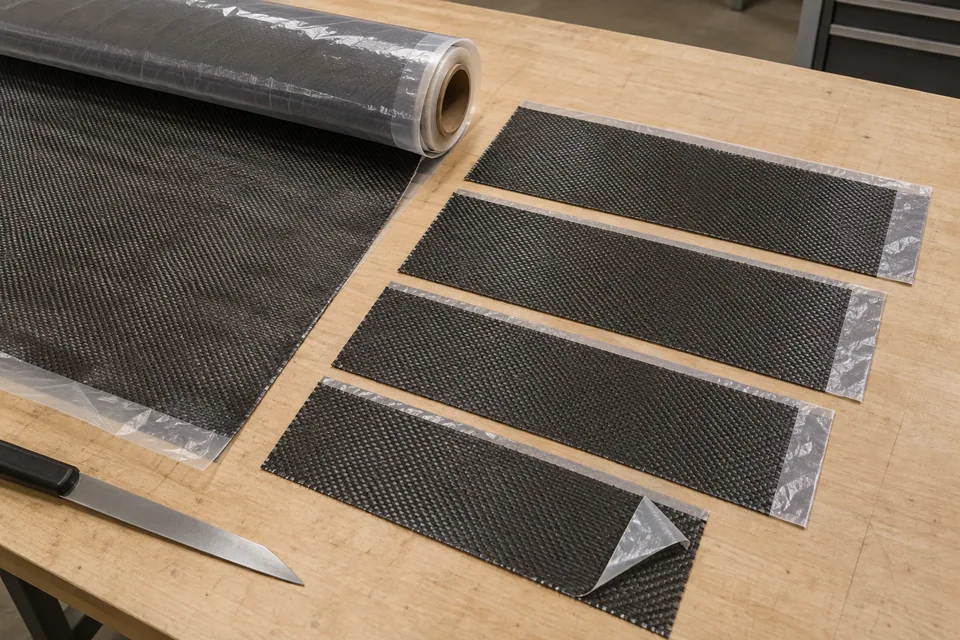
Hexcel identifies cyanate-ester systems among its aerospace prepregs and provides grade-specific technical data. Toray’s cyanate-ester handling sheet calls attention to frozen storage and moisture exposure before cure. Cut to size in this article means dividing raw prepreg into measured flat lengths or rectangles for a ply kit, rather than trimming a cured radome or satellite panel. A transverse cut can cross unidirectional fibers or woven yarns; the inspection method therefore needs both dimensions and reinforcement condition. Exact handling times and temperatures come from the supplied prepreg grade, never a blanket assumption.
Updated
Where This Cutting Application Appears
Read the ply book before cutting
Assign every rectangular blank a ply number, fiber angle, face orientation and reference edge. A square or rectangular cut is simpler than a contour, but a flipped ply can still place reinforcement at the wrong angle in the stack. Keep the prescribed cover and release materials with each blank until layup.
Condition the material using its own instructions
Document freezer removal, sealed warm-up and permitted bench time. If the grade requires moisture exclusion, plan cutting and rebagging to avoid unnecessary exposure. A cutter should not infer that Toray and Hexcel products share identical out-life limits.
Check the transverse cut and size
Support both sides of the knife to avoid dragging tacky fibers. Inspect corners for incomplete yarn separation and resin strings. Measure width, length and squareness against the buyer drawing in a stated temperature and support condition.
Kit and return traceable pieces
Keep the blank sequence and lot record with protective interleaves. Recheck a sample after transfer for liner peel or dimensional creep. The buyer evaluates layup registration, cured laminate quality and any electrical properties of the final structure.
Define the Required Cut Result
- Produce marked rectangular plies at buyer dimensions.
- Keep fiber angle, face and lot visible in the kit.
- Avoid incomplete fiber cuts and resin strings.
- Meet the supplied grade’s conditioning procedure.
Problems to Diagnose Before Changing the Knife
Yarns remain attached at the end
- Inspect knife sharpness and lower support.
- Check full cut through cover and reinforcement.
- Review tension at crosscut.
Ply size changes on the bench
- Record exposure and temperature.
- Compare measurement with supported control.
- Check whether release film is being stretched.
Kits lose orientation
- Review ply numbering and edge marks.
- Check bagging sequence.
- Match cut sheet to laminate schedule.
Knife Forms That May Be Considered
| Possible knife form | When it may be considered | What must be confirmed |
|---|---|---|
| Supported guillotine crosscut | For repeat rectangular blanks from a stable prepreg sheet. | Confirm complete fiber severance and clean corners. |
| Programmable ply-cutting head | For multiple blank sizes and tagged ply records. | Check that motion does not smear resin or shift backing. |
Information to Send for Technical Review
You do not need to know the exact blade name. Send the available workpiece, machine, current-knife and cut-result information so the application can be reviewed against a drawing or sample.
- Specific cyanate prepreg grade and lot
- Ply schedule and fiber orientation
- Supplier thaw and out-life instructions
- Width, length and squareness requirements
- Cover film and release-paper plan
- Accepted end-fiber and resin-string limits
- Kitting and rebagging sequence
- Buyer cure and part acceptance plan
Questions About This Cutting Application
Is this a guide to cut a cured cyanate laminate?
No. The workpiece is uncured prepreg before layup.
Why label fiber angle on a rectangle?
A correct outline can still be placed at the wrong reinforcement orientation.
Does the freezer time reset after repacking?
Follow the supplier’s accumulated exposure rules for the exact grade.
Can a blade cut establish dielectric performance?
No. The buyer tests the cured construction.
What makes a useful first article?
A labeled blank measured under stated conditions with edge photos and storage history.
Public references and scope
These public sources provide material, cutting-method or safety context for this guide. Supplier pages describe their own materials or equipment; they do not establish a MEIRENTE blade specification or performance claim. Confirm the actual grade, machine setup and required cut with a drawing or sample.
Related product and service information
- Cyanate-Ester Prepreg Precision Trimming Blades - cyanate-ester prepreg · precision trimming
- Thermoplastic PEEK Composite Tape Cut-to-Size Blades - thermoplastic PEEK composite tape · cut to size
- Lightning-Strike Protection Mesh Cut-to-Size Blades - lightning-strike protection mesh · cut to size
Request a Custom Cutting-Knife Review
Send the workpiece details, machine or holder information, current knife photos or sample, required quantity and examples of the present cut problem. Final dimensions, material, edge geometry and tolerances are confirmed from the approved requirements.