
Blade Application Guides / Application Guide / Aerospace composite manufacturing
Lightning-Strike Protection Mesh Cut-to-Size Blades
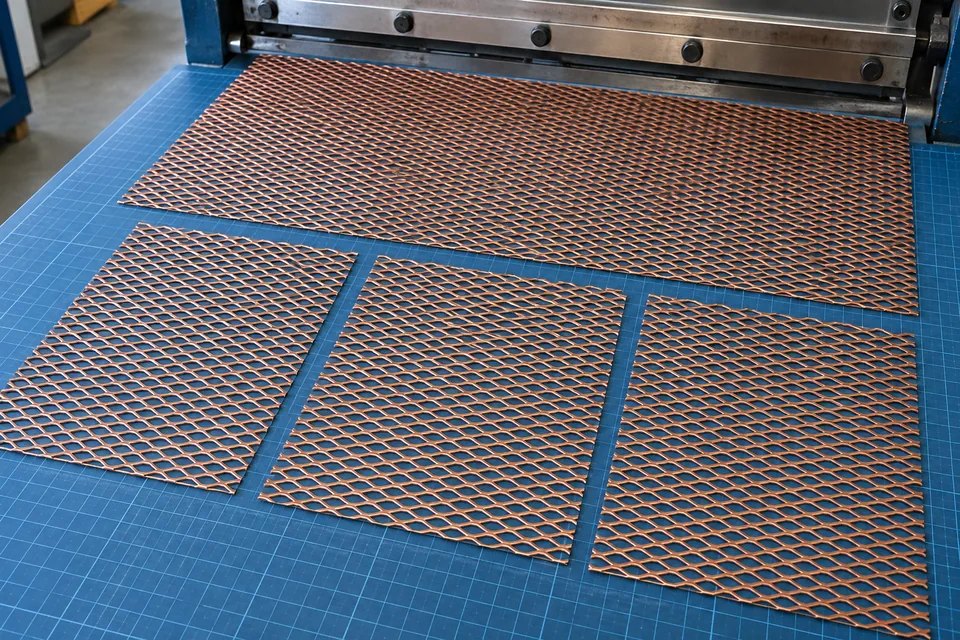
The Expanded Metal Company supplies customized conductive expanded metal micromesh for lightning-protection uses and offers fabricated cut metal formats. The raw workpiece addressed here is an independent sheet of expanded metal foil, not mesh already embedded in a prepreg and not a finished aircraft skin. Cut to size makes discrete flat rectangles or simple panels for a buyer’s layup schedule. The specified alloy, mesh pattern and installation direction determine how the piece is oriented and handled. Cutter inspection can verify geometry and loose metal, while the buyer must validate bonding, current path and lightning-strike performance in its integrated composite structure.
Updated
Where This Cutting Application Appears
Use the actual laminate ply drawing
Record nominal length and width, mesh long-way direction and which side faces the next prepreg layer. Note any overlap, edge setback or joining allowance that the designer includes. Do not treat the cut piece as net geometry for a cured part; layup and cure can change position.
Choose a supported crosscut
Place the open mesh on a surface that supports small strands without trapping them. Trial a controlled shear or guillotine through the full width, then inspect whether nodes are flattened or an uncut bridge remains at the end of travel. Separate the cut panel gently from offcut material.
Inspect the entire rectangle
Check four sides and corners for sharp protrusions, loose metal chips and cells crushed near the knife. Measure dimensions from an agreed datum because an open-edge aperture does not provide the same solid line as a film edge. Mark lot and pattern direction on packaging, not on the active metal surface unless the buyer approves.
Trial assembly placement
Lay the panel on the customer template and verify it lies flat without a strand entering a forbidden gap or bond zone. The buyer then establishes electrical continuity, adhesion and lightning qualification after composite integration.
Define the Required Cut Result
- Produce buyer-drawn flat mesh pieces.
- Preserve the open pattern near all four cut sides.
- Control loose metal fragments and sharp corner points.
- Keep pattern orientation traceable into layup.
Problems to Diagnose Before Changing the Knife
Last strands remain bridged
- Inspect full blade travel and support.
- Check mesh bunching at exit.
- Review edge sharpness and clearance.
Corner curls away from layup template
- Compare incoming sheet flatness.
- Check cut direction relative to long-way pitch.
- Review stacking and package support.
Loose fragments appear on the tool
- Trace where shedding begins.
- Inspect all four cut sides.
- Review offcut collection and transfer handling.
Knife Forms That May Be Considered
| Possible knife form | When it may be considered | What must be confirmed |
|---|---|---|
| Supported guillotine or shear cut | For straight rectangles from individual flat expanded-mesh sheets. | Confirm complete strand separation and stable corners. |
| Template-guided sheet cut | Where the buyer needs multiple sizes or a specific mesh-node reference. | Validate geometry from agreed cell datums and check debris. |
Information to Send for Technical Review
You do not need to know the exact blade name. Send the available workpiece, machine, current-knife and cut-result information so the application can be reviewed against a drawing or sample.
- Supplier and exact conductive alloy
- Mesh pitch, strand and raised/flattened condition
- Incoming sheet and carrier format
- Piece drawing and pattern direction
- Overlap, setback and layup zones
- Edge-point and fragment criteria
- Handling, stacking and packaging plan
- Buyer electrical, adhesion and lightning tests
Questions About This Cutting Application
Is the workpiece an impregnated lightning-protection prepreg?
No. It is an independent expanded metal mesh sheet before integration.
Why define a mesh measurement datum?
An open-cell boundary has alternating strands and voids, so a solid-film measurement method may be ambiguous.
Can cutting prove conductivity after lamination?
No. The assembled composite needs buyer electrical and lightning tests.
What should be inspected at corners?
Look for lifted nodes, sharp free strands and loose fragments.
Does the metal alloy alone determine the cutting setup?
No. Strand geometry, foil thickness, support and pattern orientation also matter.
Public references and scope
These public sources provide material, cutting-method or safety context for this guide. Supplier pages describe their own materials or equipment; they do not establish a MEIRENTE blade specification or performance claim. Confirm the actual grade, machine setup and required cut with a drawing or sample.
Related product and service information
- Lightning-Strike Protection Mesh Precision-Trimming Blades - lightning-strike protection mesh · precision trimming
- Thermoplastic PEEK Composite Tape Cut-to-Size Blades - thermoplastic PEEK composite tape · cut to size
- Cyanate-Ester Prepreg Cut-to-Size Blades - cyanate-ester prepreg · cut to size
Request a Custom Cutting-Knife Review
Send the workpiece details, machine or holder information, current knife photos or sample, required quantity and examples of the present cut problem. Final dimensions, material, edge geometry and tolerances are confirmed from the approved requirements.