
Blade Application Guides / Application Guide / Aerospace composite manufacturing
Thermoplastic PEEK Composite Tape Contour Cutting Blades
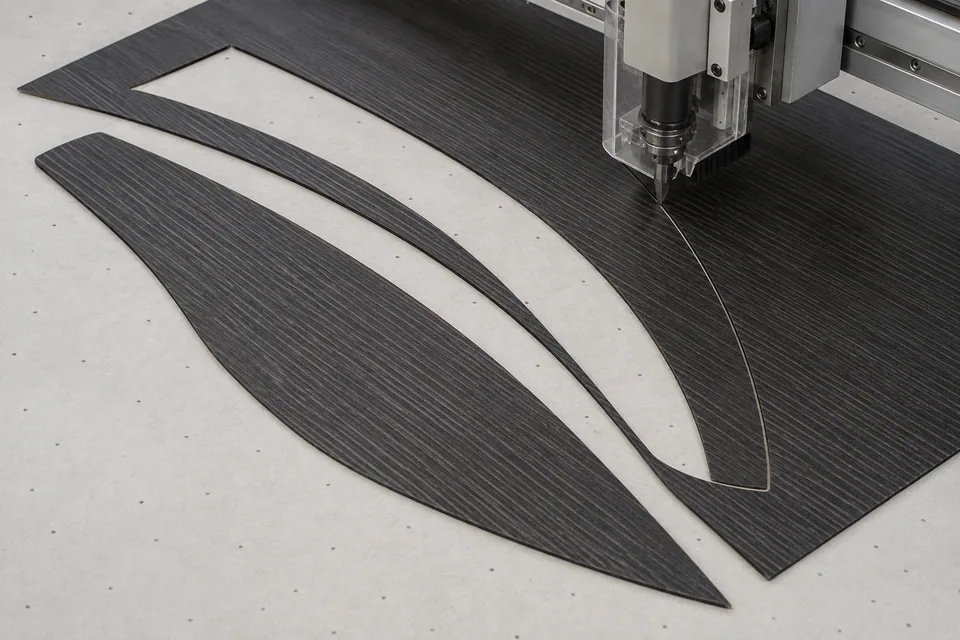
PEEK thermoplastic composites are supplied in UD tape, fabric prepreg and laminate forms, according to Toray. The subject here is a supplied flat tape or prepreg blank before final forming, and Web Industries identifies ply cutting as a composite-formatting service. Contour cutting follows a nonrectangular flat outline such as a tapered end or local relief; it is not the same as cutting a finished consolidated PEEK component. A contour can cross the reinforcement at different angles, so the buyer should provide a ply-level drawing with fiber axis, layup datum and sacrificial margin. Blade selection requires samples of the exact reinforcement and PEEK matrix.
Updated
Where This Cutting Application Appears
Translate the ply book into a flat outline
Identify each ply profile, fiber direction, reference notch and any clearance from a future weld or consolidation zone. Distinguish a layup blank from a net-shaped final part; formed shape and thickness are established downstream.
Plan direction changes in the cut path
Trial shallow angles, corners and tight returns on a supported sample. A turning blade may drag fibers differently when cutting with versus across the tape axis. Separate the scrap without pulling partially severed bundles from the useful ply.
Inspect cut quality by segment
Record edge condition at fiber-parallel, oblique and transverse sections. Check for exposed filaments, matrix cracking or resin slivers and relate defects to local blade direction. Confirm notches stay recognizable after handling, but do not assign unsupported numeric tolerances.
Check the blank in a forming fixture
Position samples on the buyer’s tool or layup template, verify orientation and overlap, then send to its forming and consolidation trial. A clean flat contour does not establish molded strength, void content or joint performance.
Define the Required Cut Result
- Make the specified ply contour and orientation features.
- Avoid dragged fibers at oblique and curved segments.
- Permit clean waste removal and blank handling.
- Support buyer validation after forming.
Problems to Diagnose Before Changing the Knife
Corner remains attached to waste
- Inspect blade path closure.
- Check backing support at tight radius.
- Compare local fiber angle to cut direction.
Oblique edge shows fiber pullout
- Review blade sharpness and downforce.
- Trial alternate travel direction.
- Compare with straight-edge control.
Ply rotates in the tool
- Check reference notch and labeling.
- Review face/fiber markings.
- Verify blank handedness against ply book.
Knife Forms That May Be Considered
| Possible knife form | When it may be considered | What must be confirmed |
|---|---|---|
| Programmable flat-ply contour blade | For a supported flat PEEK prepreg ply with changing outline. | Confirm clean cuts through all fiber angles on the exact grade. |
| Matched-profile die | For repeated, qualified contours where the material handles release cleanly. | Trial waste removal and local fiber damage before selecting production tooling. |
Information to Send for Technical Review
You do not need to know the exact blade name. Send the available workpiece, machine, current-knife and cut-result information so the application can be reviewed against a drawing or sample.
- PEEK prepreg grade and flat supplied format
- Ply contour and fiber-axis drawing
- Backing or release film stack
- Critical notch and overlap zones
- Blade path and support method
- Accepted local fiber exposure
- Handling and kitting instruction
- Buyer forming and mechanical qualification
Questions About This Cutting Application
Is this a machining guide for a consolidated PEEK part?
No. It describes cutting flat unformed tape or ply stock.
Why record fiber angle along the contour?
Cutting across fibers and along fibers can produce different edge defects.
Are a contour die and a cutting plotter equivalent?
Both may make a profile, but their contact and waste-release behavior need separate trials.
Does a flat ply need final-part tolerance?
The buyer defines ply allowance; forming and consolidation determine final-part geometry.
What is the acceptance boundary?
Check the flat blank, then validate the formed structure through the buyer’s process.
Public references and scope
These public sources provide material, cutting-method or safety context for this guide. Supplier pages describe their own materials or equipment; they do not establish a MEIRENTE blade specification or performance claim. Confirm the actual grade, machine setup and required cut with a drawing or sample.
Related product and service information
- Thermoplastic PEEK Composite Tape Cut-to-Size Blades - thermoplastic PEEK composite tape · cut to size
- Cyanate-Ester Prepreg Contour Cutting Blades - cyanate-ester prepreg · contour cutting
- Lightning-Strike Protection Mesh Contour-Cutting Blades - lightning-strike protection mesh · contour cutting
Request a Custom Cutting-Knife Review
Send the workpiece details, machine or holder information, current knife photos or sample, required quantity and examples of the present cut problem. Final dimensions, material, edge geometry and tolerances are confirmed from the approved requirements.