
Blade Application Guides / Application Guide / Aerospace composite manufacturing
Cyanate-Ester Prepreg Contour Cutting Blades
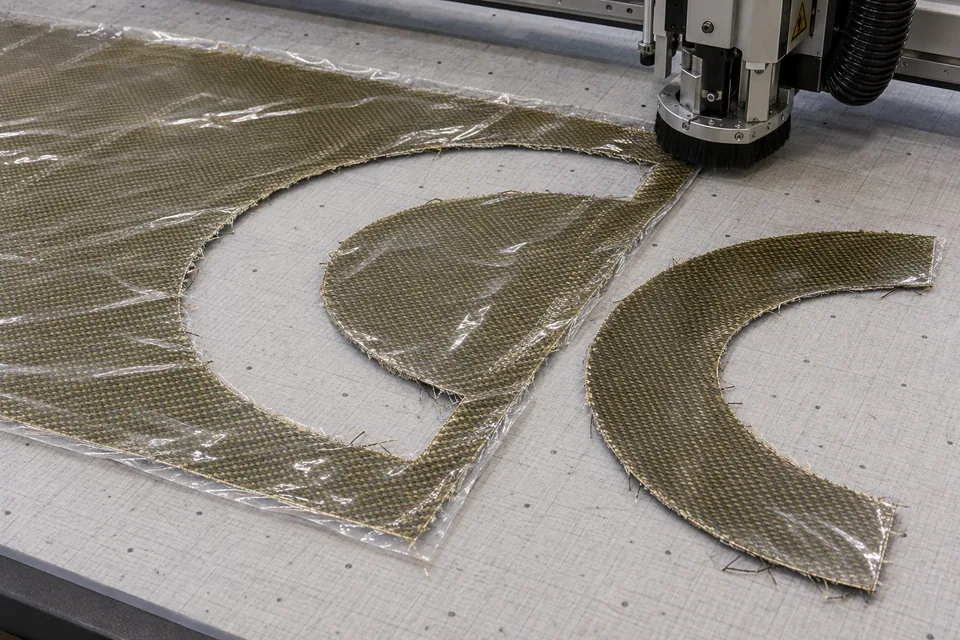
Cyanate-ester prepregs are supplied with woven or unidirectional reinforcement for aerospace and space-composite layups. Hexcel lists cyanate matrix grades, while Web Industries describes automated table cutting of flat composite plies. Toray publishes specific freezer and moisture-control instructions for its cyanate systems. This article addresses shaped uncured plies: curved perimeters, tapered ends, holes or reliefs specified by a buyer’s ply book. It does not promise that a knife can cut every construction or that the cut ply alone meets any spacecraft requirement. The resin’s tack and backing affect blade path, waste removal and the amount of qualified handling time.
Updated
Where This Cutting Application Appears
Resolve the profile into ply-level datums
Obtain the flat contour, fiber axis and tool location from the composite designer. Clarify whether small notches are registration marks or functional cutouts, and keep the cutter path outside any critical bond line unless the buyer specifies otherwise.
Trial turns on conditioned material
After supplier-approved thaw, cut small samples through straight, oblique and curved segments. A tacky resin may adhere to the blade or pull fabric at direction changes. Use a supportive table and document whether the cover film remains attached.
Release waste without distorting a ply
Remove narrow internal scrap in a controlled order rather than dragging it across the useful surface. Inspect acute corners for resin webs and partially cut yarns. Record any local stretching caused by peeling the liner or separating adjacent pieces.
Check fit and return to controlled storage
Place a trial ply in the buyer’s template, verify handedness and alignment, then package it per the supplier’s instructions. The buyer confirms cure, laminate integrity and application-specific properties after layup.
Define the Required Cut Result
- Follow the buyer’s flat contour and fiber orientation.
- Keep curved edges free of pulled yarns and resin bridges.
- Remove waste without contaminating tacky surfaces.
- Track grade-specific exposure through kitting.
Problems to Diagnose Before Changing the Knife
Internal cutout resists release
- Check blade path closure and corner radius.
- Inspect film or paper backing.
- Change waste-release order on trial pieces.
Fiber direction shifts at a curved edge
- Compare material before and after cut.
- Check table hold-down and blade travel.
- Review scrap peel direction.
Resin webs appear at tight corners
- Inspect tool cleanliness and grade tack state.
- Check backing support.
- Trial alternate path direction.
Knife Forms That May Be Considered
| Possible knife form | When it may be considered | What must be confirmed |
|---|---|---|
| Programmable flat-ply contour cutter | For a conditioned, supported prepreg sheet with multiple shapes. | Qualify fiber and resin edges at straight and curved segments. |
| Dedicated profile die | For a stable repeated ply outline and approved release method. | Verify local cut completion without pressing contaminants into tacky resin. |
Information to Send for Technical Review
You do not need to know the exact blade name. Send the available workpiece, machine, current-knife and cut-result information so the application can be reviewed against a drawing or sample.
- Cyanate resin system, fiber and weave
- Supplier thaw, out-life and moisture rules
- Ply outline, fiber angle and handedness
- Liner stack and removal order
- Critical holes, notches and bond zones
- Allowed corner fibers and resin webs
- Table support and tool cleaning plan
- Buyer layup, cure and final test
Questions About This Cutting Application
Does contour cutting form the final composite part?
No. It shapes uncured flat plies for later layup and cure.
Why examine oblique and curved cuts?
The knife meets fibers at changing angles, which can change edge defects.
Can waste be peeled away freely?
Not necessarily. Tack and backing may distort the useful ply during release.
Are out-life limits common to all cyanate prepregs?
No. Use the supplied grade’s instructions and exposure record.
What follows a successful cutting trial?
The buyer evaluates fit, cured laminate integrity and its application tests.
Public references and scope
These public sources provide material, cutting-method or safety context for this guide. Supplier pages describe their own materials or equipment; they do not establish a MEIRENTE blade specification or performance claim. Confirm the actual grade, machine setup and required cut with a drawing or sample.
Related product and service information
- Cyanate-Ester Prepreg Cut-to-Size Blades - cyanate-ester prepreg · cut to size
- Thermoplastic PEEK Composite Tape Contour Cutting Blades - thermoplastic PEEK composite tape · contour cutting
- Lightning-Strike Protection Mesh Contour-Cutting Blades - lightning-strike protection mesh · contour cutting
Request a Custom Cutting-Knife Review
Send the workpiece details, machine or holder information, current knife photos or sample, required quantity and examples of the present cut problem. Final dimensions, material, edge geometry and tolerances are confirmed from the approved requirements.