
Blade Application Guides / Application Guide / Specialty metal converting
Tantalum Metal Foil Precision Blanking Blades
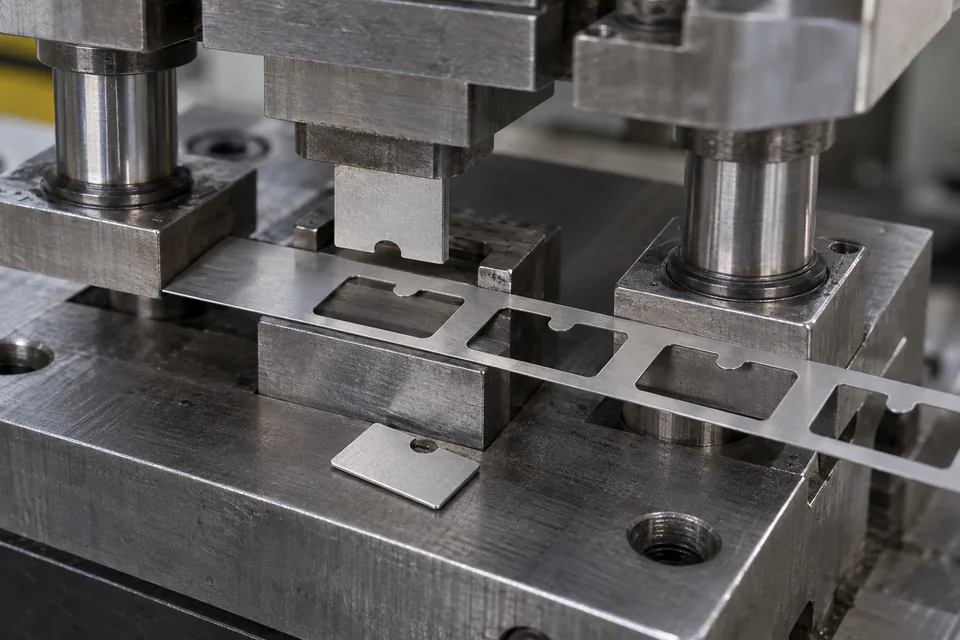
Admat describes coiled tantalum foil and strip and expressly distinguishes material routes suited to deep drawing and stamping. It also notes that tantalum sheets may be engineered for stamped shapes. Precision blanking therefore has a grounded workpiece, provided the buyer names the exact grade and part. A punch and die separate finite profiles from foil or a pre-cut sheet; this is not longitudinal slitting or rectangular cut-to-length. Material route, anneal condition and part geometry can change the cut and any later forming response. No universal punch clearance or commercial tolerance is asserted.
Updated
Where This Cutting Application Appears
Define the part boundary
Take the outline, holes, tabs and intended grain direction from the drawing. Determine whether the blank is a final flat shield, a precursor for a drawn cup or another intermediate component. Keep enough carrier or edge stock for feeding and avoid a geometry that tears during ejection. Record whether powder-metallurgy or electron-beam tantalum was specified.
Trial the actual foil in a die
Use matched punch and die tooling with support for the thin sheet. Set clearance from a production-grade trial rather than applying a generic value from steel. Check foil wrinkling before the punch enters, then observe slug exit and part release. A small tantalum slug that sticks to tooling can cause a double hit and broad-face damage.
Inspect all features
Check perimeter and internal holes for burr, rolled edge, torn corner, incomplete fracture and distorted narrow tabs. Measure outline after the part is free of the carrier. Examine both broad faces for punch marks or scratches. Keep the skeleton and slugs during setup because their deformation can reveal too much pull at the cutting line.
Control collection and identity
Separate accepted parts from sharp scrap without rubbing surfaces together. Record lot, grade, condition, tooling revision and part orientation. If a lubricant or temporary carrier is used, the receiving process must authorize it and its removal. Cleanliness requirements for a vacuum or electronic assembly cannot be assumed from a generic stamping trial.
Verify the next forming step
If the blank will become a cup or shaped shield, run a representative piece through the actual forming route. Look for edge-origin cracks, earing or local folds and compare with an unblanked control. Admat emphasizes tailoring tantalum processing to the application; a dimensionally correct blank alone does not prove the finished part will draw or function correctly. Include the most delicate tab and smallest opening in the trial matrix. Recheck both after several press cycles, because foil pickup or a worn punch can change a previously clean shape. Photograph the accepted edge for later setup comparison.
Define the Required Cut Result
- Separate precise tantalum foil shapes.
- Control burr, wrinkles and part ejection.
- Protect broad faces and lot identity.
- Confirm later forming compatibility.
Problems to Diagnose Before Changing the Knife
Blank sticks in the punch
- Review stripping and slug evacuation.
- Check tool buildup.
- Inspect double-hit marks.
Drawn part cracks from a blanked corner
- Inspect burr and corner radius.
- Review material route and orientation.
- Trial downstream forming.
Knife Forms That May Be Considered
| Possible knife form | When it may be considered | What must be confirmed |
|---|---|---|
| Matched punch and die | For repeated foil profiles after grade-specific trials. | Confirm cut perimeter, slug release and face condition. |
| Progressive blanking die | Where a carrier supports multiple small parts. | Verify carrier stability and final separation. |
Information to Send for Technical Review
You do not need to know the exact blade name. Send the available workpiece, machine, current-knife and cut-result information so the application can be reviewed against a drawing or sample.
- Tantalum grade, purity, route and anneal condition
- Part profile and downstream draw
- Foil gauge and carrier plan
- Lubricant or cleanliness limits
- Burr, surface and ejection acceptance
Questions About This Cutting Application
How is blanking different from cut to length?
Blanking separates shaped profiles; cut to length makes rectangles.
Can all tantalum grades share one die setting?
No. Route and condition must be trialed.
Why retain the skeleton during setup?
Its distortion helps diagnose pulling and incomplete cut.
Does a good blank prove a drawn cup will pass?
No. Forming and functional acceptance are separate.
Public references and scope
These public sources provide material, cutting-method or safety context for this guide. Supplier pages describe their own materials or equipment; they do not establish a MEIRENTE blade specification or performance claim. Confirm the actual grade, machine setup and required cut with a drawing or sample.
Related product and service information
- Tantalum Metal Foil Precision Coil Slitting Blades - tantalum metal foil · precision coil slitting
- Amorphous Metal Ribbon Precision Blanking Blades - amorphous metal ribbon · precision blanking
- Beryllium-Copper Foil Precision Blanking Blades - beryllium-copper foil · precision blanking
Request a Custom Cutting-Knife Review
Send the workpiece details, machine or holder information, current knife photos or sample, required quantity and examples of the present cut problem. Final dimensions, material, edge geometry and tolerances are confirmed from the approved requirements.