
Blade Application Guides / Application Guide / Specialty metal converting
Beryllium-Copper Foil Precision Blanking Blades
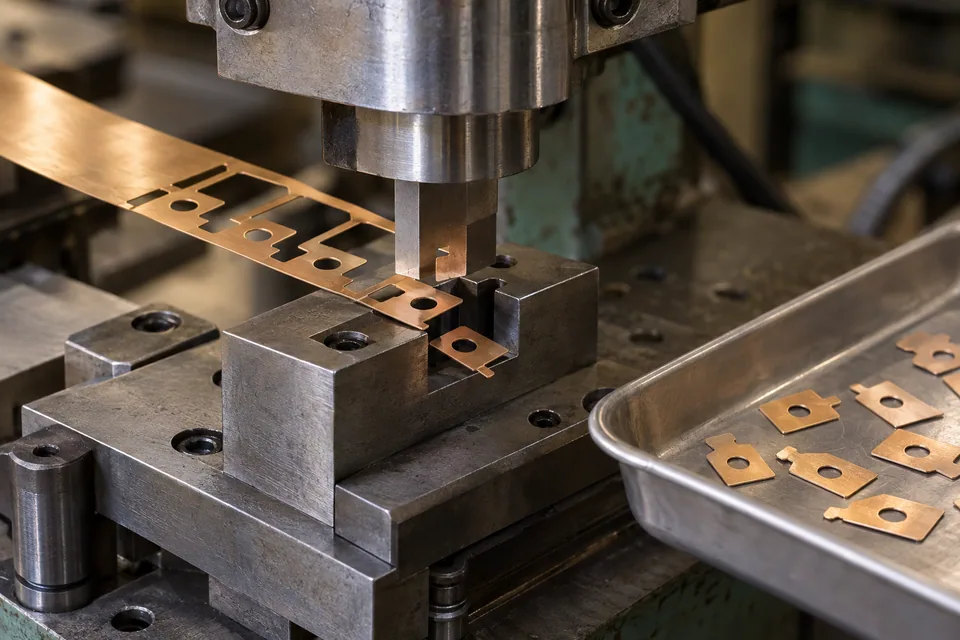
Materion names copper-beryllium strip as stock for precision stamped components, and NGK Berylco provides manufacturer guidance for copper-beryllium stamping. Advent documents foil-format copper-beryllium supplied as coil or pieces. Precision blanking here uses a matched punch and die to separate a drawing-defined part or preform from thin alloy stock. It is distinct from edge trimming, which leaves a continuous roll. Alloy and temper must be recorded because a condition that gives a clean sheared edge may not form or spring back like another condition. No generic clearance or part tolerance is asserted for the buyer’s grade.
Updated
Where This Cutting Application Appears
Read the contact or spring drawing
Identify the actual part outline, small radii, holes, carrier tabs and grain direction. Determine whether the blank will be formed, age hardened or plated later. The blanking die should not remove stock reserved for a formed spring leg or connector contact. A thin foil part may need a carrier web or temporary backing until it can be handled.
Trial punch and die on the delivered temper
NGK notes that copper-beryllium stamping behavior changes with material condition. Set clearance and support from a tooling trial instead of copying values from another gauge. Check die entry, breakthrough and slug exit on the actual foil coil. A sharp-looking top face can conceal a large exit burr or rollover below.
Measure the complete cut perimeter
Inspect outer edge and any internal holes for burr, fracture zone, pulled corners and distorted narrow features. Check slug evacuation and whether a small punched piece sticks to the tool and double-feeds. Compare dimensions after the blank lies flat, including springback or bow from residual coil set.
Keep part and scrap paths separate
Collect blanks, carrier skeleton and slugs without mixing lots or letting sharp scrap scratch accepted pieces. Follow the facility’s copper-beryllium handling procedure; do not grind or polish rejected parts as an unapproved finishing step. Record die revision, alloy, temper, lubricant or film presence and inspection results.
Confirm later forming or plating
Send a representative blank through the next authorized operation. Check that the blank edge does not initiate a crack at a forming radius and that any plating or contact surface remains acceptable. Finished electrical and fatigue properties depend on the full alloy processing and component design, not on the blanking cut alone. Include a sample with the smallest hole and thinnest web between features. That geometry may show a burr or crack missed on a broad, simple outline. Repeat after enough press strokes to reveal slug buildup.
Define the Required Cut Result
- Separate accurate BeCu foil preforms from the feed strip.
- Control burr and narrow-feature distortion.
- Prevent slug pullback or double feed.
- Preserve temper and later-process traceability.
Problems to Diagnose Before Changing the Knife
Part sticks to the punch
- Check stripper and slug path.
- Review tool cleanliness.
- Inspect double-hit marks.
Fine spring leg cracks at a cut corner
- Review radius and grain direction.
- Inspect burr orientation.
- Trial the later forming step.
Knife Forms That May Be Considered
| Possible knife form | When it may be considered | What must be confirmed |
|---|---|---|
| Matched punch and die set | For repeated drawing-defined blanks on qualified foil stock. | Confirm clearance and full perimeter on actual temper. |
| Progressive blanking die with carrier | When parts need support through several operations. | Verify carrier integrity and clean final release. |
Information to Send for Technical Review
You do not need to know the exact blade name. Send the available workpiece, machine, current-knife and cut-result information so the application can be reviewed against a drawing or sample.
- Alloy grade, temper, gauge and surface condition
- Part outline and grain direction
- Carrier, backing or lubricant plan
- Burr, flatness and slug criteria
- Later forming, heat treatment or plating route
Questions About This Cutting Application
Is this the same as slitting a coil?
No. Blanking separates finite shaped pieces with a punch and die.
Can one punch setup fit every temper?
No. Material condition changes cut and springback behavior.
Why inspect the lower face?
Exit burr and fracture may be hidden from the punch side.
Does a clean blank prove contact life?
No. Forming, heat treatment and testing follow.
Public references and scope
These public sources provide material, cutting-method or safety context for this guide. Supplier pages describe their own materials or equipment; they do not establish a MEIRENTE blade specification or performance claim. Confirm the actual grade, machine setup and required cut with a drawing or sample.
Related product and service information
- Beryllium-Copper Foil Precision Coil Slitting Blades - beryllium-copper foil · precision coil slitting
- Amorphous Metal Ribbon Precision Blanking Blades - amorphous metal ribbon · precision blanking
- Tantalum Metal Foil Precision Blanking Blades - tantalum metal foil · precision blanking
Request a Custom Cutting-Knife Review
Send the workpiece details, machine or holder information, current knife photos or sample, required quantity and examples of the present cut problem. Final dimensions, material, edge geometry and tolerances are confirmed from the approved requirements.