
Blade Application Guides / Application Guide / Rapid diagnostic test manufacturing
Lateral Flow Nitrocellulose Membrane Slitting Blades
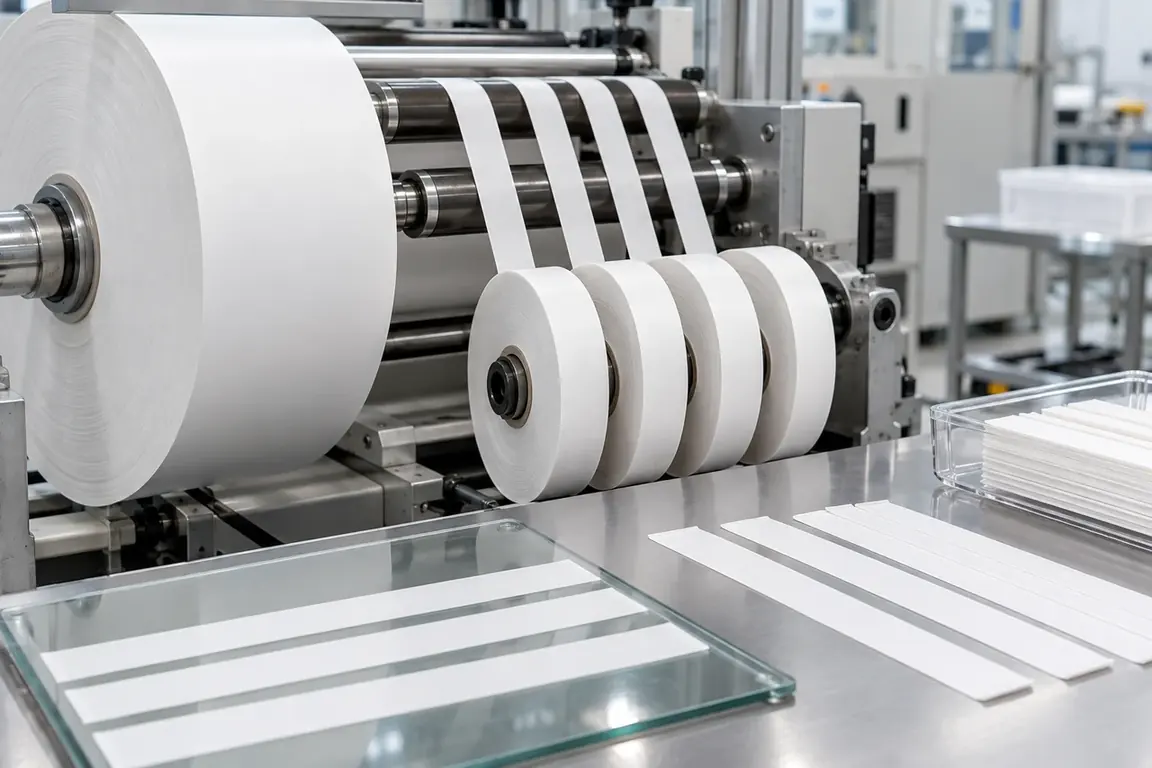
Lateral-flow nitrocellulose membrane slitting blades convert membrane rolls into controlled-width strips before dispensing, lamination or test-card assembly. A useful review distinguishes backed from unbacked membrane, records the functional surface and web direction, and evaluates edge fracture, loose particles, strip tracking and handling without assuming that every diagnostic membrane behaves alike.
Where This Cutting Application Appears
Membrane roll width conversion
Master rolls are slit into narrower membrane reels for controlled feeding into downstream diagnostic-test converting operations.
Test-card strip preparation
Membrane lanes are prepared for reagent dispensing and later lamination into lateral-flow test-card constructions.
Backed and unbacked membrane trials
Representative rolls are converted separately so edge behavior, support needs and usable strip condition can be compared.
Common Ways to Describe This Cutting Problem
- lateral flow nitrocellulose membrane slitting blades
- rapid test membrane roll slitter knives
- nitrocellulose diagnostic strip cutting blade
- backed assay membrane edge trimming knives
- unbacked lateral flow membrane slitting cutter
- diagnostic membrane narrow strip cutting blades
- nitrocellulose web clean edge slitter knife
- lateral flow membrane particle control cutting blade
Define the Required Cut Result
- Continuous membrane edges without visible fracture, torn backing or loose fragments.
- Stable strip width and web tracking across every planned lane.
- Minimal disturbance to the functional membrane surface near the slit boundary.
- Clean winding and transfer without avoidable curling, creasing or edge contact.
Problems to Diagnose Before Changing the Knife
Brittle membrane edge fractures during slitting
- Confirm whether the supplied membrane is backed, unbacked or laminated to another carrier.
- Map fracture locations by web side, lane position and material direction.
- Review web support and separation immediately before and after the slit point.
Loose membrane particles remain on the strip
- Distinguish particles generated at the edge from contamination introduced during handling.
- Document the customer's inspection and cleaning method for trial samples.
- Check contact surfaces and collection paths used before the strip is rewound.
Narrow strips curl or wander after separation
- Compare behavior between outer and center lanes from the same parent roll.
- Record web orientation, support path and winding position for affected strips.
- Inspect whether backing tension or existing roll curl contributes to the movement.
Backing separates from the membrane at the edge
- Identify the interface that opens and whether separation begins before or after cutting.
- Compare incoming parent-roll edges with newly slit and rewound edges.
- Review edge handling and winding contact without assigning an unconfirmed material cause.
Knife Forms That May Be Considered
| Possible knife form | When it may be considered | What must be confirmed |
|---|---|---|
| Rotary shear-slitting knife pair | For backed or well-supported diagnostic membrane when the production line is designed for paired circular shear knives. | Membrane and backing construction, knife-holder interface, overlap and clearance controls, web support and accepted edge sample. |
| Supported razor-slitting blade arrangement | For thin membrane web when trials confirm that a stationary razor entry with close support produces the required edge. | Blade presentation, support geometry, coated-face contact, web direction, particle control and finished-strip condition. |
| Score-slitting knife against anvil roll | When the existing membrane converter uses score slitting and representative trials confirm acceptable separation without crushing. | Membrane construction, anvil condition, applied loading control, web support, lane width and approved edge result. |
Information to Send for Technical Review
You do not need to know the exact blade name. Send the available workpiece, machine, current-knife and cut-result information so the application can be reviewed against a drawing or sample.
- Membrane product identification, supplied construction and representative roll samples.
- Backed or unbacked condition and clear identification of the functional surface.
- Parent-roll format, required strip widths, lane count and edge-trim plan.
- Machine station, holder interface, web path, support and winding arrangement.
- Close-up images of accepted edges, fractures, particles and backing separation.
- Web direction, supplied roll condition and any protective interleaf arrangement.
- Inspection, cleanliness, contact, collection and packaging requirements.
- Trial quantity, downstream process and current cutting information if available.
Questions About This Cutting Application
Can a membrane slitting blade be reviewed from the nitrocellulose name alone?
No. Backing, surface condition, roll format, support, target strip layout and accepted edge samples should be reviewed together.
Why must backed and unbacked membranes be identified separately?
The backing changes edge support, separation behavior and the interfaces that must remain intact during slitting.
What samples are useful for an initial membrane cutting review?
Provide incoming roll material plus accepted and rejected slit strips with the functional side and web direction marked.
How should membrane particles be evaluated?
Use the customer's normal inspection method and separate edge-generated fragments from particles introduced by transport or handling.
Should missing membrane properties be estimated?
No. Keep unknown details unconfirmed and base the review on supplier information, samples and documented trial observations.
Request a Custom Cutting-Knife Review
Send the workpiece details, machine or holder information, current knife photos or sample, required quantity and examples of the present cut problem. Final dimensions, material, edge geometry and tolerances are confirmed from the approved requirements.