
Blade Application Guides / Application Guide / Biopharmaceutical manufacturing
Sterile Vent-Filter Membrane Shear Slitting Blades
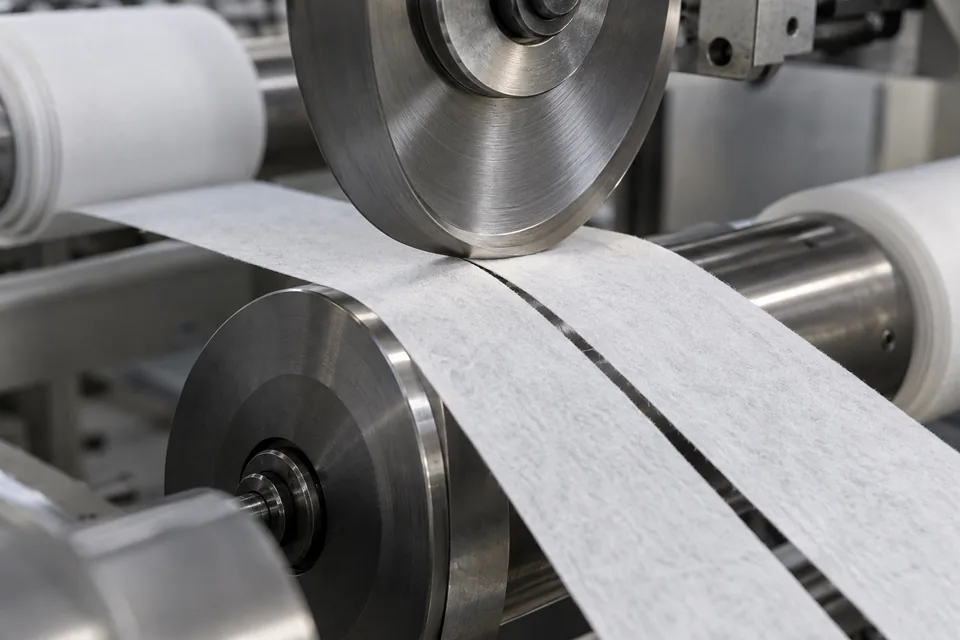
A paired rotary shear creates a continuous cut where two circular edges overlap. That is a specific knife arrangement within possible roll slitting methods. For sterile-vent applications, the workpiece here remains raw hydrophobic membrane media, not a preassembled, sterilized filter. Gore documents supported ePTFE vent media and custom slit rolls; Merck identifies hydrophobic PVDF membrane rolls for gas-sterilization use. Those sources establish material form, not an approved shear setting. Knife overlap, side load and web support therefore require trial on the exact buyer stock before anyone commits to this cut.
Updated
Where This Cutting Application Appears
Check whether the supplied media can enter a shear nip
Map the actual membrane, support and optional liner layers. A backing may stabilize the web, but it can also hide a membrane edge that is incompletely parted. Observe both sides of the rotary pair at low speed before judging a wound lane.
Set engagement from cut evidence
Trial only a controlled range of overlap and side pressure permitted by the equipment and material owner. Too little engagement can bridge support fibers; excessive loading can crush or polish the porous edge. Collect microscope views from leading, middle and trailing web positions.
Separate cut defects from feed defects
If the lane curls or necks at the slit, compare a no-cut transport sample at the same web tension. Check edge support, nip drag and differential winding. Use identical inspection lighting to distinguish loose membrane fibrils from normal support texture.
Pass a clean trial lane to assembly
Have the buyer die cut or mount representative lane samples. Examine whether the cut edge remains outside the seal footprint and whether loose strands migrate during handling. Final vent airflow and integrity are evaluated on the buyer’s assembled filter.
Define the Required Cut Result
- Determine if paired shears suit the exact membrane construction.
- Avoid crushed pore regions and incompletely cut support fibers.
- Hold useful width under controlled tension.
- Deliver samples for downstream vent validation.
Problems to Diagnose Before Changing the Knife
Support fibers bridge across the shear line
- Inspect knife overlap at the affected position.
- Check edge sharpness on both rotary blades.
- Compare backed and unsupported samples where authorized.
Cut edge looks compressed
- Reduce unnecessary side loading in the trial.
- Check lower-knife alignment and support span.
- Compare surface imagery to uncut stock.
Slit lanes curl unevenly
- Measure differential tension and winding torque.
- Review face orientation.
- Reinspect after material conditioning.
Knife Forms That May Be Considered
| Possible knife form | When it may be considered | What must be confirmed |
|---|---|---|
| Paired upper and lower rotary knives | For supported raw membrane roll stock stable in a continuous web. | Validate overlap and side load against fiber, surface and width criteria. |
| Alternative qualified slitting geometry | If shear engagement damages the supplied membrane. | Compare debris and edge integrity using the same buyer acceptance method. |
Information to Send for Technical Review
You do not need to know the exact blade name. Send the available workpiece, machine, current-knife and cut-result information so the application can be reviewed against a drawing or sample.
- Exact membrane and backing composition
- Roll thickness profile and liner arrangement
- Permitted contact side and conditioning
- Paired-knife diameter and station drawing
- Trial overlap and side-load record
- Target lane width and tension state
- Edge micrographs and loose-fiber criteria
- Buyer mounted-filter test plan
Questions About This Cutting Application
How is shear slitting different from roll slitting?
Shear names the paired rotary-knife mechanism; roll slitting describes dividing a moving parent roll into lanes.
Can the support layer conceal a bad cut?
Yes. Inspect both faces and the cross-section; support fibers may remain bridged while membrane looks parted.
Does a shear cut validate sterile venting?
No. The buyer tests the final filter for its intended integrity and gas-flow requirements.
Is a published knife overlap suitable for every membrane?
No. Use the actual web and equipment to qualify engagement against agreed edge samples.
What is the useful comparison sample?
An uncut stock control and a transported no-cut control help identify blade effects versus feed damage.
Public references and scope
These public sources provide material, cutting-method or safety context for this guide. Supplier pages describe their own materials or equipment; they do not establish a MEIRENTE blade specification or performance claim. Confirm the actual grade, machine setup and required cut with a drawing or sample.
Related product and service information
- Virus-Filtration Membrane Edge Trimming Blades - virus-filtration membrane · edge trimming
- Single-Use Bioreactor Bag Film Shear Slitting Blades - single-use bioreactor bag film · shear slitting
- Chromatography Membrane-Adsorber Media Shear Slitting Blades - chromatography membrane-adsorber media · shear slitting
Request a Custom Cutting-Knife Review
Send the workpiece details, machine or holder information, current knife photos or sample, required quantity and examples of the present cut problem. Final dimensions, material, edge geometry and tolerances are confirmed from the approved requirements.