
Blade Application Guides / Application Guide / Biopharmaceutical manufacturing
Chromatography Membrane-Adsorber Media Shear Slitting Blades
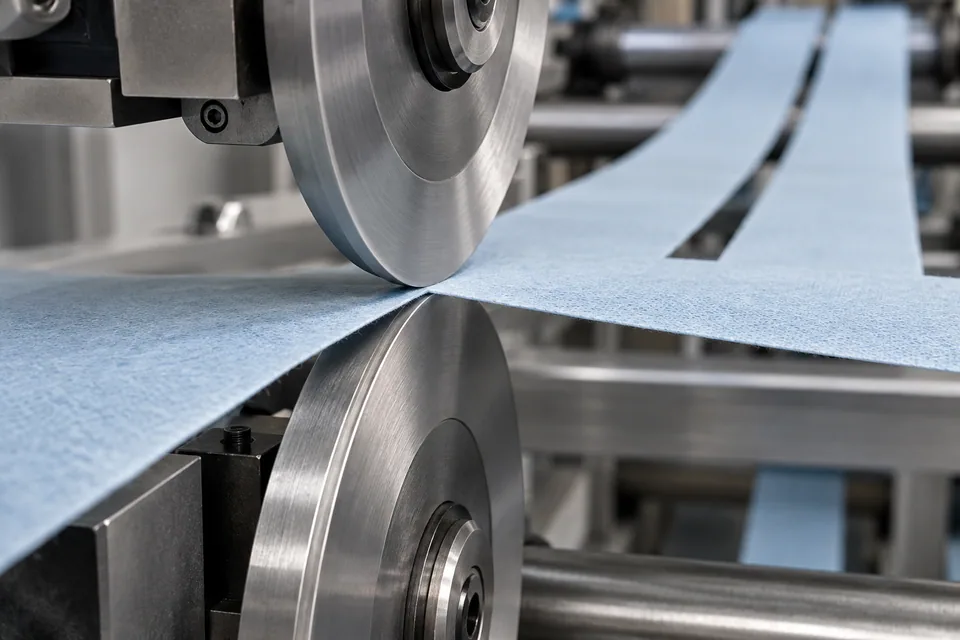
Chromatography adsorbers may contain a rolled functional membrane or stacked membrane sheets, as Sartorius shows in its manufacturing descriptions. The material at issue here is an unassembled, continuous membrane-adsorber media web, not a finished cassette or capsule. DIENES describes shear cutting as two rotating circular knives acting together on a web. That mechanism may be considered for width conversion only after the media owner confirms it is suitable for its membrane chemistry, pore structure and support. Excess overlap, side load or a worn edge can deform a functional cut margin or shed material. This guide addresses blade setup and component inspection; it makes no claim that shearing alone establishes adsorber flow, binding performance or sterility.
Updated
Where This Cutting Application Appears
Confirm shear is an approved route
Ask whether the production web is supported, coated or chemically functionalized, and obtain the permitted edge zone. A stacked-sheet device may receive sheet blanks rather than a narrow rewound roll, so define the component that this operation is meant to produce.
Set upper and lower knives together
Record overlap, side pressure, clearance, knife runout and blade condition on the installed station. Trial one representative lot at the intended speed and tension. Inspect for a true shear fracture across the membrane and backing without dragging a layer onto the functional face.
Examine the hidden edge
Look at both lane edges under suitable magnification for compacted pores, lint, loose support fibers and delamination. Inspect the outside scrap and nearby web surface too; retained fragments can travel into the next winding or stacking stage.
Compare after transfer
Measure widths and edge quality immediately after shearing and after rewind, unwind or sheet transfer. The adsorber maker then evaluates whether component orientation, active area and assembled flow path meet its released requirements.
Define the Required Cut Result
- Keep paired knife engagement stable through the functional media stack.
- Retain edge geometry and active zone specified by the owner.
- Prevent loose particles from entering later adsorber assembly.
- Deliver correctly oriented, traceable lanes.
Problems to Diagnose Before Changing the Knife
The backing pulls away from the membrane
- Check knife overlap and side load.
- Inspect blade runout and backing support.
- Compare edges at two speeds.
Fine debris appears on the active face
- Inspect blade wear and the lower knife region.
- Review suction or waste capture.
- Check web routing immediately after the cut.
One lane has a crushed edge
- Measure knife engagement at that station.
- Compare the local web tension.
- Inspect an uncut control and a fresh blade trial.
Knife Forms That May Be Considered
| Possible knife form | When it may be considered | What must be confirmed |
|---|---|---|
| Paired rotary shear knives | When the owner permits a supported, continuous flat-media web to be separated into lanes. | Confirm overlap, side load, edge morphology and particle count by trial. |
| Dedicated shear pair for outside margin | When one outer strip is removed and captured before component winding. | Confirm scrap handling and protection of the retained active web. |
Information to Send for Technical Review
You do not need to know the exact blade name. Send the available workpiece, machine, current-knife and cut-result information so the application can be reviewed against a drawing or sample.
- Exact chromatography adsorber membrane and support grade
- Owner approval of shear-cutting the functional web
- Element, active-area and lane-width drawings
- Upper and lower knife sizes, overlap and side-load range
- Representative production lot and uncut control
- Particle, pore-compaction and support-peel criteria
- Web orientation, tension, clean handling and winding plan
- Final adsorber binding, flow and integrity qualification owner
Questions About This Cutting Application
Are the knives cutting a finished membrane-adsorber device?
No. The operation is limited to flat functional media before device assembly.
Is shear slitting automatically suitable for every ligand membrane?
No. The media owner must approve the route on its actual chemistry and support.
Why inspect both sides of a slit?
A damaged backing or compacted functional edge may be visible from only one face.
Can a visually clean edge prove adsorber capacity?
No. Binding and flow require the manufacturer’s component and device tests.
What must a useful RFQ include?
Include the media stack, paired-knife station, component width and edge acceptance samples.
Public references and scope
These public sources provide material, cutting-method or safety context for this guide. Supplier pages describe their own materials or equipment; they do not establish a MEIRENTE blade specification or performance claim. Confirm the actual grade, machine setup and required cut with a drawing or sample.
Related product and service information
- Single-Use Bioreactor Bag Film Edge Trimming Blades - single-use bioreactor bag film · edge trimming
- Virus-Filtration Membrane Shear Slitting Blades - virus-filtration membrane · shear slitting
- Sterile Vent-Filter Membrane Shear Slitting Blades - sterile vent-filter membrane · shear slitting
Request a Custom Cutting-Knife Review
Send the workpiece details, machine or holder information, current knife photos or sample, required quantity and examples of the present cut problem. Final dimensions, material, edge geometry and tolerances are confirmed from the approved requirements.