
Blade Application Guides / Application Guide / Biopharmaceutical manufacturing
Single-Use Bioreactor Bag Film Shear Slitting Blades
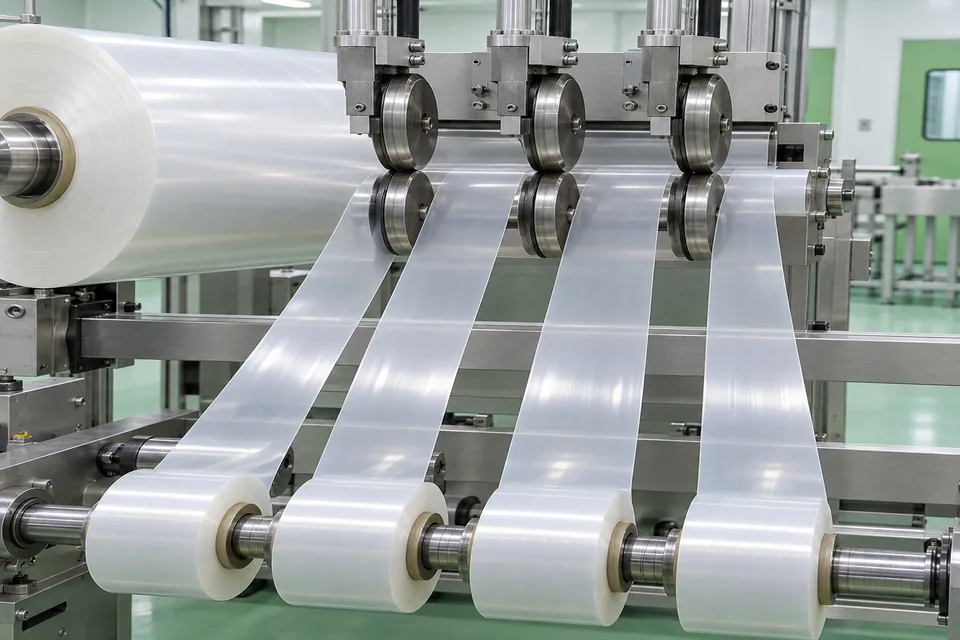
Corning and Thermo Fisher describe single-use bioprocess bags assembled from specific single- or multilayer films. This guide focuses on paired rotary shear slitting of the unassembled film web into lanes; it does not cut a finished sterile bag. DIENES describes shear slitting as overlapping upper and lower rotary edges that can divide flexible webs. For a bioreactor film, the tool interface must be evaluated for inner seal-layer damage, barrier-layer fracture and debris rather than merely measuring width. Identify the fluid-contact face, film grade and manufacturer’s permitted processing condition. An accepted cut strip remains raw material: the bioreactor bag maker is responsible for weld, port, leak, extractables and sterility qualification.
Updated
Where This Cutting Application Appears
Anchor shears to weld geometry
Set slit lanes from panel width, planned weld region and later port location. Mark the face that may touch the lower knife or support roll. Sample outer and central lanes so knife-position differences are visible.
Record the matched edge setup
Use installed machine drawings for knife diameter, overlap, side clearance, drive, backing and spacer stack. Trial the actual film rather than a plain PE surrogate. If one edge shows more stress, compare upper/lower knife wear and tension before assuming the laminate itself is defective.
Inspect the two new faces separately
Check both sides of every shear for rolled polymer lip, layer peel, crease, particles and local translucent stress marks. Use the bag maker’s approved optical or section inspection where an internal barrier defect is not visible at the surface.
Check after rewind and welding trial
Measure lane width after winding and unwinding; inspect surface rub at guides. Provide representative material to the bag assembler for a weld sample that crosses the actual converted edge if required. Neither shear appearance nor a weld coupon alone substitutes for final bag validation.
Define the Required Cut Result
- Maintain lane width and future weld allowance.
- Limit asymmetric lip, delamination and loose particles.
- Protect designated contact and barrier faces.
- Record shear-pair settings for buyer repeatability.
Problems to Diagnose Before Changing the Knife
One side has a rolled polymer lip
- Check overlap and side clearance.
- Inspect knife drive and lower-edge support.
- Compare both sides from the same slit.
Barrier layer shows a localized crease
- Review web tension and guide contact.
- Inspect before-and-after samples.
- Check whether the shear pulls layers at the cut.
Particles appear after winding
- Inspect knife exit, separator and rewind guides in sequence.
- Check edge wear and cleanroom handling.
- Retain station-tagged samples.
Knife Forms That May Be Considered
| Possible knife form | When it may be considered | What must be confirmed |
|---|---|---|
| Matched upper/lower circular shear knives | For a compatible manufacturer-approved multilayer film line. | Confirm actual pair geometry and accepted layer cross-section on buyer stock. |
| Outside trim shear pair | When only a sacrificial outer film margin is removed. | Confirm retained weld allowance and clean waste takeoff. |
Information to Send for Technical Review
You do not need to know the exact blade name. Send the available workpiece, machine, current-knife and cut-result information so the application can be reviewed against a drawing or sample.
- Approved film grade and layer cross-section
- Fluid-contact face and roll orientation
- Panel, weld and port drawing
- Rotary knives, arbor and clearance drawings
- Line cleanliness and particle acceptance
- Accepted lip, crease and delamination samples
- Rewind and film protection method
- Bag-maker weld and final integrity validation plan
Questions About This Cutting Application
How does shear slitting differ from generic roll slitting?
It names the opposed rotating-knife method; roll slitting only describes the longitudinal conversion result.
Why inspect both sides of one cut?
The adjacent edges can show different lip or layer stress from the paired knives.
Is the film sterile after shear conversion?
No conclusion follows from cutting. Sterility and bag release use the manufacturer’s validated process.
Can a blade be qualified from its steel grade alone?
No. Machine setup, real film and bag-maker acceptance are required.
What must stay outside the cut?
The buyer-defined functional and weld areas according to the panel drawing.
Public references and scope
These public sources provide material, cutting-method or safety context for this guide. Supplier pages describe their own materials or equipment; they do not establish a MEIRENTE blade specification or performance claim. Confirm the actual grade, machine setup and required cut with a drawing or sample.
Related product and service information
- Sterile Vent-Filter Membrane Edge-Trimming Blades - sterile vent-filter membrane · edge trimming
- Virus-Filtration Membrane Shear Slitting Blades - virus-filtration membrane · shear slitting
- Chromatography Membrane-Adsorber Media Shear Slitting Blades - chromatography membrane-adsorber media · shear slitting
Request a Custom Cutting-Knife Review
Send the workpiece details, machine or holder information, current knife photos or sample, required quantity and examples of the present cut problem. Final dimensions, material, edge geometry and tolerances are confirmed from the approved requirements.