
Blade Application Guides / Application Guide / Biopharmaceutical manufacturing
Sterile Vent-Filter Membrane Rotary Die-Cutting Blades
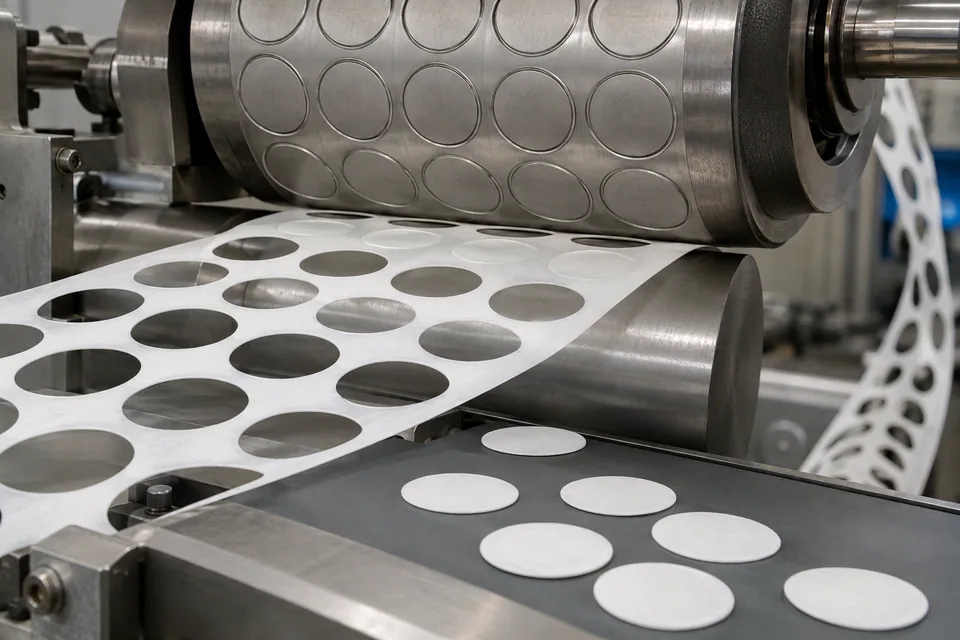
Gore describes supported ePTFE microfiltration media engineered for custom die-cut parts, while Merck lists hydrophobic gas-vent membrane in both roll and disc formats. Those examples support the existence of unassembled vent-media blanks. This article addresses a proposed rotary die for repeated insert contours from a qualified web; Gore’s custom part statement does not by itself approve every rotary tool or cutting condition. The workpiece is raw membrane or membrane-plus-support, not a cartridge, welded vent or sterilized assembly. Die geometry, matrix stripping and any kiss-cut depth must be proven on the exact supplied structure.
Updated
Where This Cutting Application Appears
Start with the insert and seal geometry
Use the buyer’s housing drawing to identify the disc or shaped insert, effective exposed vent area and zone held by a gasket or weld. Set nesting pitch to preserve required material around the seal, while keeping any registration marks outside the flow path.
Select the cut stack deliberately
Inspect whether the web has a backing, removable liner or sacrificial carrier. A through-cut die must part membrane and support without ragged edges; a kiss cut is relevant only if the buyer explicitly wants parts retained on a liner. Trial the anvil and die with the full delivered construction.
Strip matrix without losing parts
Observe whether the porous insert sticks to the waste matrix or deforms during removal. Check every contour for bridging, flattened perimeter fibers and surface pickup. Retain both parts and matrix for microscope review, especially around holes or tight radii.
Send formed blanks for device tests
Measure insert dimensions in the conditioning state required by the supplier. Fit sample blanks in the buyer’s fixture and record any seal-land encroachment. The assembled vent then needs the buyer’s integrity, liquid intrusion and gas-flow testing; blade inspection cannot substitute for those results.
Define the Required Cut Result
- Form repeatable membrane inserts without crushed perimeter.
- Keep support and membrane aligned through extraction.
- Preserve the buyer-defined open vent area and seal zone.
- Leave final sterile-filter validation to the assembled device.
Problems to Diagnose Before Changing the Knife
Disc remains attached to surrounding web
- Check die-to-anvil contact over the full contour.
- Examine local thickness variation and support fibers.
- Inspect die wear at repeated positions.
Insert distorts during matrix stripping
- Review release direction and liner use.
- Check web tension and part pickup method.
- Compare pre- and post-stripping dimensions.
Edge intrudes into the seal area
- Check contour registration to housing datum.
- Inspect pitch and rotary repeat.
- Confirm the buyer’s seal-land drawing.
Knife Forms That May Be Considered
| Possible knife form | When it may be considered | What must be confirmed |
|---|---|---|
| Rotary full-cut die | For approved roll-form raw vent media needing repeated separate inserts. | Confirm complete contour and a clean unsupported perimeter. |
| Rotary kiss-cut die with carrier | Only when the buyer supplies a suitable liner and needs retained parts. | Prove the membrane/support cut depth without scoring the release carrier. |
Information to Send for Technical Review
You do not need to know the exact blade name. Send the available workpiece, machine, current-knife and cut-result information so the application can be reviewed against a drawing or sample.
- Exact PTFE/PVDF or other membrane grade
- Backing and liner construction
- Supplier handling restrictions
- Insert outline and exposed-area drawing
- Seal or weld land drawing
- Die, anvil and matrix-removal layout
- Edge micrographs and particle criteria
- Buyer device-level vent and sterility tests
Questions About This Cutting Application
Does the die cut a finished sterile vent?
No. It forms raw media inserts; device assembly and validation happen downstream.
Can a liner be kiss cut in every construction?
No. The delivered web must actually have an approved carrier, and cut depth must be trialed.
What is the main perimeter concern?
Ragged or compressed membrane/support edges can affect assembly or shed material.
Why inspect both parts and waste matrix?
Bridges and torn edges in the matrix can reveal an incomplete contour even when a released insert looks round.
Can good dimensions prove microbial retention?
No. The buyer must test the completed vent under its qualified protocol.
Public references and scope
These public sources provide material, cutting-method or safety context for this guide. Supplier pages describe their own materials or equipment; they do not establish a MEIRENTE blade specification or performance claim. Confirm the actual grade, machine setup and required cut with a drawing or sample.
Related product and service information
- Sterile Vent-Filter Membrane Shear Slitting Blades - sterile vent-filter membrane · shear slitting
- Single-Use Bioreactor Bag Film Rotary Die-Cutting Blades - single-use bioreactor bag film · rotary die cutting
- Virus-Filtration Membrane Rotary Die-Cutting Blades - virus-filtration membrane · rotary die cutting
Request a Custom Cutting-Knife Review
Send the workpiece details, machine or holder information, current knife photos or sample, required quantity and examples of the present cut problem. Final dimensions, material, edge geometry and tolerances are confirmed from the approved requirements.