
Blade Application Guides / Application Guide / Precision metal converting
Stainless Woven Wire Mesh Precision Blanking Blades
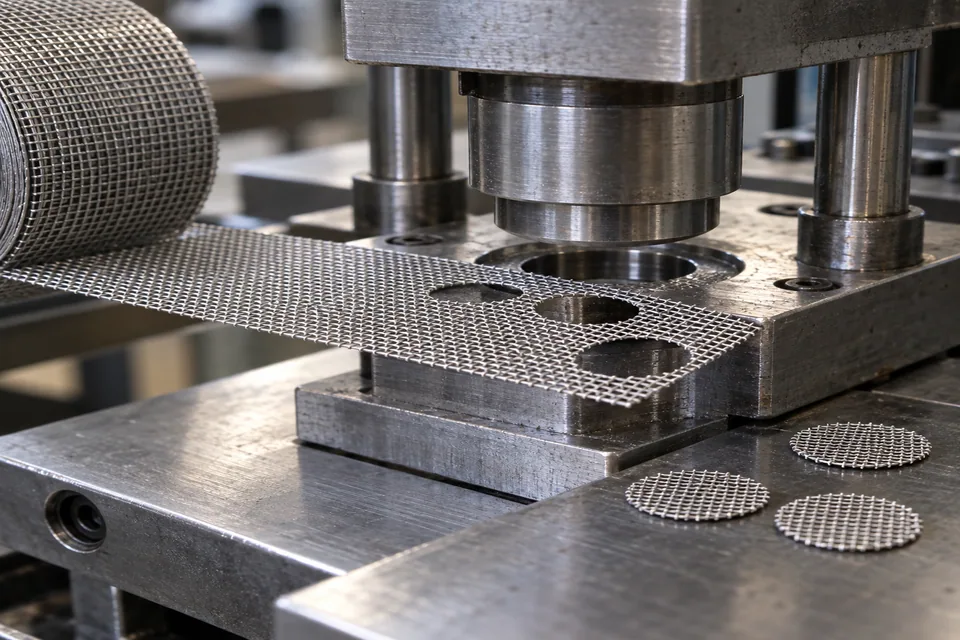
Precision blanking releases a discrete shape from a sheet or strip of stainless woven wire mesh. It differs from longitudinal coil slitting, which produces continuous narrow reels. Gerard Daniel documents punching many mesh counts and cautions that mesh does not behave uniformly like solid sheet metal; it also describes edge treatments that prevent loosening. The buyer must provide a profile drawing, weave orientation and the intended handling method. A die can meet outer dimensions while pulling individual wires from an open weave or collapsing apertures along a seal or filter interface. Select die, support and ejection only after trialing the actual mesh. No blade alone establishes the performance of a finished filter or screen.
Updated
Where This Cutting Application Appears
Lay out the blank in the weave
Place the part outline, any inner opening and functional area on a diagram that shows warp and weft. Identify which edges later sit in a gasket, weld or frame. Nest parts with enough web between die impressions to avoid carrying a partly severed wire into the next blank.
Trial die and support together
Record punch/die clearance, stripper plate, support surface and stroke sequence from the installed press. A thin open mesh can bridge an unsupported hole or stick to a punch. Test complete separation and controlled slug ejection without flattening the functional center area.
Inspect discrete released pieces
Check profile dimensions, squareness or roundness as applicable, and count loose or bent wire ends. Inspect apertures near corners and internal cutouts. Retain both the accepted blank and its skeleton so wire pullout can be traced to the cutting line.
Verify the edge finishing plan
If the buyer crimps, welds or bonds the blank into a filter assembly, run representative parts through that step. Confirm that exposed ends do not unravel or snag in the fixture. Functional filtration or shielding performance remains the assembly maker’s qualification.
Define the Required Cut Result
- Release repeatable mesh blanks to the approved profile.
- Minimize pulled wires and aperture collapse at the edge.
- Eject slugs and skeleton without damaging useful parts.
- Preserve weave orientation for downstream mounting.
Problems to Diagnose Before Changing the Knife
A wire pulls out at a corner
- Review corner radius and weave orientation.
- Inspect stripper action and die clearance.
- Compare incoming mesh stability at that location.
Small internal slug remains attached
- Check punch penetration and support below the opening.
- Inspect the wire bridge left in the skeleton.
- Review slug ejection before stacking parts.
Blank measures correctly but snags in assembly
- Inspect protruding wire tails.
- Trial the planned edging or frame insertion.
- Compare handling direction with weave orientation.
Knife Forms That May Be Considered
| Possible knife form | When it may be considered | What must be confirmed |
|---|---|---|
| Matched punch and die set with stripper | For repeated discrete profiles on a press compatible with the mesh grade. | Confirm clearance, stripper contact and supported ejection with actual weave samples. |
| Compound blanking tool | When outer profile and approved internal opening must register in one controlled stroke. | Confirm slug removal, press fit and absence of functional-aperture crush. |
Information to Send for Technical Review
You do not need to know the exact blade name. Send the available workpiece, machine, current-knife and cut-result information so the application can be reviewed against a drawing or sample.
- Exact stainless alloy, mesh count, weave and wire diameter
- Dimensioned outer profile and internal openings
- Functional area, frame and gasket drawings
- Warp/weft orientation on incoming stock
- Press, punch, die and stripper details
- Accepted edge-wire and aperture-distortion samples
- Part/skeleton/slug ejection method
- Final mounting and functional test criteria
Questions About This Cutting Application
Why call this blanking rather than slitting?
The tool releases individual shaped parts; slitting makes continuous longitudinal coils.
What makes mesh harder to blank than solid foil?
Wires can move, pull out or bridge a die opening even when the outer profile is dimensionally correct.
Can an internal hole be blanked in the same stroke?
Possibly, with a designed compound tool and a trial that confirms complete slug removal.
Is a free wire end always rejected?
The buyer must define the edge and downstream edging method; protruding or loose wires need explicit acceptance limits.
Who qualifies the finished filter?
The assembly owner validates its seal, flow, filtration or electrical function separately.
Public references and scope
These public sources provide material, cutting-method or safety context for this guide. Supplier pages describe their own materials or equipment; they do not establish a MEIRENTE blade specification or performance claim. Confirm the actual grade, machine setup and required cut with a drawing or sample.
Related product and service information
- Carbon Fiber Epoxy Prepreg Cut-To-Size Blades - carbon fiber epoxy prepreg · cut to size
- Stainless Woven Wire Mesh Cut-to-Length Blades - stainless woven wire mesh · cut to length
- Expanded Copper Mesh Cut-To-Length Blades - expanded copper mesh · cut to length
Request a Custom Cutting-Knife Review
Send the workpiece details, machine or holder information, current knife photos or sample, required quantity and examples of the present cut problem. Final dimensions, material, edge geometry and tolerances are confirmed from the approved requirements.