
Blade Application Guides / Application Guide / Composite manufacturing
Carbon Fiber Epoxy Prepreg Cut-To-Size Blades
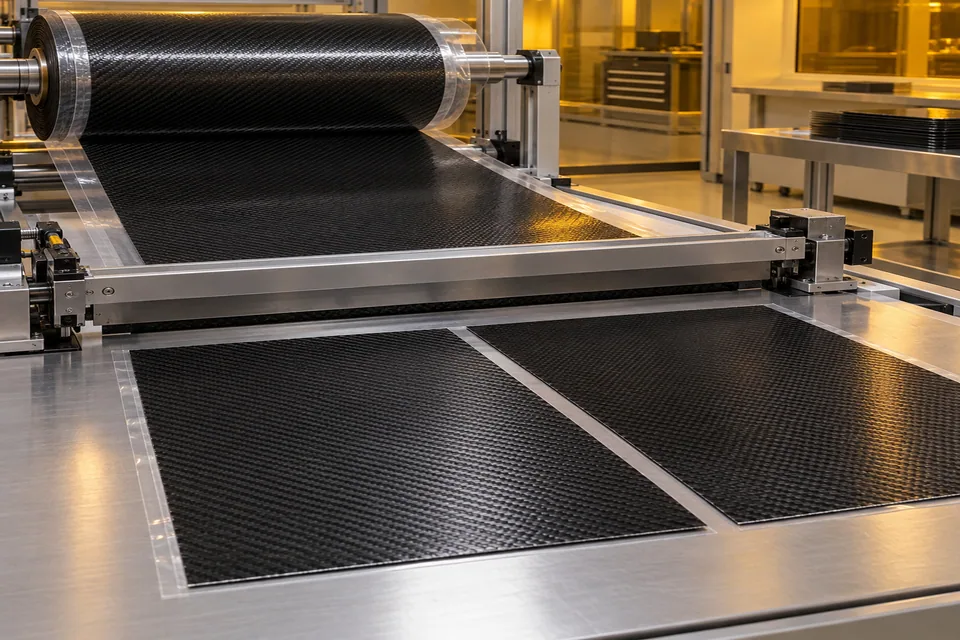
Hexcel lists carbon/epoxy prepregs in woven, multiaxial and unidirectional forms and has documented variable widths and lengths for wind-energy prepreg products. Eastman identifies dry and prepreg carbon-fiber cutting as a composite process. This page covers straight stock sizing of an uncured carbon/epoxy roll before final ply contours are nested. It does not describe cutting cured carbon laminate. Because carbon architecture and release layers vary, any knife or dimensional acceptance must be trialed on the exact supplied construction.
Updated
Where This Cutting Application Appears
Map the carbon axis before cutting
Take blank size and orientation from the layup drawing. A UD roll requires its tow direction to remain clear on every piece; a woven grade may require warp/fill or bias marks. Allow only the stock margin that the later ply nesting plan needs. Do not rotate a blank for yield if that would alter the intended fiber direction.
Support tacky plies through the straight cut
Cut the actual carbon/resin/liner stack on a clean support. Observe whether the blade pulls a tow across the cut line or deposits resin on the tool. A carrier can help lift the blank, but only if the buyer’s grade permits its use. Trial both the leading and trailing edges because the sheet may move differently when the final strip separates.
Inspect tow ends and surface
Check four edges for carbon filament tails, resin smearing, tow waviness and liner scuff. Use the buyer’s method for measuring flat dimensions, then confirm that orientation markings remain readable. Inspect the cutting bed and blank surfaces for loose fiber fragments; those particles should not travel into the layup kit.
Move into controlled ply kitting
Keep material lot, grade and exposure history with the sized blank. Place protective interleaves only if permitted by the prepreg supplier. The laminate builder will create the final outline and verify consolidation and cure. Sizing accuracy alone does not qualify structural properties.
Confirm the blank remains usable after pickup
Trial one blank through the real pickup and positioning steps used at the next station. Look for stretched tow near the handling edge and resin transfer where operators grip the carrier. Compare dimensions before and after repositioning. A process that cuts square stock but requires hand straightening of carbon tows should not be approved, because it creates a difficult-to-repeat starting condition for final ply nesting. Record whether the carbon edge stays aligned after a short permitted dwell, since a tacky blank can deform between cutting and the next operation.
Define the Required Cut Result
- Size uncured carbon/epoxy stock without tow distortion.
- Keep fiber-axis identity visible on every blank.
- Minimize loose filaments and resin pickup.
- Preserve lot and material-control records.
Problems to Diagnose Before Changing the Knife
A tow is dragged at the end of the stroke
- Review hold-down near release.
- Check blade wear and backing support.
- Inspect carbon architecture and liner.
Blank looks square while tows are skewed
- Compare marked fiber axis with blank edge.
- Check feed tension.
- Measure after release from the cutting table.
Knife Forms That May Be Considered
| Possible knife form | When it may be considered | What must be confirmed |
|---|---|---|
| Guided straight cutter | For flat stock sizing when coupons show intact tow ends. | Check resin pickup and orientation retention. |
| Sheet shear blade | For a supported construction that trials cleanly. | Confirm no lower-layer bridges or tow movement. |
Information to Send for Technical Review
You do not need to know the exact blade name. Send the available workpiece, machine, current-knife and cut-result information so the application can be reviewed against a drawing or sample.
- Exact carbon/epoxy grade and fiber architecture
- Liner and resin tack handling limits
- Blank drawing and carbon axis
- Loose-filament and resin-contact criteria
- Downstream ply nesting and cure owner
Questions About This Cutting Application
Is this the cut of a cured CFRP panel?
No. It sections uncured prepreg broadgoods before layup.
Why mark tow direction?
Laminate properties depend on the specified ply orientation.
Can yield optimization rotate every blank?
No. Nesting must respect the design fiber axis.
What confirms the blank is usable?
The next ply-cutting station must handle it without tow shift or contamination.
Public references and scope
These public sources provide material, cutting-method or safety context for this guide. Supplier pages describe their own materials or equipment; they do not establish a MEIRENTE blade specification or performance claim. Confirm the actual grade, machine setup and required cut with a drawing or sample.
Related product and service information
- Glass Fiber Epoxy Prepreg Cut-To-Size Blades - glass fiber epoxy prepreg · cut to size
- Silicone Rubber Sheet Cut To Size Blades - silicone rubber sheet · cut to size
- Fluoroelastomer Rubber Sheet Cut To Size Blades - fluoroelastomer rubber sheet · cut to size
Request a Custom Cutting-Knife Review
Send the workpiece details, machine or holder information, current knife photos or sample, required quantity and examples of the present cut problem. Final dimensions, material, edge geometry and tolerances are confirmed from the approved requirements.