
Blade Application Guides / Application Guide / Precision metal converting
Expanded Copper Mesh Cut-To-Length Blades
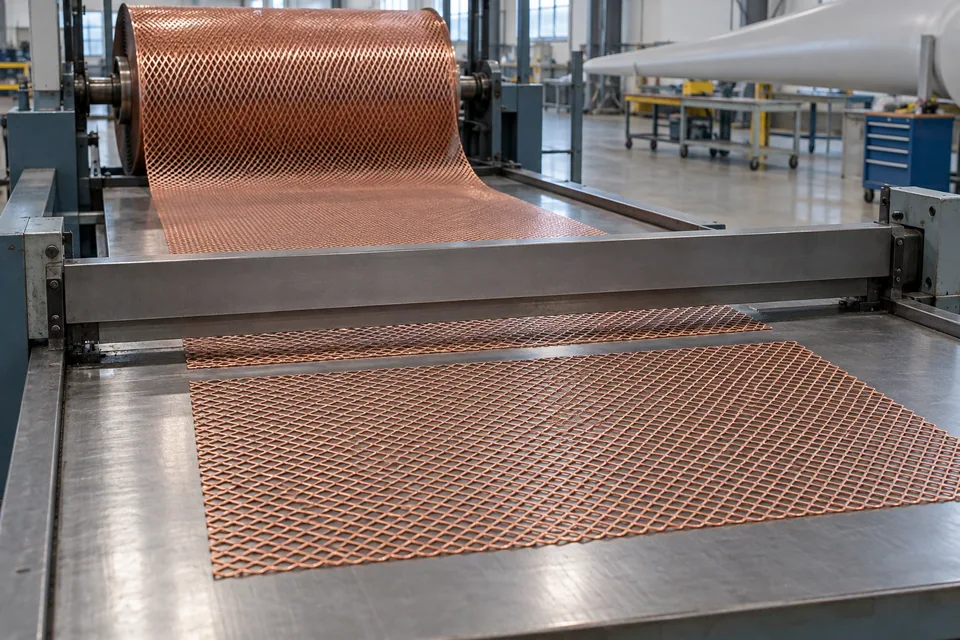
CThru Metals describes expanded copper foil as a continuous one-piece mesh that can be wound into a coil and then automatically cut to specified lengths. Niles Expanded Metals also documents shearing expanded mesh to a sheet requirement. These manufacturer sources support a transverse cut-to-length operation on an approved expanded copper mesh roll or strip. The workpiece is an open diamond-pattern network created earlier by slitting and stretching solid foil; cutting it into finite blanks is a separate step. The final dimensions, pattern direction and edge acceptance depend on the intended electrical or mechanical assembly, not on a generic cutter setting.
Updated
Where This Cutting Application Appears
Specify the finite mesh blank
Take length, usable width and orientation from the component drawing. Record expanded pattern, strand width, metal condition, incoming roll lot and whether the mesh has been flattened. A dimension across open cells can be ambiguous, so agree how the buyer measures from the first intact junction or the overall envelope. Note whether the blank is later folded, laminated or welded into a larger conductive part.
Unwind and register without stretching cells
Support the coil through the feed path and avoid snag points that catch diamond edges. Measure the feed under the actual web tension, then verify the relaxed blank length after release. Thin copper strands can deform when pulled even if the drive reports the right travel distance. If a protective carrier or interleaf is present, identify whether it remains during cutting and how it is removed.
Trial the transverse separation
Test a supported shear or guided cross-web blade on the actual copper pattern and thickness. The cutting edge must separate every intersected strand without hooking adjacent diamonds or folding a burr toward the part. A solid-foil knife setup should not be assumed suitable for expanded mesh. Compare the cut at both sides and across the center, where support and cell alignment may differ.
Inspect both cut ends
Measure blank length and squareness after release from the fixture. Examine upper and lower faces for sharp hooks, burrs, loose fragments, displaced junctions and cells stretched beyond the intended cut line. Gently handle a sample in the same direction used during assembly to reveal a strand that catches later. Keep an incoming control to separate an expansion defect from cutting damage.
Package for the next conversion step
Identify pattern, copper lot, blank size and orientation on the package. Interleave pieces only with a material accepted for the intended application and protect edges from compression. The receiving engineer still checks electrical continuity, contact design, adhesion or other end-use performance. A correctly cut rectangle shows dimensional conversion quality, not approval of the completed device or lightning system.
Define the Required Cut Result
- Produce finite expanded-copper-mesh blanks from a coil or long strip.
- Retain diamond pattern and usable length.
- Avoid hooks, burrs and loose copper fragments.
- Preserve metal, pattern and orientation traceability.
Problems to Diagnose Before Changing the Knife
The feed length is correct but blank relaxes short
- Measure after release.
- Review unwind tension and cell stretch.
- Compare with uncut control.
Cut end contains hooked copper strands
- Inspect both faces and waste.
- Review blade geometry and backing support.
- Test handling at the next station.
Knife Forms That May Be Considered
| Possible knife form | When it may be considered | What must be confirmed |
|---|---|---|
| Supported transverse shear blade | For a pattern-specific sheet or strip cut after trials. | Check every strand, burr and full-width squareness. |
| Guided cross-web knife | For compatible fine mesh on a controlled web path. | Verify it does not drag open cells or shed fragments. |
Information to Send for Technical Review
You do not need to know the exact blade name. Send the available workpiece, machine, current-knife and cut-result information so the application can be reviewed against a drawing or sample.
- Copper mesh pattern, strand dimensions and condition
- Coil or long-strip width and protective carrier
- Blank length and measurement convention
- Flattened or raised mesh state
- Hook, burr, fragment and squareness acceptance
Questions About This Cutting Application
Is cut to length the same as making the expanded pattern?
No. Expansion slits and stretches foil first; this process later separates finite blanks.
Is this solid copper foil cutting?
No. Open diamond cells and junctions need their own edge inspection.
Why measure after release?
Web tension can stretch cells during feeding and change the relaxed blank length.
Does a clean blank prove electrical performance?
No. The receiving assembly must validate continuity and connection design.
Public references and scope
These public sources provide material, cutting-method or safety context for this guide. Supplier pages describe their own materials or equipment; they do not establish a MEIRENTE blade specification or performance claim. Confirm the actual grade, machine setup and required cut with a drawing or sample.
Related product and service information
- Stainless Woven Wire Mesh Coil Slitting Blades - stainless woven wire mesh · coil slitting
- Inconel Alloy Foil Cut-to-Length Blades - Inconel alloy foil · cut to length
- Beryllium-Copper Foil Cut-to-Length Blades - beryllium-copper foil · cut to length
Request a Custom Cutting-Knife Review
Send the workpiece details, machine or holder information, current knife photos or sample, required quantity and examples of the present cut problem. Final dimensions, material, edge geometry and tolerances are confirmed from the approved requirements.