
Blade Application Guides / Application Guide / Precision metal converting
Stainless Woven Wire Mesh Cut-to-Length Blades
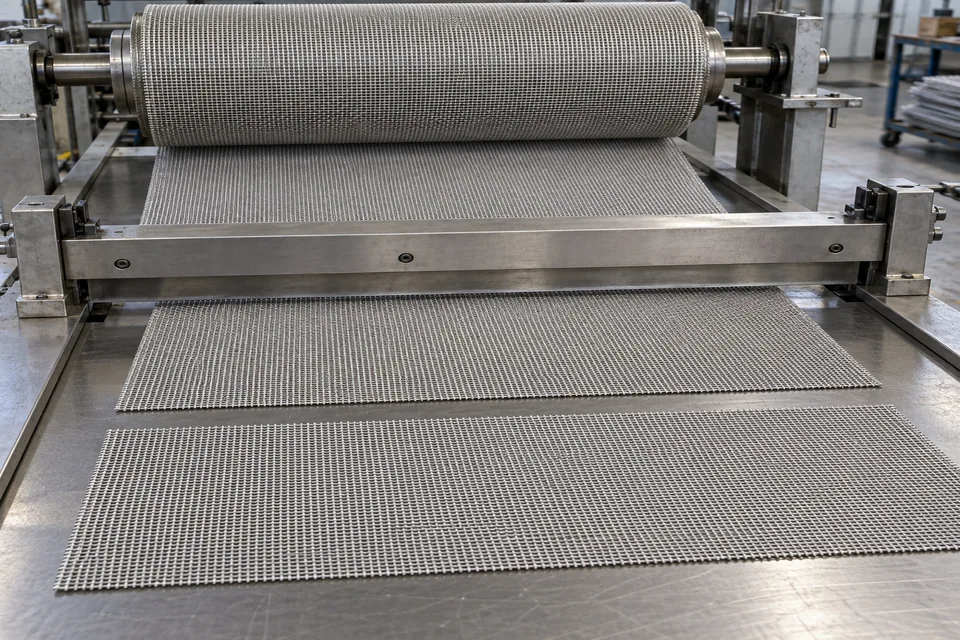
A cut-to-length operation takes stainless woven wire cloth from a reel and shears it across the web to make individual rectangular pieces. Gerard Daniel explicitly distinguishes this transverse shearing from slitting wire cloth lengthwise into a narrower wound reel. Its wire-mesh guidance also warns that the weave can move out of line or fray during cutting. The buyer's alloy, weave, wire diameter, mesh count and downstream part geometry therefore matter more than a nominal sheet length alone. This guide addresses a straight cross-cut in continuous mesh. It does not describe a perimeter blanking die, a shaped filter part or shearing solid stainless strip. Check length, squareness and released wire ends after the piece is lifted and stacked, not only at the blade. Final screening, filtration or assembly performance must be verified by the buyer.
Updated
Where This Cutting Application Appears
Map length across the woven structure
Identify warp and weft, the delivered roll width and the direction in which pieces leave the reel. Set length and squareness from the buyer's downstream frame or blank layout. Mark any selvage retained on the sides and any sacrificial leading or trailing edge. A cross-cut can expose different wire ends from a longitudinal slit, so accepted edge photographs should show the transverse edge specifically. Do not transfer acceptance criteria from a solid metal strip or an unrelated mesh count.
Hold the mesh flat through the cross-shear stroke
Trial the actual reel using a straight supported shear arrangement sized to the width and wire construction. Establish feed control and local hold-down so loose strands do not rise in front of the blade. Review blade straightness, edge condition, clearance and support against the installed machine drawing. A gap that accepts an individual wire can pull that strand before severing it, shifting the next row and changing both the edge and the apparent length. Compare first pieces with later pieces after repeated feeding.
Inspect the full width of each cut edge
Measure length at both sides and at the center under a repeatable low-tension condition. Check squareness and compare aperture shape in the first rows beside each cross-cut with uncut stock. Count pulled wires, protruding wire ends, bent strands and detached fragments according to the buyer's limits. A piece may meet nominal length while its weave has skewed locally; retain an uncut control and a marked accepted piece for the production setup record.
Recheck pieces after lifting and stacking
Watch whether the leading edge snags guides as the next length feeds and whether a newly sheared piece unravels when picked up. Keep the cut pieces flat during collection and prevent one exposed wire end from catching the following piece. If the buyer will weld, bind or frame the edge, trial that follow-on step with actual cross-cut pieces. Label alloy, weave direction and lot so a later defect can be traced to material, cut setup or handling.
Define the Required Cut Result
- Produce rectangular mesh pieces at the buyer's length and squareness criteria.
- Limit released wires, bent strands and aperture distortion at transverse edges.
- Keep the weave aligned during feeding, cutting and collection.
- Preserve edge quality through the specified finishing or framing step.
Problems to Diagnose Before Changing the Knife
Length differs between left and right edges
- Check feed skew and roll tracking before the cross-shear.
- Measure squareness under the same low-tension setup each time.
- Inspect whether a bent row makes the edge appear out of line.
Wires pull out near the transverse cut
- Compare cut location with the weave intersection pattern.
- Review hold-down, blade gap and wire diameter together.
- Reinspect after lifting and stacking, when fray may become visible.
A sheared piece snags during collection
- Look for projecting wire ends on both the leading and trailing edges.
- Review guide and stacking contact points.
- Confirm whether edge binding is required before further handling.
Knife Forms That May Be Considered
| Possible knife form | When it may be considered | What must be confirmed |
|---|---|---|
| Supported straight cross-shear blade and opposing edge | For cutting rectangular lengths across a reel of the approved woven wire mesh. | Trial the exact weave and wire size for squareness, complete separation and limited strand pullout. |
| Guillotine-style straight shear with hold-down | Where the installed sheeter can restrain a flexible open weave immediately beside the transverse cut. | Confirm that hold-down contact does not crush apertures or distort the delivered piece. |
Information to Send for Technical Review
You do not need to know the exact blade name. Send the available workpiece, machine, current-knife and cut-result information so the application can be reviewed against a drawing or sample.
- Stainless alloy, weave pattern, mesh count and wire diameter
- Parent reel width, winding direction and selvage condition
- Target piece length, squareness and edge-finishing drawing
- Warp/weft orientation in the finished piece
- Cross-shear blade, counter-edge, hold-down and feed drawings
- Accepted transverse edge and loose-wire samples
- Collection and downstream welding, binding or framing method
- Buyer functional test for the finished mesh assembly
Questions About This Cutting Application
How does cut to length differ from coil slitting?
A transverse shear releases individual pieces from the reel; longitudinal slitting makes narrower continuous reels.
Why measure length at both sides?
Open weave can feed or stretch unevenly, leaving a skewed edge even when one side meets the target length.
Can solid-sheet shear settings be reused?
They must be trialed. Separate wires and open apertures respond differently to blade gap and hold-down pressure.
Is a clean edge at the blade enough?
No. Lifting and stacking can release or snag wire ends, so inspect the delivered pieces again.
Does the cut determine filtration performance?
No. The buyer must evaluate the finished framed or bonded mesh part for its intended function.
Public references and scope
These public sources provide material, cutting-method or safety context for this guide. Supplier pages describe their own materials or equipment; they do not establish a MEIRENTE blade specification or performance claim. Confirm the actual grade, machine setup and required cut with a drawing or sample.
Related product and service information
- Stainless Woven Wire Mesh Precision Blanking Blades - stainless woven wire mesh · precision blanking
- Expanded Copper Mesh Cut-To-Length Blades - expanded copper mesh · cut to length
- Inconel Alloy Foil Cut-to-Length Blades - Inconel alloy foil · cut to length
Request a Custom Cutting-Knife Review
Send the workpiece details, machine or holder information, current knife photos or sample, required quantity and examples of the present cut problem. Final dimensions, material, edge geometry and tolerances are confirmed from the approved requirements.