
Blade Application Guides / Application Guide / Precision metal converting
Stainless Woven Wire Mesh Coil Slitting Blades
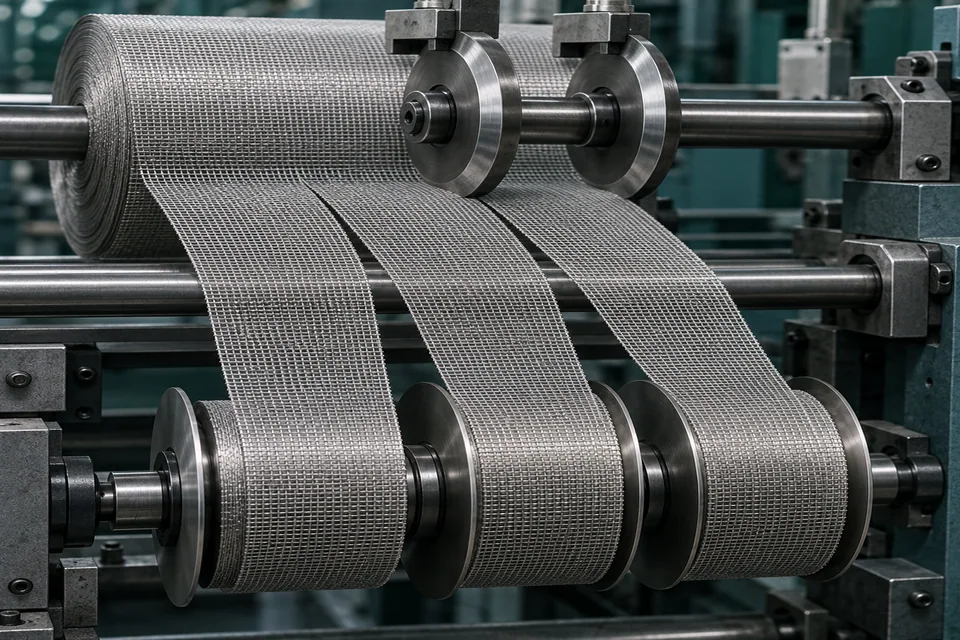
Stainless woven wire mesh is interlaced wire cloth, not solid strip. Gerard Daniel describes supplying woven mesh as rolls, slitting it lengthwise into narrower coils and also stamping shaped pieces. This guide covers the first operation: a continuous parent mesh coil becomes one or more narrower wound mesh coils. The selected weave, wire diameter and mesh count determine whether the cut runs parallel or oblique to a wire path. A nominal width does not ensure a stable edge; loose wire ends can fray during winding or later use. Identify the buyer’s edge treatment and application before choosing a shear arrangement. Finished filtration, screening or electrical performance belongs to the assembly owner.
Updated
Where This Cutting Application Appears
Orient the slit to the weave
Mark warp and weft directions, selvages and desired finished widths on a sample roll. Plan the cut line relative to wire intersections so the delivered coil does not have long unsupported tails. Record whether the buyer accepts an open cut edge or requires later welded, hemmed or bound edging.
Support the mesh at the knife
Trial the actual stiffness and mesh count with compatible opposed edges or a supported slitting tool. Check knife condition, gap and tracking; a very open mesh can deform into a blade clearance instead of parting cleanly. Keep coil tension low enough to avoid width distortion.
Count released and bent wires
Measure width at several points, then inspect both sides of the slit for loose picks, bent warp wires, crushed openings and protruding ends. Compare the aperture pattern immediately beside the cut with uncut material. Save a marked sample that shows acceptable fray and edge treatment.
Examine wound slit coils
Inspect after rewinding for telescoping, mesh imprint, edge wire snagging and nested turns. A clean knife-exit edge can unravel when a narrow coil is handled. Separate scrap selvages from useful coils and label weave direction, alloy and lot.
Define the Required Cut Result
- Produce the approved narrow coil widths and lengths.
- Limit free wire ends, fray and distorted apertures at both edges.
- Keep weave direction and coil identity traceable.
- Deliver an edge suited to the buyer’s specified finishing step.
Problems to Diagnose Before Changing the Knife
Wire ends pull out after rewinding
- Inspect where the slit crosses wire intersections.
- Compare knife-exit and wound samples.
- Review edge binding and winding tension.
Finished coil width varies
- Check weave stretch and lateral tracking.
- Measure under a consistent low-tension condition.
- Inspect knife spacer position and parent-roll edge.
Mesh opening distorts beside the cut
- Review blade gap and local backing.
- Compare wire diameter and weave batch.
- Inspect whether a guide or take-up roll causes later crush.
Knife Forms That May Be Considered
| Possible knife form | When it may be considered | What must be confirmed |
|---|---|---|
| Matched rotary shear knife pair | For a supported continuous mesh coil whose wire size and weave trial cleanly separate. | Confirm pair geometry, wire-end condition and accepted aperture next to the slit. |
| Single supported edge-trim knife | Where one sacrificial selvage is removed from a wide mesh coil. | Confirm retained width and scrap handling without unraveling the adjacent weave. |
Information to Send for Technical Review
You do not need to know the exact blade name. Send the available workpiece, machine, current-knife and cut-result information so the application can be reviewed against a drawing or sample.
- Stainless grade, weave pattern, mesh count and wire diameter
- Parent coil width, length and winding direction
- Target slit widths and outside selvage plan
- Warp/weft orientation and allowable edge-wire release
- Knife/arbor/support drawings and web path
- Accepted fray, wire-tail and aperture samples
- Required welded, hemmed or bound edge treatment
- Buyer final screen/filter/assembly acceptance method
Questions About This Cutting Application
Why is mesh slitting unlike solid metal strip?
Cutting releases individual wires; edge stability and aperture distortion matter as much as width.
Can every woven mesh be slit with a rotary pair?
No. Trial the actual weave, wire diameter and stiffness with the installed support and knife geometry.
When is edge finishing needed?
The buyer decides based on handling and end use; a slit edge may require welding, hemming or binding.
Should width be measured under tension?
Use a stated low-tension method because stretching the weave changes the apparent width.
Does a clean coil prove filtration performance?
No. The finished element and its edge construction must meet the buyer’s functional tests.
Public references and scope
These public sources provide material, cutting-method or safety context for this guide. Supplier pages describe their own materials or equipment; they do not establish a MEIRENTE blade specification or performance claim. Confirm the actual grade, machine setup and required cut with a drawing or sample.
Related product and service information
- Stainless Woven Wire Mesh Cut-to-Length Blades - stainless woven wire mesh · cut to length
- Expanded Copper Mesh Cut-To-Length Blades - expanded copper mesh · cut to length
- Amorphous Metal Ribbon Precision Coil Slitting Blades - amorphous metal ribbon · precision coil slitting
Request a Custom Cutting-Knife Review
Send the workpiece details, machine or holder information, current knife photos or sample, required quantity and examples of the present cut problem. Final dimensions, material, edge geometry and tolerances are confirmed from the approved requirements.