
Blade Application Guides / Application Guide / Specialty metal converting
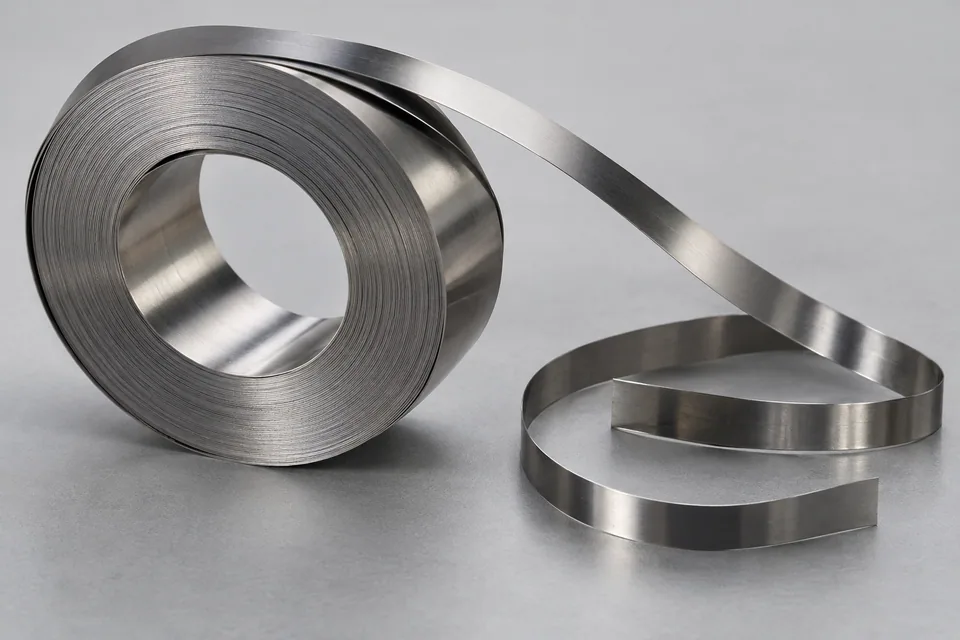
Amorphous Metal Ribbon Precision Coil Slitting Blades
Metglas describes rapidly cast amorphous metal as a flexible, very thin ribbon that can be slit, stamped and wound; its magnetic-material data distinguish as-cast and annealed properties. This guide concerns an identified, unassembled ribbon coil before core winding or final heat treatment. A buyer may order a ribbon already cast at target width, so another slitting pass is justified only by an actual lane-width drawing and a representative conversion trial. DIENES describes paired rotary shear slitting for nonferrous metal and foil webs. Knife alignment alone does not establish that a hard amorphous alloy will survive the required width, handling and later magnetic-core process. The core builder must confirm final magnetic loss and permeability on finished parts.
Updated
Where This Cutting Application Appears
Confirm the source coil and final lane plan
Record alloy designation, cast width, thickness map, wheel-side versus free-side appearance and delivery temper. Draw every intended lane and narrow outside trim. A cast ribbon edge may be usable as delivered; avoid removing it merely to make the coil resemble conventional steel strip.
Trial one shear station before a full-width layout
Pair the upper and lower circular knives with controlled engagement and support, then run a short lot at the planned tension. Observe edge chipping, lateral wandering and brittle flakes. Save left and right specimens with a sample of the incoming cast edge for comparison.
Inspect slit lanes after winding
Measure width on each lane and along the coil, not only at startup. Unwind a sample to inspect burr-like rollover, micro-notches, chips and edge-to-edge contact marks. Identify where trimmed scrap travels so fragments cannot enter coils intended for stacking or winding.
Hand off to the magnetic-core maker
Label the finished lane orientation, alloy lot and machine direction. The buyer should evaluate bend/wind behavior on its real core geometry, then test the annealed core electrically. A smooth visual slit cannot predict stress-sensitive magnetic properties after assembly.
Define the Required Cut Result
- Produce the buyer’s documented lane widths from approved cast stock.
- Limit chips and raised edge features that could damage adjacent layers.
- Preserve coil identity and orientation through rewind.
- Provide evidence for downstream core-winding trials.
Problems to Diagnose Before Changing the Knife
Cracks follow the new slit edge
- Compare blade engagement, web tension and as-cast edge control.
- Review alloy and heat-treatment history.
Adjacent lanes differ in width
- Check spacer stack, lateral web tracking and knife thermal condition.
- Sample both start and end of each reel.
Metallic fragments appear in wound coils
- Inspect edge pickup at both knives and trim takeoff.
- Examine guides and core surfaces before release.
Knife Forms That May Be Considered
| Possible knife form | When it may be considered | What must be confirmed |
|---|---|---|
| Matched upper and lower rotary shear knives | For a coil-width reduction supported by a trial on the actual amorphous alloy. | Confirm both child-edge profiles, lane width and fragment containment. |
| Alternative separation method selected by material owner | If the trial shows cracking or unacceptable magnetic-core scrap. | Compare full process yield and finished core results, not a single cut photograph. |
Information to Send for Technical Review
You do not need to know the exact blade name. Send the available workpiece, machine, current-knife and cut-result information so the application can be reviewed against a drawing or sample.
- Exact alloy and as-cast or annealed supply state
- Cast width, thickness variation and wheel/free side identification
- Lane layout, retained edges and trim allowances
- Parent and child coil winding directions
- Knife pair, support and side-load settings
- Approved edge-chip, burr and width acceptance
- Chip and trim collection method
- Core maker’s winding and post-anneal test plan
Questions About This Cutting Application
Can any amorphous coil be slit after casting?
No. Metglas lists slitting as possible, but the exact alloy and delivered condition still need a trial.
Why compare cast and slit edges?
The comparison separates incoming casting defects from damage made by the knives.
Is a clean visual edge proof of core performance?
No. Magnetic behavior must be checked after winding and required heat treatment.
Why keep wheel-side orientation?
It preserves traceability when core stacking or winding specifies which face contacts adjacent layers.
What should the first RFQ include?
Send a labeled sample coil, alloy data, lane drawing and finished-core handling plan.
Public references and scope
These public sources provide material, cutting-method or safety context for this guide. Supplier pages describe their own materials or equipment; they do not establish a MEIRENTE blade specification or performance claim. Confirm the actual grade, machine setup and required cut with a drawing or sample.
Related product and service information
- Amorphous Metal Ribbon Strip Edge-Trimming Blades - amorphous metal ribbon · strip edge trimming
- Nanocrystalline-Alloy Precursor Ribbon Precision Coil Slitting Blades - nanocrystalline-alloy amorphous precursor ribbon · precision coil slitting
- Beryllium-Copper Foil Precision Coil Slitting Blades - beryllium-copper foil · precision coil slitting
Request a Custom Cutting-Knife Review
Send the workpiece details, machine or holder information, current knife photos or sample, required quantity and examples of the present cut problem. Final dimensions, material, edge geometry and tolerances are confirmed from the approved requirements.