
Blade Application Guides / Application Guide / Surface protection converting
Stainless Steel Protection Film Shear Slitting Blades
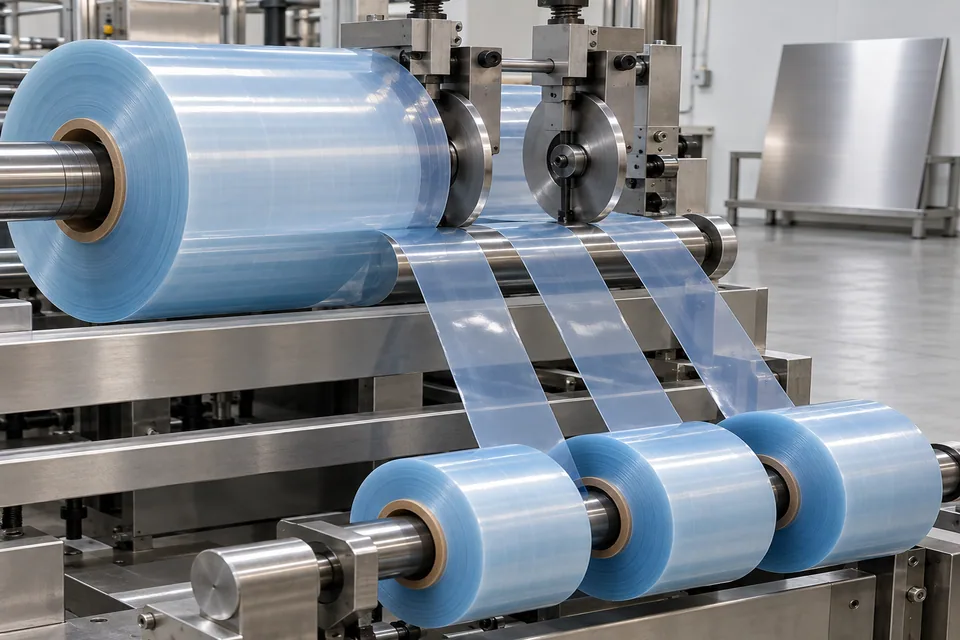
The workpiece is a removable protection-film roll before it is applied to stainless steel, not a steel coil with film already laminated to it. Novacel identifies films selected for different stainless finishes and describes slitting and rewinding protective-film rolls to customer widths. A paired rotary shear can divide a suitable wide film web into narrower rolls, but the film backing, adhesive formulation and release system must be identified from the buyer's grade. Film that cuts cleanly can still telescope, block at the wound edge or lift during application. Trial the actual roll, then inspect slit edges after rewinding and a buyer-approved application and removal test. The cut itself cannot establish surface protection or residue-free removal on every stainless finish.
Updated
Where This Cutting Application Appears
Set width from the steel application route
Identify the stainless finish, planned coating width and whether the film will be applied to a sheet or coil. Specify useful film width separately from any sacrificial edge trim and allow for the applicator's tracking scheme. Record printing, direction marks or a release liner if present; do not assume every protective-film grade has the same adhesive face or release construction. A narrow film lane can wander on an applicator even if its static width measures correctly.
Trial the actual backing and adhesive at the shear pair
Use the buyer's production roll to set knife overlap, side contact and web support. DIENES describes shear slitting as two overlapping rotary knives for film and other wide webs, but that general method does not establish suitability for this adhesive grade. Inspect both sides of the slit for backing deformation, stringing adhesive and transfer to either knife. Compare first cuts with samples taken after the blades have run long enough for adhesive build-up to become visible. Keep machine geometry and cleaning intervals tied to trial evidence.
Check the delivered roll rather than the knife exit alone
Measure lane width and edge straightness at several roll positions. Inspect the face and adhesive edge for nicking, edge ooze, blocking between turns and contamination picked up at guides. A protection film may look straight while flat yet form a hard, adhesive-rich rim after winding. Unwind a representative length at the buyer's handling tension and compare it with a knife-exit sample before assigning the defect to the blade.
Confirm application and clean removal downstream
Apply a trial lane to the specified brushed, polished or other stainless finish using the buyer's normal pressure and dwell conditions. Look for film-edge lift, trapped debris, uneven coverage and any adhesive transfer at removal. Those checks are the buyer's qualification of film grade and application method; a blade supplier should record cutting observations without claiming that a slit edge guarantees surface protection. Retain both accepted and rejected samples for later knife setup comparisons.
Define the Required Cut Result
- Deliver buyer-approved protection-film roll widths for the applicator.
- Limit backing burr, adhesive stringing and contamination at both slit edges.
- Maintain stable rewound lanes without blocking or telescoping.
- Preserve traceability of film grade, adhesive face and stainless finish trial.
Problems to Diagnose Before Changing the Knife
Adhesive accumulates on the upper or lower knife
- Inspect both knife faces and the adhesive formulation on the actual roll.
- Compare the first sample with later samples from the same run.
- Review side contact, blade finish and approved cleaning method.
Lane edges block after rewinding
- Check edge ooze and winding tension against the buyer's storage condition.
- Compare unwind force at center and outside roll positions.
- Separate cutting defects from adhesive migration during storage.
Film lifts at the stainless edge after application
- Inspect the cut backing for curl or uneven edge width.
- Confirm the film grade matches the actual steel finish.
- Review applicator alignment and downstream dwell before blaming the knife.
Knife Forms That May Be Considered
| Possible knife form | When it may be considered | What must be confirmed |
|---|---|---|
| Matched rotary shear knife pair | For longitudinal width conversion of an approved wide protection-film roll. | Trial backing separation, adhesive transfer, both-edge quality and rewound roll handling. |
| Supported rotary shear edge-trim pair | Where the parent roll needs a sacrificial outside edge removed before useful lanes are wound. | Check trim-strip collection without adhesive contact or wander into the useful lane. |
Information to Send for Technical Review
You do not need to know the exact blade name. Send the available workpiece, machine, current-knife and cut-result information so the application can be reviewed against a drawing or sample.
- Actual protection-film roll and manufacturer grade sheet
- Backing, adhesive and release-liner construction if applicable
- Stainless finish and planned sheet or coil application route
- Parent-roll and target-lane widths, trim plan and winding cores
- Shear knife, arbor, guide and rewinder drawings
- Accepted edge, adhesive-transfer and roll-unwind samples
- Buyer application, dwell and removal test conditions
Questions About This Cutting Application
Is the stainless steel cut during this operation?
No. This topic concerns slitting the removable film roll before it is applied to steel. Cutting a film-coated steel coil is a different process.
Can blade choice be fixed from film thickness alone?
No. Backing, adhesive, release construction and winding behavior must be trialed on the actual grade.
Why inspect a rewound roll?
Adhesive ooze, edge blocking and telescoping can appear after a clean-looking knife-exit cut.
Does a clean slit guarantee residue-free removal?
No. The buyer must test its chosen film on the specified stainless finish under the intended application and removal conditions.
What is the main shear setup risk?
Poor knife contact or adhesive build-up can deform the backing and leave different defects on the two adjacent film lanes.
Public references and scope
These public sources provide material, cutting-method or safety context for this guide. Supplier pages describe their own materials or equipment; they do not establish a MEIRENTE blade specification or performance claim. Confirm the actual grade, machine setup and required cut with a drawing or sample.
Related product and service information
- Lithium-Ion Battery Recycling Pre-Shredder Knives - Discharged lithium-ion cells, modules and approved production scrap · Rotary-shear pre-shredding and controlled granulation
- Stainless Steel Protection Film Cross-Cutting Blades - stainless steel protection film · cross cutting
- Optical Lens Protection Film Cross-Cutting Blades - optical lens protection film · cross cutting
Request a Custom Cutting-Knife Review
Send the workpiece details, machine or holder information, current knife photos or sample, required quantity and examples of the present cut problem. Final dimensions, material, edge geometry and tolerances are confirmed from the approved requirements.