
Blade Application Guides / Application Guide / Lithium-ion battery recycling
Lithium-Ion Battery Recycling Pre-Shredder Knives
Lithium-ion battery recycling pre-shredder knives reduce discharged cells, modules or approved production scrap before drying, separation and black-mass recovery. Feed can combine housings, foils, separator film and polymers, so review must stay within the recycler's validated safety process and define feed state, atmosphere, stages, foreign-material controls, target output and rotor or stator interfaces.
Updated
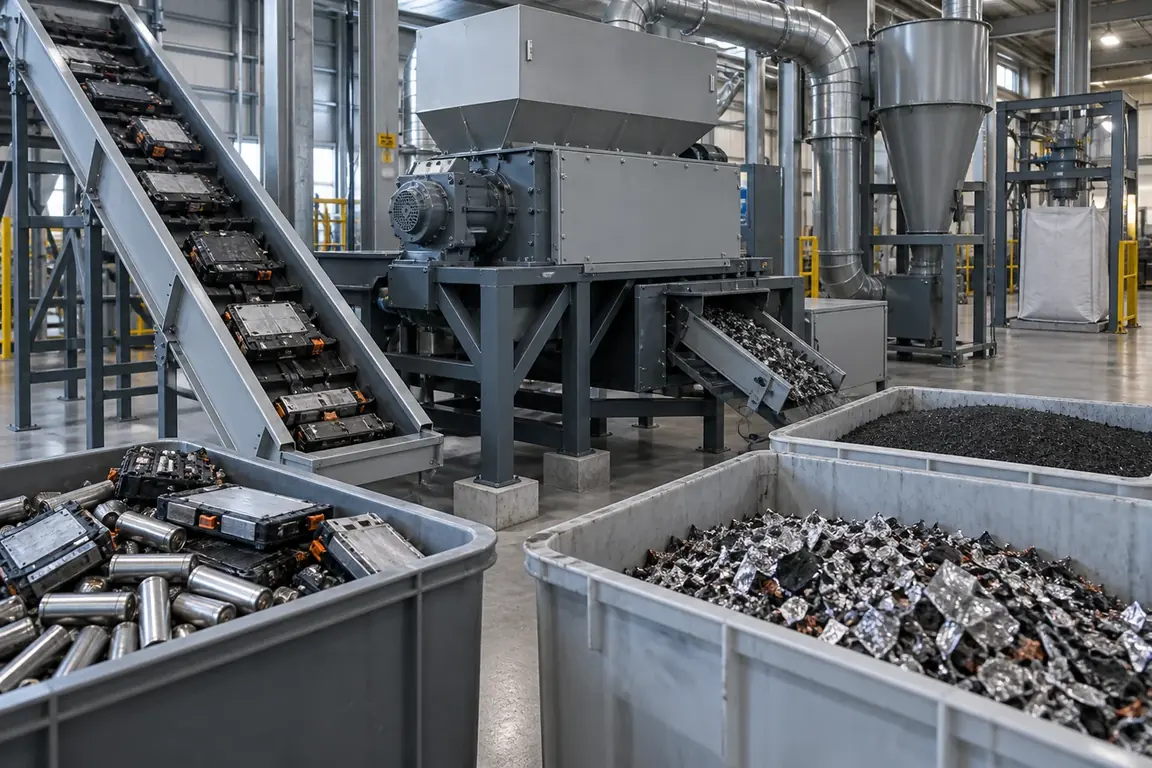
Where This Cutting Application Appears
Discharged cell pre-shredding
Validated discharged cells are opened and reduced within controlled mechanical pretreatment.
Module component size reduction
Approved dismantled or process-ready components are reduced before sorting.
Battery production scrap granulation
Controlled electrode and assembly scrap follows the plant-specific recovery route.
Rotary-Shear Pre-Shredding And Controlled Granulation process boundary
Rotary-shear pre-shredding and controlled granulation for Discharged lithium-ion cells, modules and approved production scrap is a linked sequence: the output condition and datum from each operation become the controlled input for the next. It should not be evaluated as one generic cut or accepted only by the final dimension.
Rotary-Shear Pre-Shredding And Controlled Granulation setup checkpoint
For Discharged lithium-ion cells, modules and approved production scrap, define the operation order, intermediate dimensions, registration transfer, material support, web or part handling and waste route for every stage of Rotary-shear pre-shredding and controlled granulation.
Rotary-Shear Pre-Shredding And Controlled Granulation acceptance checkpoint
Verify both intermediate and final results from Rotary-shear pre-shredding and controlled granulation, including dimensions, registration, edge or feature quality, material damage, waste separation and stable transfer between stages.
Define the Required Cut Result
- Controlled engagement without persistent wrapping or uncontrolled ejection.
- Output suitable for downstream drying and separation.
- Stable clearances and wear across approved mixed feed.
- Compatibility with validated atmosphere, temperature and fire controls.
Problems to Diagnose Before Changing the Knife
Separator film and electrode foils wrap around the rotor
- Identify which flexible fraction starts wrapping.
- Review rotor, counter-knife, stripper and discharge relationships.
- Record feed state and buildup pattern without changing safety settings.
Knife edges chip after hard impacts
- Characterize permitted housings and hard components.
- Map damage against rotor position and documented events.
- Review mounting support, fasteners and existing geometry.
Material heats or produces excessive fines
- Use approved atmosphere and temperature records.
- Compare feed preparation, loading and output distribution.
- Review whether recirculation or dull cutting changes residence time.
Output size becomes inconsistent
- Sample output with the recycler's controlled method.
- Inspect rotor and stator wear, clearance and screen.
- Separate knife variation from feed-composition changes.
Knife Forms That May Be Considered
| Possible knife form | When it may be considered | What must be confirmed |
|---|---|---|
| Intermeshing rotary-shear knife set | For low-speed pre-shredders gripping approved battery feed between shafts. | OEM drawings, tooth sequence, spacers, shaft interface, atmosphere and feed envelope. |
| Hooked rotor knife and counter-knife arrangement | For equipment using replaceable rotor tools against stationary components. | Rotor, pockets, counter-knife, stripper, clearances and wear samples. |
| Granulator rotor-and-stator knife set | For downstream reduction after controlled pre-shredding and safety preparation. | Chamber drawing, screen, output, feed state, process controls and accepted material. |
Information to Send for Technical Review
You do not need to know the exact blade name. Send the available workpiece, machine, current-knife and cut-result information so the application can be reviewed against a drawing or sample.
- Validated feed description, discharge status and exclusions.
- Cell, module or scrap construction and safe samples where permitted.
- Process flow for shredding, drying, granulation and separation.
- Atmosphere, temperature, fire-protection and safety requirements.
- Machine model and rotor and stator drawings.
- Existing knife, spacer, counter-knife and fastener information.
- Target output, throughput context and sampling method.
- Wear records, damaged parts and wrapping or impact locations.
Questions About This Cutting Application
Can knives be reviewed without the plant safety process?
No; discharge, atmosphere and fire controls must be defined by the recycler and equipment provider.
How does this differ from electrode slitting?
It reduces recovery feed rather than making electrode widths for new cells.
What helps an impact-damage review?
Provide safely handled damaged parts, wear maps, feed records and documented events.
Does smaller output always mean better cutting?
No; excessive fines can hinder handling and separation.
Can material be selected from the battery name alone?
No; feed, process stage, interface, atmosphere and wear evidence are required.
Related product and service information
- Aseptic Beverage Carton Recycling Shredder Knives - Post-consumer aseptic beverage cartons and PolyAl residue · Carton pre-shredding and residue size reduction
- Coated Paper Sheet Trimming Without Surface Damage - coated paper sheets · sheet trimming
- Tissue Log Cross Cutting and Compression Control - tissue logs · cross cutting
Request a Custom Cutting-Knife Review
Send the workpiece details, machine or holder information, current knife photos or sample, required quantity and examples of the present cut problem. Final dimensions, material, edge geometry and tolerances are confirmed from the approved requirements.