
Blade Application Guides / Application Guide / Surface protection converting
Stainless Steel Protection Film Cross-Cutting Blades
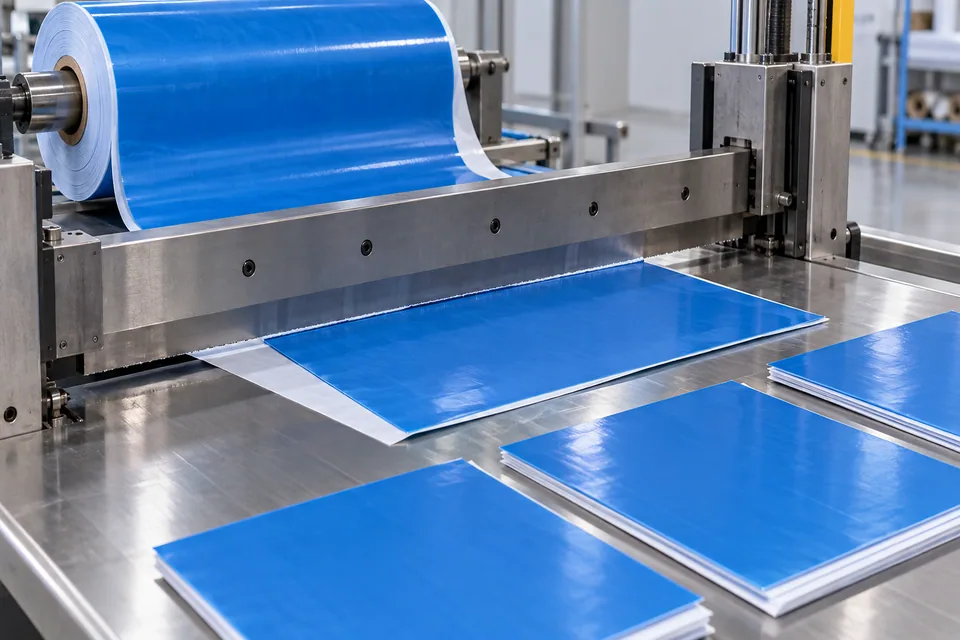
Nitto and Novacel describe removable films selected for stainless-steel sheets and coils with differing finishes and processing demands. This guide cuts the protective film itself from a roll into discrete rectangular lengths before application or as a controlled film-only conversion step. It does not instruct cutting through film already bonded to a finished stainless panel: a blade contacting the metal could mark the surface being protected. Rosenthal documents cross-cut sheeters for flexible film rolls. The film may have pressure-sensitive adhesive, release liner or a nonadhesive interleaf; the exact construction dictates feed and cut support. A neat rectangle does not prove adhesion, residue-free removal or finish compatibility after the customer’s forming and storage cycle.
Updated
Where This Cutting Application Appears
Derive length from the metal workflow
Use the customer’s plate, coil or cut-sheet schedule to define protective coverage and handhold allowance. Note grain direction or mirror finish and whether film will be applied before bending, cutting or transport. Specify the application face on every bundle.
Protect adhesive and liner during feed
Record the film grade, liner configuration and unwind direction before cross-cutting. Trial the actual roll so the feed rollers do not transfer adhesive or imprint a high-gloss face. If the film is already on steel, stop and ask for a film-only cut plan approved by the customer.
Inspect full-width transverse edges
Check corners for liner overhang, adhesive strings, torn backing and particles. Measure sheet length from the same datum in a stated tension state. A short cut can leave an exposed metal zone; an oversized piece can interfere with later fixturing.
Test application and removal on real steel
Stack sheets with protected adhesive faces and traceable lot labels. Apply samples to the actual stainless finish for the buyer’s process and storage trial. The buyer evaluates removal force, residue, staining and scratch protection after use.
Test the application sequence, not only free film
Cut a short series of film lengths and apply one to the intended stainless finish using the buyer’s actual roller or hand method. Check that the new transverse edge does not lift during forming or transport, and that the coverage line stays clear of any later trim or clamp. Record the panel finish and dwell before removal. This reveals whether an attractive free-film edge is useful on the metal without putting a conversion blade against the substrate.
Define the Required Cut Result
- Supply rectangular film lengths for the stainless panel schedule.
- Avoid exposed adhesive, liner mismatch and loose scraps.
- Keep blades away from finished metal surfaces.
- Preserve grade and lot traceability for removal testing.
Problems to Diagnose Before Changing the Knife
Adhesive strings at the crosscut
- Inspect edge and knife cleanliness.
- Check film temperature and feed support.
- Compare liner-on and approved liner-off trials.
One corner lifts after application
- Verify sheet squareness and handhold allowance.
- Inspect liner registration.
- Check the stainless finish and application method.
Cut lengths vary from the order
- Review feed stop and roll tension.
- Measure under a defined condition.
- Inspect slip at drive rollers.
Knife Forms That May Be Considered
| Possible knife form | When it may be considered | What must be confirmed |
|---|---|---|
| Supported reciprocating film crosscut | For unbonded protective-film rolls converted into repeat lengths. | Confirm full backing and liner separation without adhesive smearing. |
| Guillotine-style sheet crosscut | For short film-only lots or wide flat stock. | Check straightness, corner condition and clean handling. |
Information to Send for Technical Review
You do not need to know the exact blade name. Send the available workpiece, machine, current-knife and cut-result information so the application can be reviewed against a drawing or sample.
- Protective film supplier, grade and adhesive system
- Target stainless finish and buyer process
- Whether film is unattached, lined or nonadhesive
- Parent roll width and sheet-length drawing
- Coverage, overlap and handhold allowances
- Feed, crosscut and stacking arrangement
- Accepted adhesive/liner edge samples
- Buyer adhesion and clean-removal protocol
Questions About This Cutting Application
Can the blade crosscut film already stuck to stainless?
Only under a separate buyer-approved method that protects the metal; this guide assumes film-only cutting.
Does the same film suit every steel finish?
No. Mirror, brushed and other finishes need an approved protective-film grade.
Why inspect liner overhang?
A misaligned liner can expose adhesive or hinder clean application.
Can a straight cut prove residue-free removal?
No. Test the film on the actual substrate after the intended process and dwell.
What should the buyer send?
Provide the film grade, stainless finish and panel coverage drawing.
Public references and scope
These public sources provide material, cutting-method or safety context for this guide. Supplier pages describe their own materials or equipment; they do not establish a MEIRENTE blade specification or performance claim. Confirm the actual grade, machine setup and required cut with a drawing or sample.
Related product and service information
- Stainless Steel Protection Film Shear Slitting Blades - stainless steel protection film · shear slitting
- Optical Lens Protection Film Cross-Cutting Blades - optical lens protection film · cross cutting
- Automotive Paint Protection Film Cross-Cutting Blades - automotive paint protection film · cross cutting
Request a Custom Cutting-Knife Review
Send the workpiece details, machine or holder information, current knife photos or sample, required quantity and examples of the present cut problem. Final dimensions, material, edge geometry and tolerances are confirmed from the approved requirements.