
Blade Application Guides / Application Guide / Surface protection converting
Automotive Paint Protection Film Cross-Cutting Blades
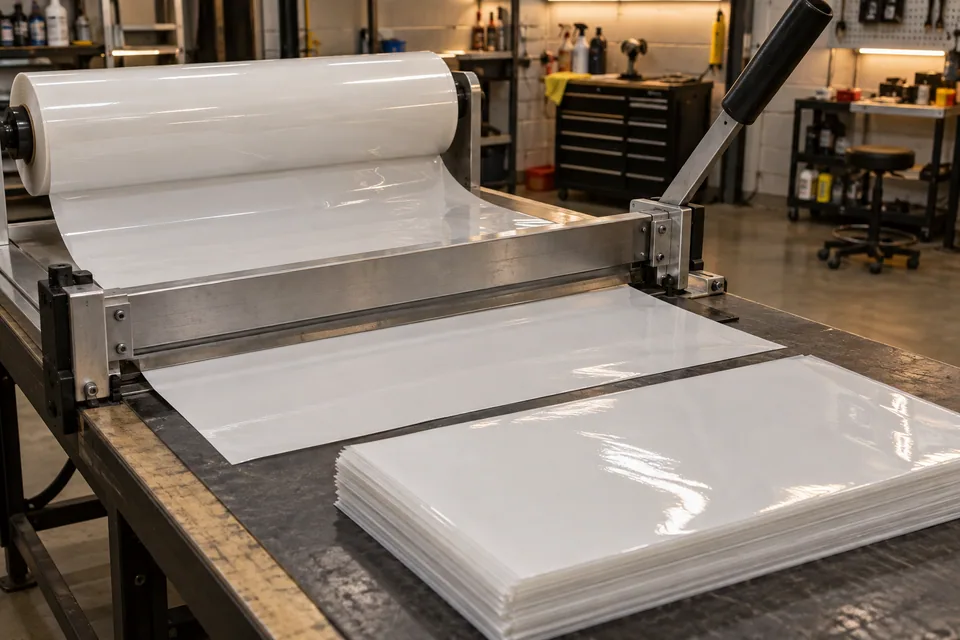
3M supplies automotive paint protection film in rolls and its installation guideline discusses cutting bulk parts, plotter cutting and handling a partially used roll. This supports a transverse cut-off that separates an uninstalled length of film from the parent roll. The cut makes a rectangular bulk blank; it is not the vehicle-specific contour cut and should never be performed against vehicle paint. Clear topcoat, adhesive, liner and any cap sheet must be identified for the exact PPF grade.
Updated
Where This Cutting Application Appears
Plan blank length without losing usable film
Use the installer’s vehicle-panel plan or plotter nest to set length plus the approved handling allowance. Identify whether the source roll has a protective cap sheet. 3M says cap sheets on some grades are removed before plotting, but that does not mean every grade has one. Mark the coating face and adhesive-liner side before separating the piece so the later cut and installation orientation remain clear.
Control the roll at the crosscut
Support the wound roll and guide film onto a clean table without introducing a diagonal pull. A transverse blade should sever topcoat, polyurethane body and any layers meant to travel with the blank, while preserving the release liner until application. Trial at the actual web tension and support condition. Do not use an unsupported on-vehicle cut as a proxy for a bench cutoff.
Inspect the two fresh ends
Check both the removed blank and the remaining roll for stretch marks, lifted liner, adhesive contamination, partial film bridges and edge curl. Measure cut length and squareness after relaxing the film on a flat surface. Protect the loose end on the parent roll; 3M’s handling bulletin specifically addresses securing partial rolls after bulk or plotter cuts.
Send the blank to the next process
Label grade, lot, face and intended panel. If the piece will be plotted, confirm it still fits the nest with margin; if used as a bulk piece, the installer decides the final trim on a safe surface. Final appearance, paint compatibility and installation durability are not established by a straight crosscut.
Check a realistic production sequence
Run several blank lengths from one partial roll rather than approving a single square sample. Photograph the cut ends, examine the liner after each stroke, and compare the last blank with the first for buildup on the knife. Feed one accepted blank through the intended plotter or installation preparation to confirm the handling margin. This exercise does not authorize a blade to touch painted bodywork; it only verifies clean intermediate stock for that later operation.
Define the Required Cut Result
- Separate a clean rectangular PPF length from roll stock.
- Preserve the release liner and exposed clear surface.
- Keep the remainder roll stable and identified.
- Leave vehicle-specific outlining to the installer or plotter.
Problems to Diagnose Before Changing the Knife
Film stretches near one selvage
- Check web guidance and asymmetric pull.
- Compare the liner edge before and after release.
- Review knife support across full width.
Cut blank tunnels after rewinding
- Check how partial roll is secured.
- Look for trapped slack and cap-sheet handling.
- Follow supplier storage instructions.
Protective cap sheet shifts at the end cut
- Check whether the exact grade has a cap sheet.
- Inspect nip and hold-down contact.
- Compare incoming and cut edges.
Knife Forms That May Be Considered
| Possible knife form | When it may be considered | What must be confirmed |
|---|---|---|
| Guided transverse end cutter | For repeatable across-width bench cuts from roll stock. | Confirm every intended layer parts without damaging the liner. |
| Straight-rule cutter | For short-run bulk blanks on a clean support. | Verify cut length and non-stretched film edge. |
Information to Send for Technical Review
You do not need to know the exact blade name. Send the available workpiece, machine, current-knife and cut-result information so the application can be reviewed against a drawing or sample.
- Exact PPF product and cap-sheet/liner construction
- Roll width and blank length schedule
- Clean handling and table requirements
- Cut length, squareness and edge-lift criteria
- Installer or plotter handoff plan
Questions About This Cutting Application
Is this the final shape for a vehicle panel?
No. The crosscut produces a bulk rectangle for subsequent plotting or installation.
Should a cap sheet always be removed?
Only as directed for the specific film and later cutting method.
Can the cut be made on vehicle paint?
This workflow is a bench roll-stock cutoff, not an on-car trim.
Why inspect the parent roll end?
It must remain usable and protected from curl or contamination.
Does a bulk rectangle fit every vehicle panel?
No. The installer still plots or trims to the approved vehicle pattern.
Public references and scope
These public sources provide material, cutting-method or safety context for this guide. Supplier pages describe their own materials or equipment; they do not establish a MEIRENTE blade specification or performance claim. Confirm the actual grade, machine setup and required cut with a drawing or sample.
Related product and service information
- Optical Lens Protection Film Cross-Cutting Blades - optical lens protection film · cross cutting
- Stainless Steel Protection Film Cross-Cutting Blades - stainless steel protection film · cross cutting
- Suppository Strip-Pack Foil Cross Cutting Blades - suppository strip-pack foil · cross cutting
Request a Custom Cutting-Knife Review
Send the workpiece details, machine or holder information, current knife photos or sample, required quantity and examples of the present cut problem. Final dimensions, material, edge geometry and tolerances are confirmed from the approved requirements.