
Blade Application Guides / Application Guide / Spacecraft component manufacturing
Spacecraft Thermal-Control Film Razor Slitting Blades
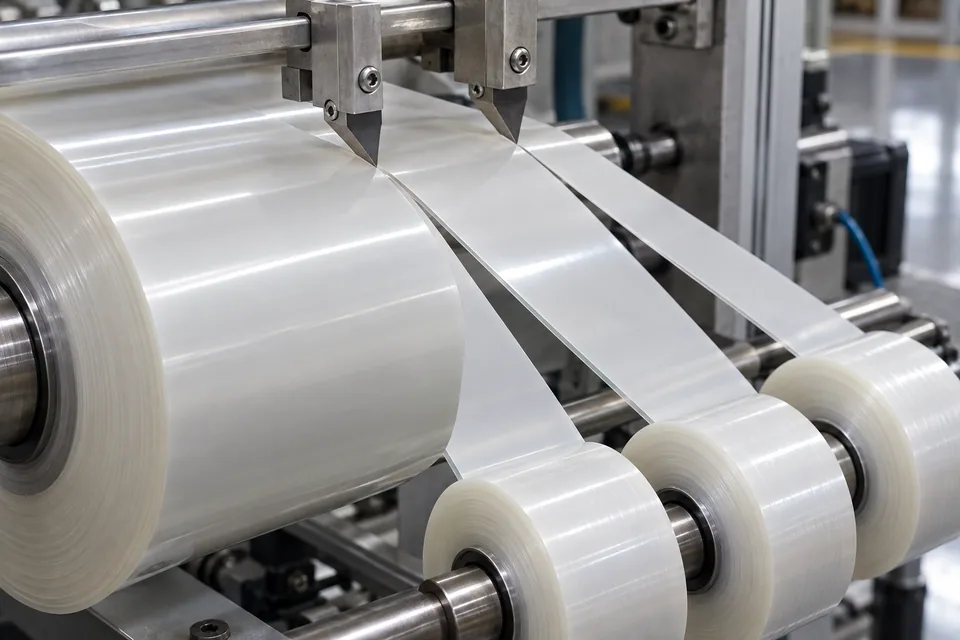
Sheldahl describes spacecraft radiator materials made from metallized FEP and coated aluminized Kapton. Those loose films are distinct from an assembled radiator panel or MLI blanket. DIENES documents a stationary razor entering a moving thin film web, making it one candidate for longitudinal width conversion. This guide is limited to an approved, separate thermal-control film roll before attachment to spacecraft hardware. Its metal or SiOx/ITO face may have optical, electrical or atomic-oxygen-control functions specified by the film maker. The cutter must not assume that a visually clean polymer edge preserves those properties. The spacecraft integrator defines acceptable coating contact, width and subsequent panel qualification.
Updated
Where This Cutting Application Appears
Identify the radiator-facing construction
Record whether the supplied web is metallized FEP, coated polyimide or another approved stack. Mark space-facing and bond-facing sides, plus any sacrificial liner. Plan lane widths from the radiator applique or panel pattern, not from a generic insulation roll.
Compare razor support positions
A fixed blade may run in a grooved support or between guide rolls. On representative stock, observe coating rub at the knife holder, guide and strip separator. Trial only the exposure needed to fully part the film; a bent or dirty edge can drag a longer scratch.
Inspect reflective and cut surfaces
Check width, slit tear, edge curl, metal flakes, pinholes and scratches under agreed lighting. Distinguish damage generated by slitting from incoming deposition marks. Collect outside trim without letting it sweep across a space-facing surface.
Pass reels into thermal-control fabrication
Label face and lot on every finished reel; use clean winding cores and interleaves specified by the material owner. Trial downstream applique cutting and bonding. Optical properties, charging behavior and space-environment durability require the integrator’s qualified tests.
Compare the active and sacrificial bands
Trial a lane whose edge falls within future applique trim and a lane with a retained optical edge. Inspect both under the same light and magnification, then map any score, flake or pinhole into the radiator drawing. A mark on sacrificial material may be acceptable under the buyer’s plan while the same mark on a space-facing region is not. Record contact with the metal side separately from contact with the polymer side; the two faces serve different functions.
Define the Required Cut Result
- Produce a specified thermal-film lane width.
- Preserve coated face and cut-edge integrity.
- Keep generated particles from recontacting a radiator surface.
- Retain film orientation and lot for applique fabrication.
Problems to Diagnose Before Changing the Knife
Bright coating flakes follow the slit
- Check blade and support contact.
- Compare incoming roll surface.
- Inspect waste ribbon and first downstream guide.
FEP edge curls after rewinding
- Review blade drag and web tension.
- Compare left and right lanes.
- Measure after specified recovery.
A scratch repeats along the lane
- Inspect fixed knife holder and guide roll.
- Check trapped debris.
- Compare coated-face orientation.
Knife Forms That May Be Considered
| Possible knife form | When it may be considered | What must be confirmed |
|---|---|---|
| Supported stationary razor | For a film maker-approved thin thermal-control web. | Confirm coating, edge and reel quality on actual stock. |
| Rotary shear trial alternative | If a razor leaves drag marks or unacceptable tearing. | Compare the same grade under matched inspection conditions. |
Information to Send for Technical Review
You do not need to know the exact blade name. Send the available workpiece, machine, current-knife and cut-result information so the application can be reviewed against a drawing or sample.
- Thermal-film maker and exact coated construction
- Space-facing, bond-facing and liner identification
- Released radiator/applique width drawing
- Parent roll dimensions and handling limits
- Permitted knife and guide face contact
- Edge, pinhole, flake and scratch acceptance samples
- Clean winding and packaging requirements
- Optical and environmental qualification owner
Questions About This Cutting Application
Is the cutter slitting a finished radiator panel?
No. This is a loose film web before panel application.
Are all silver-colored thermal films the same?
No. Substrate, deposited metal and overcoat vary by specification.
Can a blade trial prove emissivity?
No. The owner must test the relevant optical properties and completed panel.
Why inspect the waste strip?
It can reveal metal flaking or edge tearing before useful lanes are wound.
What is the first RFQ item?
Send the exact coating stack and width drawing with the face-contact limits.
Public references and scope
These public sources provide material, cutting-method or safety context for this guide. Supplier pages describe their own materials or equipment; they do not establish a MEIRENTE blade specification or performance claim. Confirm the actual grade, machine setup and required cut with a drawing or sample.
Related product and service information
- Spacecraft Thermal-Control Film Shear Slitting Blades - spacecraft thermal-control film · shear slitting
- Multilayer-Insulation Blanket Film Razor Slitting Blades - multilayer-insulation blanket film · razor slitting
- Satellite Solar-Array Cover Film Razor Slitting Blades - satellite solar-array cover film · razor slitting
Request a Custom Cutting-Knife Review
Send the workpiece details, machine or holder information, current knife photos or sample, required quantity and examples of the present cut problem. Final dimensions, material, edge geometry and tolerances are confirmed from the approved requirements.