
Blade Application Guides / Application Guide / Spacecraft component manufacturing
Multilayer-Insulation Blanket Film Razor Slitting Blades
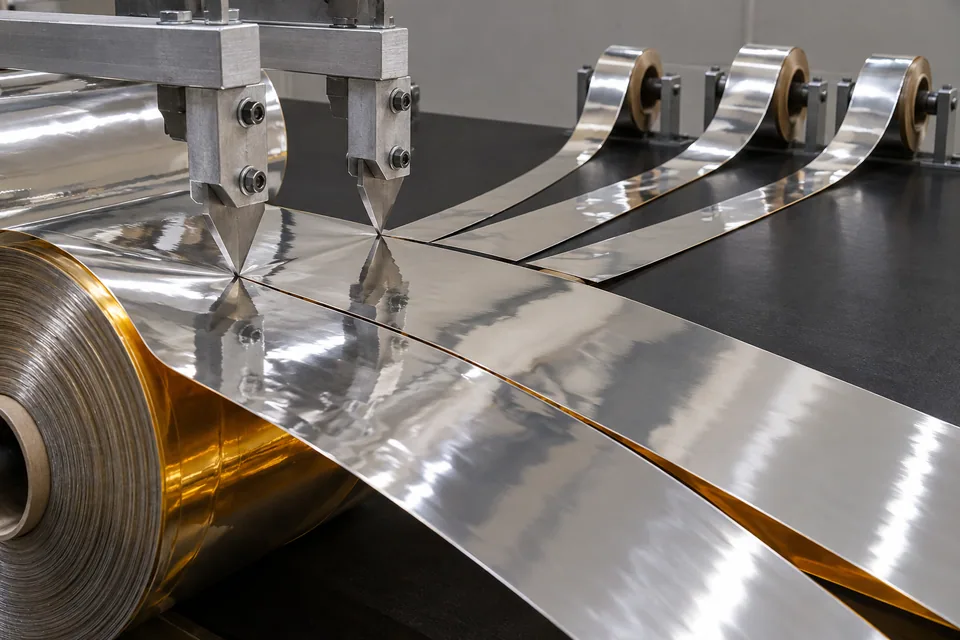
Sheldahl describes metallized PET, polyimide and FEP films used as individual layers of spacecraft multilayer insulation (MLI). NASA documents aluminized Kapton in MLI outer layers. This guide concerns a single approved film web before blanket stacking, spacer addition, seaming or installation. A stationary razor can divide an appropriately supported thin web into narrow lanes, as DIENES explains for film. It is a trial option, not an assertion that every metallized space-grade film tolerates blade contact. The buyer must specify which face is coated, where that coating may touch guides, and how cut rolls will enter its blanket pattern. Visible edge quality cannot establish emissivity, thermal insulation or flight qualification.
Updated
Where This Cutting Application Appears
Map widths to the blanket layer schedule
Use the thermal engineer’s layer drawing to distinguish inner reflector, outer cover and sacrificial trim. Record the coated face and machine direction for each parent roll. A strip that fits one layer cannot automatically substitute for another polymer or metal deposition.
Trial razor entry without scraping the coating
Compare unsupported and grooved-support cutting only where the material owner permits. Observe the film just ahead of the fixed edge for flutter, wrinkling or dragged metal. Keep blades, bushings and guides clean; a small trapped particle can mark a much longer lane.
Inspect edge and face separately
Look for slit-edge tears, metallization flake, pinholes and roll-edge curl on both retained lanes. Compare with an uncut control under consistent lighting. Check whether the narrow waste strip folds back over the reflective face during collection.
Rewind for the blanket maker
Measure width after winding under the buyer’s conditioning method and identify face-out direction. Supply samples for layer stacking and seam trials. The blanket integrator must verify finished thermal and electrical behavior using its mission-specific acceptance plan.
Use a coating-sensitive release coupon
Include a narrow outer-layer lane and a wider inner-reflector lane from the same specified stock. Record blade age, groove choice, web tension, face contact and the point where waste is removed. Photograph both edges immediately, then unwind a short length after the trial reel has rested. A coating scratch introduced by the rewind path can otherwise be mistaken for a razor defect. Ask the blanket engineer to define whether a defect is inside a seam or active thermal area.
Define the Required Cut Result
- Produce specified widths from approved MLI film stock.
- Preserve the reflective or protective surface near each cut.
- Avoid loose metal and film debris entering blanket assembly.
- Retain film grade, face and lot identity through rewinding.
Problems to Diagnose Before Changing the Knife
Metallic specks appear near the slit
- Inspect blade wear and guide contact.
- Compare parent-film surface before cutting.
- Review waste collection direction.
A lane wrinkles ahead of the razor
- Check unsupported span and tension.
- Inspect grooved support position.
- Compare uncut transport at the same line speed.
Finished rolls show edge curl
- Compare both slit sides and film orientation.
- Review winding tension and core condition.
- Measure after the owner’s recovery period.
Knife Forms That May Be Considered
| Possible knife form | When it may be considered | What must be confirmed |
|---|---|---|
| Supported stationary razor | For a single thin film grade that passes a material-owner conversion trial. | Confirm edge tear, coating loss and wound-roll condition. |
| Paired rotary shear alternative | If razor drag damages the approved stock. | Compare the same film lot and face-contact map before changing route. |
Information to Send for Technical Review
You do not need to know the exact blade name. Send the available workpiece, machine, current-knife and cut-result information so the application can be reviewed against a drawing or sample.
- Exact film polymer, metallization and coating face
- MLI layer function and released width drawing
- Parent roll dimensions, lot and winding direction
- Permitted guide and knife contact surfaces
- Approved particle, pinhole and coating-loss criteria
- Slitter, support and trim takeoff drawing
- Sample handling and clean packaging instructions
- Blanket-level thermal and electrical validation owner
Questions About This Cutting Application
Is a finished MLI blanket being slit?
No. The operation divides one separate film web before blanket assembly.
Can every shiny film use a razor?
No. Metallization, polymer and backing require a representative trial.
Why label the coated face?
It determines guide contact and placement in the final multilayer stack.
Does a clean edge prove low heat leak?
No. The blanket maker verifies the built stack and seams.
What begins a useful RFQ?
Provide the exact film grade and its layer-width and face-orientation drawing.
Public references and scope
These public sources provide material, cutting-method or safety context for this guide. Supplier pages describe their own materials or equipment; they do not establish a MEIRENTE blade specification or performance claim. Confirm the actual grade, machine setup and required cut with a drawing or sample.
Related product and service information
- Multilayer-Insulation Blanket Film Shear Slitting Blades - multilayer-insulation blanket film · shear slitting
- Spacecraft Thermal-Control Film Razor Slitting Blades - spacecraft thermal-control film · razor slitting
- Satellite Solar-Array Cover Film Razor Slitting Blades - satellite solar-array cover film · razor slitting
Request a Custom Cutting-Knife Review
Send the workpiece details, machine or holder information, current knife photos or sample, required quantity and examples of the present cut problem. Final dimensions, material, edge geometry and tolerances are confirmed from the approved requirements.