
Blade Application Guides / Application Guide / Spacecraft component manufacturing
Space-Grade Polyimide Adhesive Tape Shear Slitting Blades
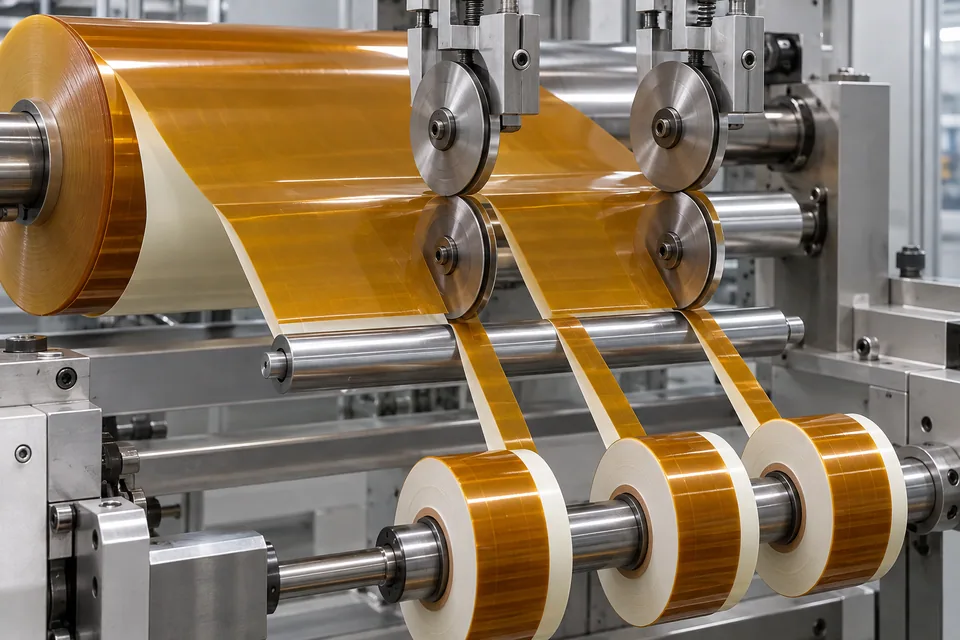
Saint-Gobain documents both a polyimide adhesive tape laminate developed for a deep-space mission and wide polyimide tape logs that can be slit. Dienes identifies rotary shear slitting as suitable for foil, tape and plastic. Together they support a shear-pair trial for a buyer-approved space-use tape, not a blanket endorsement of any standard commercial tape. Shear slitting uses cooperating upper and lower circular knives along the web, distinct from a stationary razor drawn through unsupported film.
Updated
Where This Cutting Application Appears
Map lanes around the tape stack
Define desired widths, edge waste, adhesive face and any release liner before positioning shear holders. Confirm whether the laminate has one or two adhesive sides; a double-coated tape may need a liner on both relevant surfaces during winding. Do not place a new edge through a protected printed or functional zone. Maintain a material identity map from mother roll to each daughter roll.
Set overlap and side load with coupons
Qualify knife overlap, side pressure and web support on the delivered backing/adhesive construction. Too much shear contact can compress adhesive or produce edge dust; too little can leave polyimide tags or a liner bridge. Inspect the lower knife as well as the upper knife because damage can originate at either contact surface. A different polyimide grade or adhesive may require a new setup.
Measure roll quality after winding
Inspect retained edges for film chips, adhesive squeeze-out, liner offset and loose particles. Measure width along the lane and look at roll faces for telescoping and blocking. A sharp-looking web edge before winding may smear when adhesive is pressed into the core; therefore examine an unwound sample from the finished daughter roll.
Close the materials review
Record blade pair, parent lot, core type and packaging. Submit sample rolls for the spacecraft owner’s bonding and contamination evaluation. The custom-mission case establishes that such materials can be designed for space, but the conversion process must not claim mission heritage or outgassing compliance for the supplied tape unless documented.
Compare shear trials fairly
Run a short shear trial against the same parent roll used for any razor comparison. Match lane width, winding direction and inspection method, then compare lower-film tags, adhesive bead, loose fragments and roll-face stability. The selected route should pass the buyer’s measured criteria across early and late samples. If edge appearance improves only by squeezing the adhesive into the liner, it is not a valid improvement for a flight-controlled tape.
Define the Required Cut Result
- Create narrow daughter rolls with controlled shear edges.
- Avoid adhesive squeeze-out and polyimide tags.
- Keep liner registration and width stable after rewind.
- Retain program-specific material identity.
Problems to Diagnose Before Changing the Knife
Film tags remain at one edge
- Review knife overlap and side pressure.
- Inspect upper and lower edges for damage.
- Compare support at web entry.
Adhesive blocks on finished roll
- Check squeeze-out after winding.
- Review approved winding tension.
- Inspect liner coverage at the edge.
Loose particles collect at the lower knife
- Inspect both rotary edges and nearby guides.
- Check adhesive squeeze-out.
- Compare a clean-start and late-run sample.
Knife Forms That May Be Considered
| Possible knife form | When it may be considered | What must be confirmed |
|---|---|---|
| Rotary shear pair | For grade-specific trials on running tape web. | Qualify edge debris, adhesive pressure and lane width. |
| Razor comparison coupon | To benchmark the shear edge when the web is thin. | Select from measured defects, not assumed superiority. |
Information to Send for Technical Review
You do not need to know the exact blade name. Send the available workpiece, machine, current-knife and cut-result information so the application can be reviewed against a drawing or sample.
- Tape grade and flight material requirement
- Backing, adhesive and liner architecture
- Lane map and acceptable edge waste
- Shear setup and rewind conditions
- Particle, smear and width acceptance
Questions About This Cutting Application
Why use two circular knives?
Shear slitting parts the web between cooperating upper and lower edges.
Is this identical to razor slitting?
No. Blade interaction, compression and debris behavior differ.
Can a mission case qualify this exact tape?
No. The customer must verify its specified grade and converted roll.
When should an unwound sample be checked?
After rewind, because pressure can reveal adhesive defects hidden on the open web.
Can the shear pair be set by thickness alone?
No. Backing, adhesive, liner and line support must be trialed together.
Public references and scope
These public sources provide material, cutting-method or safety context for this guide. Supplier pages describe their own materials or equipment; they do not establish a MEIRENTE blade specification or performance claim. Confirm the actual grade, machine setup and required cut with a drawing or sample.
Related product and service information
- Spacecraft Thermal-Control Film Precision Cross-Cutting Blades - spacecraft thermal-control film · precision cross cutting
- Multilayer-Insulation Blanket Film Shear Slitting Blades - multilayer-insulation blanket film · shear slitting
- Satellite Solar-Array Cover Film Shear Slitting Blades - satellite solar-array cover film · shear slitting
Request a Custom Cutting-Knife Review
Send the workpiece details, machine or holder information, current knife photos or sample, required quantity and examples of the present cut problem. Final dimensions, material, edge geometry and tolerances are confirmed from the approved requirements.