
Blade Application Guides / Application Guide / Spacecraft component manufacturing
Space-Grade Polyimide Adhesive Tape Precision Cross-Cutting Blades
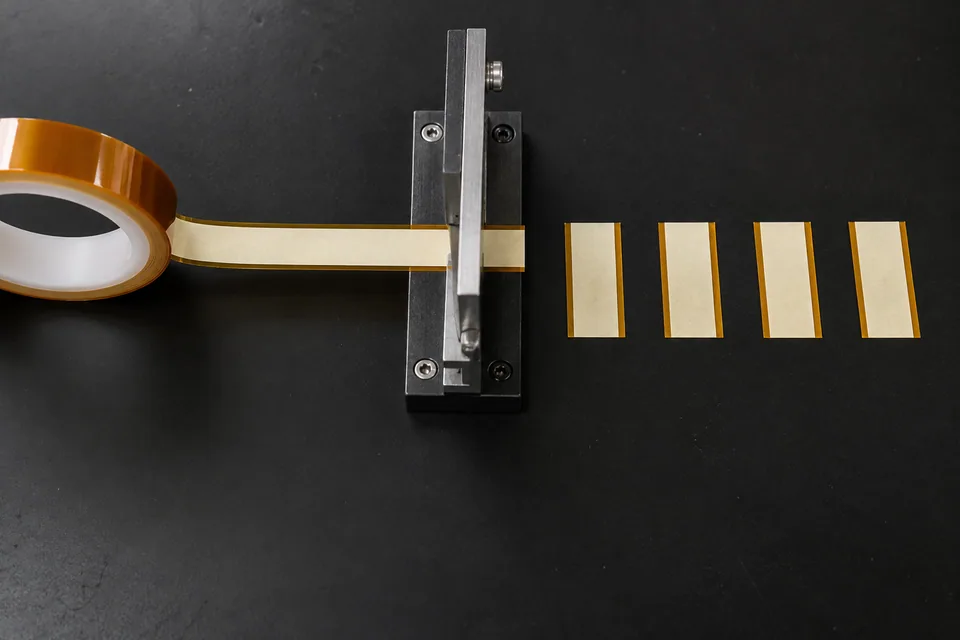
Saint-Gobain shows that polyimide adhesive tape can be made in wide slit rolls and has described a custom tape laminate for a deep-space mission. That supports roll-to-length conversion of an approved tape grade. Precision cross cutting here is a straight cut across the narrow tape feed to produce specified lengths or pads; it does not divide the roll longitudinally like razor or shear slitting. The word space-grade refers only to the buyer’s qualified material, not to all polyimide tape.
Updated
Where This Cutting Application Appears
Define length and functional end zones
Take finished length, datum and any overlap or wrap allowance from the released assembly drawing. Note whether pieces remain on a liner, are wound on a temporary carrier or are transferred as individual lengths. If a printed marking or pre-slit edge guides orientation, preserve it. Crosscut pitch should avoid placing a damaged end in a critical bond region.
Feed without distorting the adhesive stack
Support the tape before and after the cutoff so its tack does not pull the short piece out of alignment. Trial the actual silicone or acrylic adhesive and any release liner. A rigid stop against exposed adhesive can cause pickup; a loose unsupported span can create a slanted cut. If liner is intended to remain with the part, specify whether it is fully severed or only pre-scored.
Inspect both ends and piece length
Measure after the strip lies flat, using the buyer’s conditioning method. Examine polyimide film, adhesive and liner for tags, smear, roll-back or nicks. Check the upstream roll end as well as the separated piece. Repeated short lengths can reveal knife buildup even when the first sample is clean, so include an extended trial run.
Pack for controlled assembly
Separate finished lengths without contaminating adhesive, label lot and orientation, and preserve any required material history. The spacecraft program must evaluate bond, outgassing and environmental performance after placement. Cut-length precision is only one part of its acceptance decision.
Define a stable inspection sample
Cut a sequence of short and long pieces if the drawing uses both sizes, retaining their order from the roll. Compare dimensions and adhesive condition after each piece is placed on the specified carrier. Inspect the cutter contact surface at a predetermined interval and record any residue. The roll-tail piece also needs assessment, because a poorly supported final segment may receive a slanted end even when central pieces remain accurate. Compare release-liner position on every size so one skewed segment does not reach downstream placement.
Define the Required Cut Result
- Produce repeatable cut lengths from approved tape rolls.
- Keep film and adhesive ends clean.
- Control liner severance as specified.
- Protect material identity and adhesive surface.
Problems to Diagnose Before Changing the Knife
Short piece sticks to the end cutter
- Review adhesive contact surfaces.
- Check blade cleaning interval.
- Use an approved temporary carrier if needed.
Length drifts during repeated cuts
- Check feed calibration and end-stop contact.
- Measure after relaxation.
- Compare early and late trial pieces.
Roll tail receives a slanted end
- Support the final short feed length.
- Check end-stop position.
- Measure last-piece squareness.
Knife Forms That May Be Considered
| Possible knife form | When it may be considered | What must be confirmed |
|---|---|---|
| Guided transverse cutter | For repetitive straight tape lengths. | Confirm full-stack severance and clean adhesive ends. |
| Die cutoff station | For short repeated parts on a controlled carrier. | Verify length and release without lifting the film. |
Information to Send for Technical Review
You do not need to know the exact blade name. Send the available workpiece, machine, current-knife and cut-result information so the application can be reviewed against a drawing or sample.
- Qualified tape grade and adhesive chemistry
- Roll width, required cut length and end tolerance
- Liner or transfer carrier instructions
- End-edge and contamination criteria
- Lot labeling and flight material release process
Questions About This Cutting Application
Is cross cutting the same as slitting?
No. It cuts across tape feed to set length rather than along the web to set width.
Should the release liner always be cut?
Only according to the buyer’s part delivery requirement.
Why examine late-run samples?
Adhesive buildup can change the edge after several cuts.
Does length accuracy approve spacecraft use?
No. Material and assembled-bond qualification remain separate.
Is every short piece delivered without liner?
No. The buyer specifies whether liner travels with each part.
Public references and scope
These public sources provide material, cutting-method or safety context for this guide. Supplier pages describe their own materials or equipment; they do not establish a MEIRENTE blade specification or performance claim. Confirm the actual grade, machine setup and required cut with a drawing or sample.
Related product and service information
- Space-Grade Polyimide Adhesive Tape Razor Slitting Blades - space-grade polyimide adhesive tape · razor slitting
- Multilayer-Insulation Blanket Film Precision Cross-Cutting Blades - multilayer-insulation blanket film · precision cross cutting
- Spacecraft Thermal-Control Film Precision Cross-Cutting Blades - spacecraft thermal-control film · precision cross cutting
Request a Custom Cutting-Knife Review
Send the workpiece details, machine or holder information, current knife photos or sample, required quantity and examples of the present cut problem. Final dimensions, material, edge geometry and tolerances are confirmed from the approved requirements.