
Blade Application Guides / Application Guide / Spacecraft component manufacturing
Multilayer-Insulation Blanket Film Precision Cross-Cutting Blades
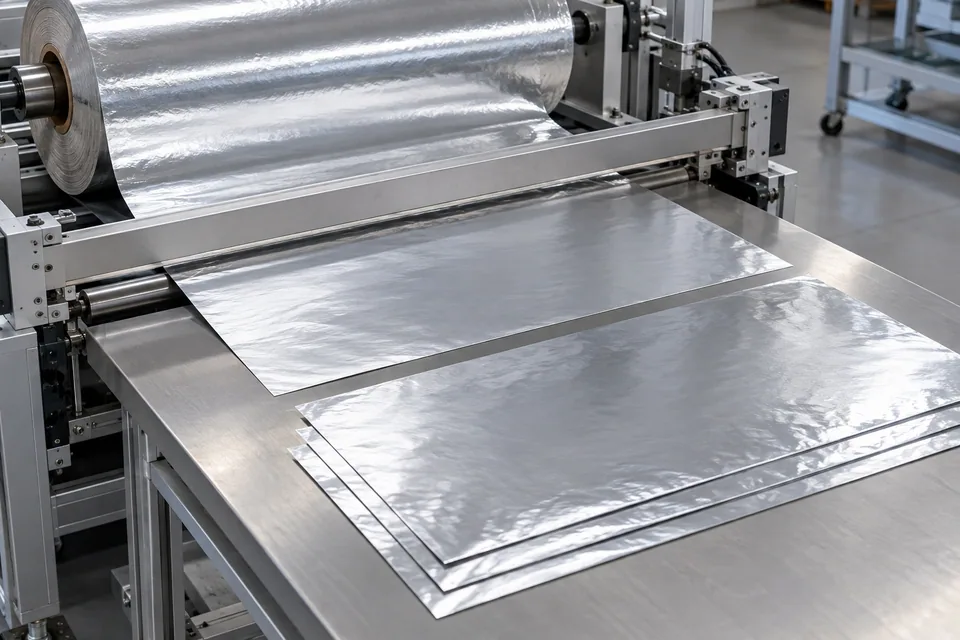
Spacecraft multilayer-insulation blankets are assembled from several individual thin films and other components. Sheldahl documents metallized PET, polyimide and FEP blanket materials; Web Industries describes multilayer blanket cutting and assembly. This article concerns a single loose film web cut across its travel direction into flat layer blanks before that assembly. Rosenthal documents equipment that cross-cuts flexible film rolls, but no machine setting is presumed suitable for a flight material. “Precision” here refers to the buyer’s released length, squareness, layer identity and handling criteria, not a promised tolerance. The blanket integrator still controls hole patterns, seam construction and thermal qualification.
Updated
Where This Cutting Application Appears
Issue a layer-by-layer cut ticket
Translate the blanket pattern into film grade, blank length, overlap allowance and orientation. Outer cover and inner reflectors may differ in polymer or coating. Label each blank away from its active surface so similar-looking silver sheets are not interchanged.
Support the transverse knife path
Set a low-contact web path and controlled feed for the actual thin film. Observe whether the blade or hold-down traps a wrinkle or rubs the deposited metal. Trial cut initiation and exit separately because a thin edge can tear at either end.
Measure after release and stacking
Check length, squareness, coating scratches, pinholes and static-held fragments on both faces. Inspect a stack of several blanks to reveal length drift or curling that a single flat sample hides. Use the buyer’s conditioning and datum convention.
Deliver clean blanks to blanket build
Separate sheets with approved interleaves and lot labels. A sample should pass the integrator’s spacer placement, perforation, seam or fastening sequence without unintended film strain. Only the completed blanket can be evaluated for thermal behavior.
Prove layer identity during kitting
Crosscut two visually similar qualified films according to different layer tickets, then ask the blanket kit operator to identify grade, coated face and intended stack position from the delivered labels alone. If the result is ambiguous, change marking or packaging before production. Maintain separate cut records for each parent lot. Compare a representative stack after handoff for curl and relative length so a mixed layer is not discovered only when the seam or fastener is fitted.
Define the Required Cut Result
- Meet the released MLI layer lengths without confusing materials.
- Avoid coating damage at blade entry and hold-down.
- Control stack registration and flatness.
- Keep particulate and handling history visible to the integrator.
Problems to Diagnose Before Changing the Knife
One end of a blank tears diagonally
- Inspect blade support and travel.
- Check film tension at stop.
- Compare entry and exit edges.
Lengths drift through a batch
- Review feed calibration and web slip.
- Check thermal or tension conditioning.
- Compare first, middle and last pieces.
Silver surface has contact lines
- Locate guide, hold-down or stacking touchpoint.
- Compare the uncut roll.
- Check interleaf cleanliness.
Knife Forms That May Be Considered
| Possible knife form | When it may be considered | What must be confirmed |
|---|---|---|
| Supported cross-cut shear blade | When a qualified film web can be stopped or synchronized for transverse cutting. | Confirm complete cut, square edge and no metallization rub. |
| Flat-sheet straight cutter | For short controlled lots of already unwound single-layer film. | Confirm same dimension and coating criteria as the roll route. |
Information to Send for Technical Review
You do not need to know the exact blade name. Send the available workpiece, machine, current-knife and cut-result information so the application can be reviewed against a drawing or sample.
- MLI film grade and exact layer role
- Blank length, orientation and overlap drawing
- Parent roll width, coating face and lot
- Cross-cutter and hold-down details
- Allowed coating marks, pinholes and particles
- Measurement state and layer stacking datum
- Clean interleaf and labeling method
- Blanket integrator thermal and seam acceptance
Questions About This Cutting Application
Are several MLI layers cut at once?
This guide evaluates a single loose film layer; a multi-layer stack needs a separate validated setup.
Does precision imply a stated micron tolerance?
No. The customer drawing supplies the actual dimensional limits.
Why track each layer’s identity?
Different films may have distinct roles even if they look alike.
Does a square blank prove insulation performance?
No. Assembly, seams and spacing determine blanket behavior.
What first article is useful?
A labeled blank with dimension, edge and coating records from the actual roll.
Public references and scope
These public sources provide material, cutting-method or safety context for this guide. Supplier pages describe their own materials or equipment; they do not establish a MEIRENTE blade specification or performance claim. Confirm the actual grade, machine setup and required cut with a drawing or sample.
Related product and service information
- Multilayer-Insulation Blanket Film Razor Slitting Blades - multilayer-insulation blanket film · razor slitting
- Spacecraft Thermal-Control Film Precision Cross-Cutting Blades - spacecraft thermal-control film · precision cross cutting
- Satellite Solar-Array Cover Film Precision Cross-Cutting Blades - satellite solar-array cover film · precision cross cutting
Request a Custom Cutting-Knife Review
Send the workpiece details, machine or holder information, current knife photos or sample, required quantity and examples of the present cut problem. Final dimensions, material, edge geometry and tolerances are confirmed from the approved requirements.