
Blade Application Guides / Application Guide / Paper converting
Silicone Release Paper Cross Cutting: Flat Sheets Without Edge Damage
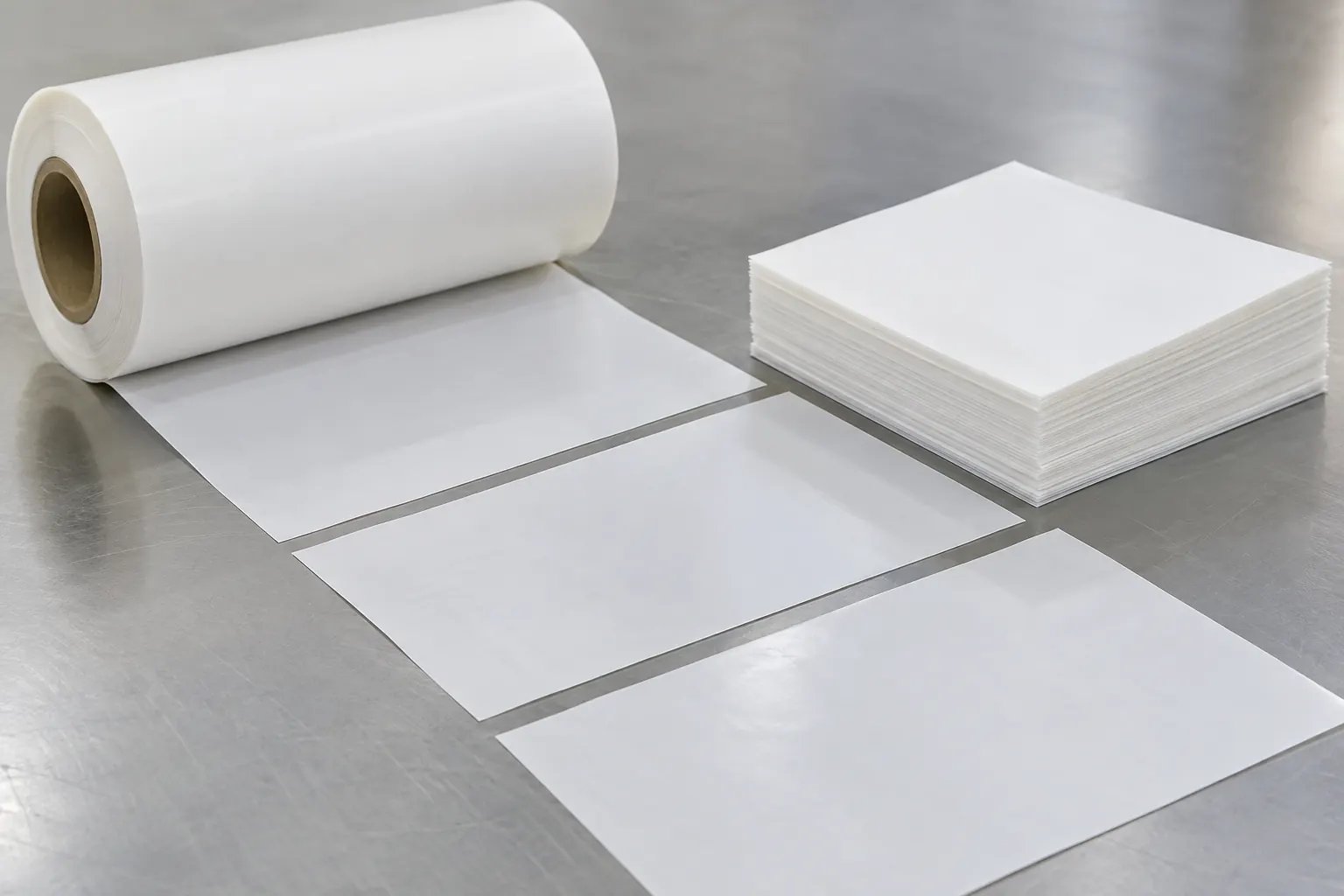
Cross cutting silicone release paper must separate a moving web without dragging the low-friction coating, buckling the sheet or creating fibers that contaminate adhesive processes. Sheet length, squareness and stack behavior should be evaluated together with the base paper, coating orientation and actual cutoff motion.
Updated
Where This Cutting Application Appears
Adhesive-product release sheets
Rolls are cut into sheets used behind labels, pads, gaskets or adhesive components, where surface cleanliness and sheet dimensions matter.
Composite layup release layers
Siliconized sheets are prepared as process separators for laminates and composites, requiring intact coating and manageable flatness.
Converted packaging components
Release paper is sheeted before printing, die cutting or lamination, so burrs and curl can disrupt registration and feeding.
Transverse Cross Cutting process boundary
Transverse cross cutting separates material across the web into sheets or repeated lengths; it is distinct from longitudinal roll slitting.
Transverse Cross Cutting setup checkpoint
Confirm repeat length, registration reference, web speed, cut timing, support across the width and sheet transfer immediately after separation.
Transverse Cross Cutting acceptance checkpoint
Measure repeat length and squareness, then inspect leading and trailing edges, registration error, sheet curl and stacking consistency.
Define the Required Cut Result
- Produce square sheets at the specified repeat length
- Prevent coating scuffing and surface contamination
- Reduce loose fibers at leading and trailing edges
- Deliver flat sheets that separate and stack consistently
Problems to Diagnose Before Changing the Knife
Dragged or torn cutoff edge
Review web support, cutoff synchronization, blade-to-counterface relationship, paper strength, coating side and whether tearing begins at a specific sheet position.
Length or squareness variation
Check feed-roll slip, encoder measurement, web guiding, cutoff timing, cross-web tension and the inspection datum used for finished sheets.
Coating scuff near the edge
Compare coated-side orientation, contact surfaces, debris, clamping or hold-down method and stack handling after cutoff.
Curling or poor stack registration
Review moisture balance, coating asymmetry, roll set, web tension, static charge, delivery airflow and stack height before treating it as a cutting-only defect.
Knife Forms That May Be Considered
| Possible knife form | When it may be considered | What must be confirmed |
|---|---|---|
| Straight cutoff knife | Consider when the sheeter uses a linear or coordinated straight-edge cutoff motion. | Confirm length, thickness, hole pattern, bevel, motion, counterface and mounting datum from the machine record or approved drawing. |
| Rotary cutoff knife | Consider where synchronized rotating cylinders perform the transverse separation. | Confirm cylinder interface, cutting diameter, helix or edge geometry, timing and current-part sample before selection. |
Information to Send for Technical Review
You do not need to know the exact blade name. Send the available workpiece, machine, current-knife and cut-result information so the application can be reviewed against a drawing or sample.
- Paper basis weight, caliper, moisture and grain direction
- Silicone system, coated side and release-surface condition
- Web width, sheet length, squareness and tolerance requirements
- Line speed, cutoff frequency and acceleration profile
- Web tension, feed method, hold-down and delivery arrangement
- Existing cutoff motion, counterface and mounting information
- Accepted and rejected edge, curl and stack samples
- Downstream process, cleanliness limit and inspection plan
Questions About This Cutting Application
Why does the cutoff edge tear only on one side?
One-sided tearing can follow web skew, uneven support, coating orientation, local paper-strength variation or nonuniform contact. Compare both sides with feed and timing records.
Is sheet curl always caused by cutting?
No. Roll set, moisture imbalance, one-sided coating, tension release, static and delivery handling can all create curl even when the edge is acceptable.
Which dimensions define cross-cut quality?
Specify sheet length, diagonal or squareness tolerance, edge-tear limit, flatness, coating acceptance and stack registration using a documented sampling method.
Can the knife form be chosen from paper thickness?
Paper thickness alone is insufficient. The installed cutoff motion, support, mounting interface, speed and approved finished-edge sample are also required.
What evidence helps diagnose coating scuff?
Provide close photographs of both surfaces and edges, mark web direction and coated side, and record all contact points from unwind through sheet delivery.
Related product and service information
- Water-Based Coated Poster Paper Cross Cutting: Clean Display Sheets - water-based coated poster paper · transverse cross cutting
- Glassine Liner Paper Cross Cutting: Accurate, Flat Release Sheets - glassine liner paper · transverse cross cutting
- Clay-Coated Label Paper Cross Cutting: Clean Printed Sheets - clay-coated label paper · transverse cross cutting
Request a Custom Cutting-Knife Review
Send the workpiece details, machine or holder information, current knife photos or sample, required quantity and examples of the present cut problem. Final dimensions, material, edge geometry and tolerances are confirmed from the approved requirements.