
Blade Application Guides / Application Guide / Paper converting
Clay-Coated Label Paper Cross Cutting: Clean Printed Sheets
Cross cutting clay-coated label paper must control a brittle mineral surface while preserving print, varnish and sheet geometry. The cutoff review should distinguish coating fracture from base-paper tearing and connect sheet defects with feed accuracy, support, static and delivery handling.
Updated
Where This Cutting Application Appears
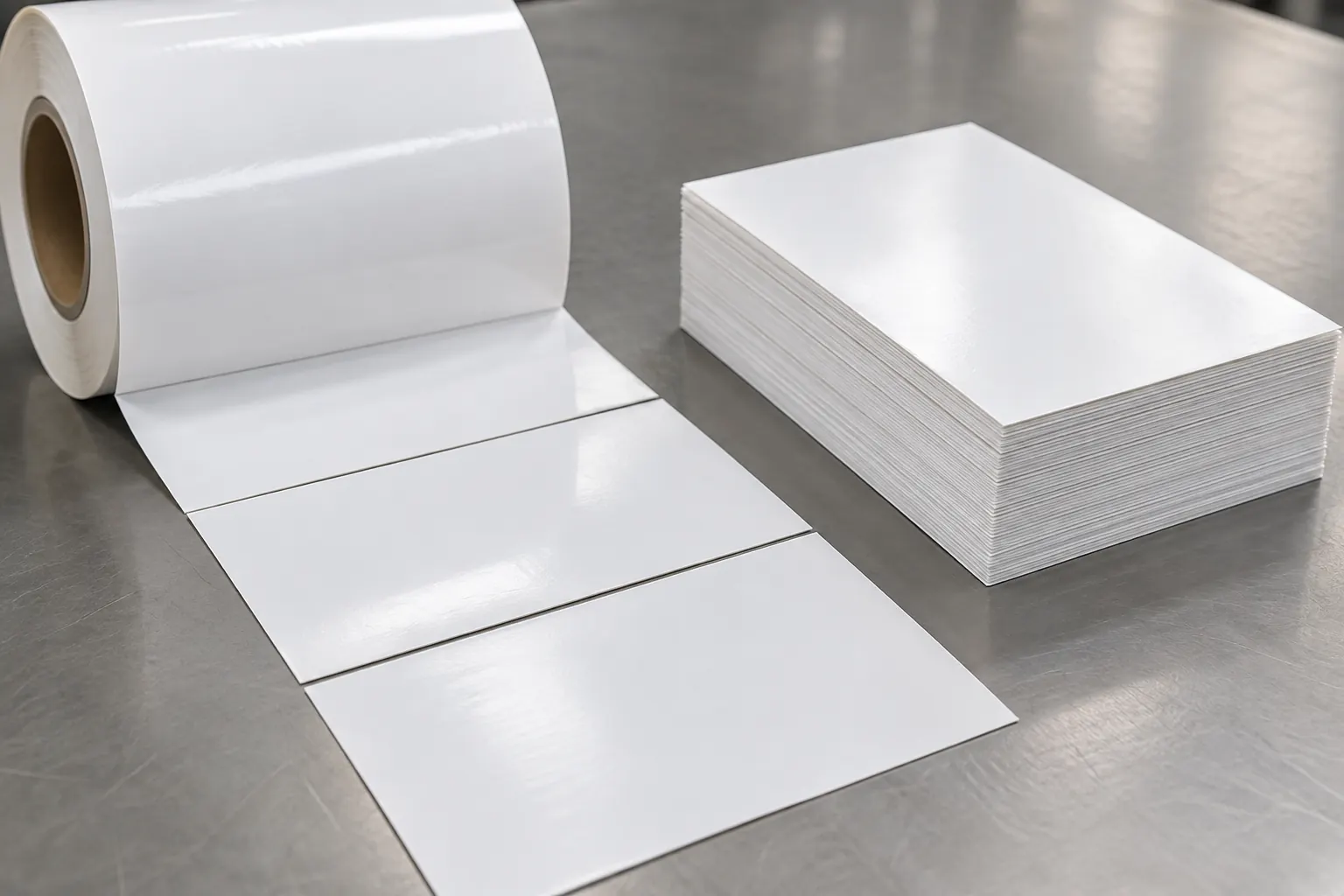
Sheet-fed label production
Printed or unprinted coated rolls are converted to sheets for punching, embossing or adhesive application.
Wet-glue label blanks
Rectangular stacks are prepared before final profile cutting, with squareness and coating integrity supporting accurate feeding.
Printed paper component conversion
Coated graphics and packaging components are sheeted while preserving registration margins and surface finish.
Transverse Cross Cutting process boundary
Transverse cross cutting separates material across the web into sheets or repeated lengths; it is distinct from longitudinal roll slitting.
Transverse Cross Cutting setup checkpoint
Confirm repeat length, registration reference, web speed, cut timing, support across the width and sheet transfer immediately after separation.
Transverse Cross Cutting acceptance checkpoint
Measure repeat length and squareness, then inspect leading and trailing edges, registration error, sheet curl and stacking consistency.
Define the Required Cut Result
- Prevent coating flakes along transverse edges
- Hold sheet length, width and squareness
- Avoid scratches, ink transfer and corner damage
- Deliver flat, aligned stacks for the next process
Problems to Diagnose Before Changing the Knife
Coating fractures at the leading edge
Review coating surface strength, sheet support, cutoff direction, contact progression, web tension and whether fracture is worse across or with grain.
Printed sheets show scuff lines
Trace guides, hold-downs, conveyor surfaces, loose mineral particles, delivery speed and stack sliding after cutoff.
Cut length changes after a roll splice
Check splice thickness, feed-roll traction, encoder response, tension recovery and cutoff synchronization before and after the splice.
Corners curl or chip in the stack
Evaluate paper moisture, grain, coating balance, static, impact at delivery and packing pressure in addition to edge condition.
Knife Forms That May Be Considered
| Possible knife form | When it may be considered | What must be confirmed |
|---|---|---|
| Straight cutoff knife | Consider for sheeters using a straight-edge transverse cutting motion. | Confirm overall dimensions, mounting, bevel, motion, counterface and tolerances from the machine drawing or existing part. |
| Rotary cutoff knife | Consider where printed coated paper is cut by synchronized rotary cylinders. | Confirm cylinder geometry, cutting diameter, timing, interface, print registration and support from verified line data. |
Information to Send for Technical Review
You do not need to know the exact blade name. Send the available workpiece, machine, current-knife and cut-result information so the application can be reviewed against a drawing or sample.
- Paper furnish, basis weight, caliper, grain and moisture
- Coating weight, print process, ink, varnish and cure status
- Web width, sheet length, squareness and edge-chip tolerance
- Speed, cutoff frequency, feed control and splice construction
- Web support, static control, delivery and stack handling
- Current cutoff form, counterface, mounting and dimensional record
- Accepted sheets and examples of flaking, scuffing or curl
- Downstream blanking process and inspection sampling plan
Questions About This Cutting Application
Why does coating flake at only one sheet edge?
Cut progression, grain direction, support asymmetry, coating variation or web skew can make entry and exit edges behave differently. Mark orientation on samples.
Can surface scratches come from loose coating dust?
Yes. Mineral particles trapped under sheets or on transport surfaces can abrade the print. Inspect contact points and clean samples before changing geometry.
How should printed-sheet squareness be checked?
Measure against a defined paper or print datum, including diagonals where appropriate, over multiple sheets and operating speeds.
Can an unprinted sample represent the final job?
It helps assess the base paper and coating, but print, varnish, cure, registration and surface friction can change production behavior.
What determines the final cutoff specification?
Verified machine interface, motion, counterface, material construction, speed, tolerances and accepted samples determine it; the paper name alone does not.
Related product and service information
- Glassine Liner Paper Cross Cutting: Accurate, Flat Release Sheets - glassine liner paper · transverse cross cutting
- Silicone Release Paper Cross Cutting: Flat Sheets Without Edge Damage - silicone release paper · transverse cross cutting
- Water-Based Coated Poster Paper Cross Cutting: Clean Display Sheets - water-based coated poster paper · transverse cross cutting
Request a Custom Cutting-Knife Review
Send the workpiece details, machine or holder information, current knife photos or sample, required quantity and examples of the present cut problem. Final dimensions, material, edge geometry and tolerances are confirmed from the approved requirements.