
Blade Application Guides / Application Guide / Protective textile converting
Silicone-Coated Glass Fabric Cross-Cutting Blades
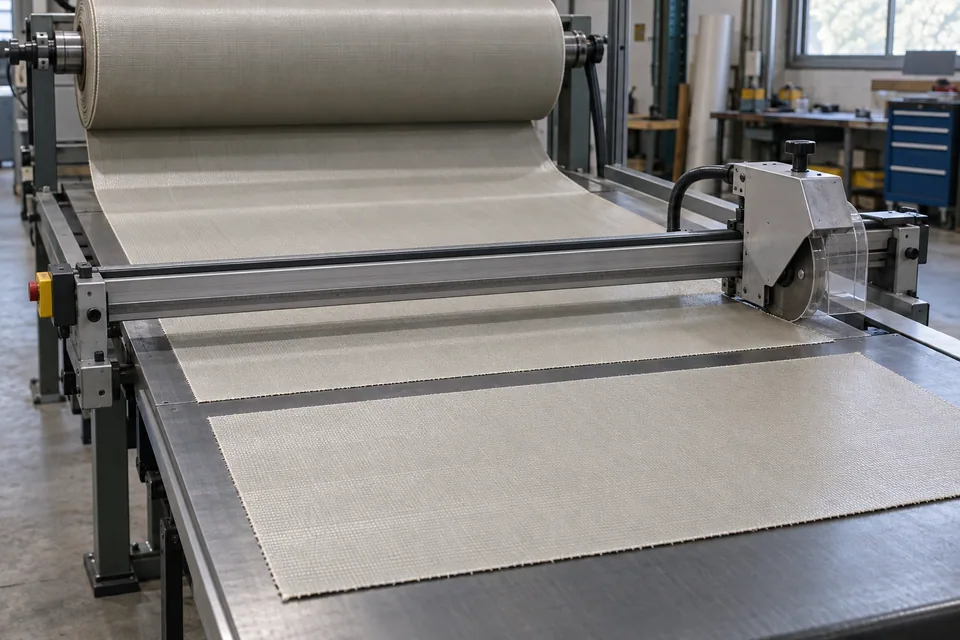
Auburn Manufacturing lists silicone-rubber-coated fiberglass cloth in roll put-ups, and Eastman identifies silicone-coated fiberglass among materials handled by industrial cutting systems. Eastman also describes an end cutter that advances roll fabric to a set length and moves a round knife across its width. These manufacturer statements support a transverse roll-to-sheet cutting trial. This page covers a straight cross-web cut that separates rectangular blanks for later fabrication, not longitudinal roll slitting or the final contour of an expansion joint or protective cover. Actual coating side, glass weave, thickness and required downstream seam allowance must be known before choosing a tool.
Updated
Where This Cutting Application Appears
Set the sheet length and fabric direction
Use the buyer’s blank schedule to determine cut length across the incoming full width. Mark the warp direction and which face carries silicone if the grade is coated on one side. Confirm whether the blank will later be sewn, sealed, laminated or contour cut; each use can have a different minimum sound edge and seam allowance. Record incoming roll width, any selvage and the permitted length tolerance from the drawing.
Feed the coated web without distortion
Support the roll and draw a measured length onto a flat bed. Avoid uneven side pull that skews woven glass yarns or stretches a soft coating. Check whether the coating sticks to support surfaces or neighboring plies under the actual handling conditions. A cross cutter can travel across the web while the material is stationary, but blade form and hold-down must be proven on the supplied construction rather than inferred from an equipment catalogue.
Trial the complete transverse stroke
Cut a representative length across both coated and uncoated surfaces if the production stack changes orientation. Inspect entry, middle and exit regions: the tool may start cleanly yet drag glass filaments or smear silicone as it leaves the edge. Compare a single ply with any proposed low-ply stack because trapped fibers can bridge on lower layers. Track blade buildup and edge quality over repeated strokes.
Inspect the blank after release
Measure length on both side edges and verify the crosscut is square to the roll axis. Examine both cut faces for exposed glass yarns, filament tails, coating peel-back, ragged silicone lips and unintended tension marks. Inspect the waste strip and cutting bed for loose fiberglass. A coating that visually closes over a cut can mask unsevered reinforcement; gently separate the blank without tearing the edge.
Hand off to the actual fabrication step
Identify material grade, lot, face orientation and blank dimensions before stacking. Use a protective interleaf only if compatible with the ordered coating and buyer’s procedure. Run a first article through the later contour, joining or sewing step to verify that the transverse edge remains sound. Final heat-shield or expansion-joint performance depends on the complete design and assembly, not on the blank cut alone.
Define the Required Cut Result
- Produce square, traceable full-width blanks from coated-glass roll goods.
- Sever glass yarn and silicone coating through the whole width.
- Prevent coating pull, filament tails and skewed weave.
- Keep face orientation and later seam allowance identifiable.
Problems to Diagnose Before Changing the Knife
Silicone drags at the cut exit
- Review blade condition and backing support.
- Compare entry and exit faces.
- Check coating buildup during repeated strokes.
Glass yarns bridge under a neat coating edge
- Inspect both faces and the waste.
- Trial actual ply count.
- Confirm full severance before lifting.
Knife Forms That May Be Considered
| Possible knife form | When it may be considered | What must be confirmed |
|---|---|---|
| Guided cross-web round knife | For roll-to-sheet end cutting after a grade-specific coupon trial. | Check full-width squareness, glass tails and coating smear. |
| Supported straight transverse blade | For a stationary web where the coating and weave permit it. | Confirm complete cut without silicone displacement. |
Information to Send for Technical Review
You do not need to know the exact blade name. Send the available workpiece, machine, current-knife and cut-result information so the application can be reviewed against a drawing or sample.
- Actual silicone-coated glass grade, weave and coating side
- Roll width, thickness and delivered put-up
- Blank length, squareness and later seam allowance
- Single-ply or low-ply cutting plan
- Coating-peel, glass-tail and cleanliness acceptance
Questions About This Cutting Application
Is transverse cutting the same as roll slitting?
No. A transverse cut crosses the web to create separate full-width blanks; slitting runs along the roll.
Can a generic textile blade be specified from the material name?
No. Coating, weave, thickness and ply count require a material trial.
Why inspect the back of the cut?
The coating can hide glass yarn bridges or pull on the lower face.
Does a square blank qualify a heat shield?
No. The finished assembly needs its own material and performance verification.
Public references and scope
These public sources provide material, cutting-method or safety context for this guide. Supplier pages describe their own materials or equipment; they do not establish a MEIRENTE blade specification or performance claim. Confirm the actual grade, machine setup and required cut with a drawing or sample.
Related product and service information
- EVOH Barrier Film Laminate Rotary Die Cutting Blades: Layer and Barrier Integrity - EVOH barrier film laminate · rotary die cutting
- Para-Aramid Prepreg Fabric Cross-Cutting Blades - para-aramid prepreg fabric · transverse cutting
- Ballistic UHMWPE Fabric Cross-Cutting Blades - ballistic UHMWPE fabric · transverse cutting
Request a Custom Cutting-Knife Review
Send the workpiece details, machine or holder information, current knife photos or sample, required quantity and examples of the present cut problem. Final dimensions, material, edge geometry and tolerances are confirmed from the approved requirements.