
Blade Application Guides / Application Guide / conveyor belt fabrication
Trimming Rubber Conveyor Belt Edges
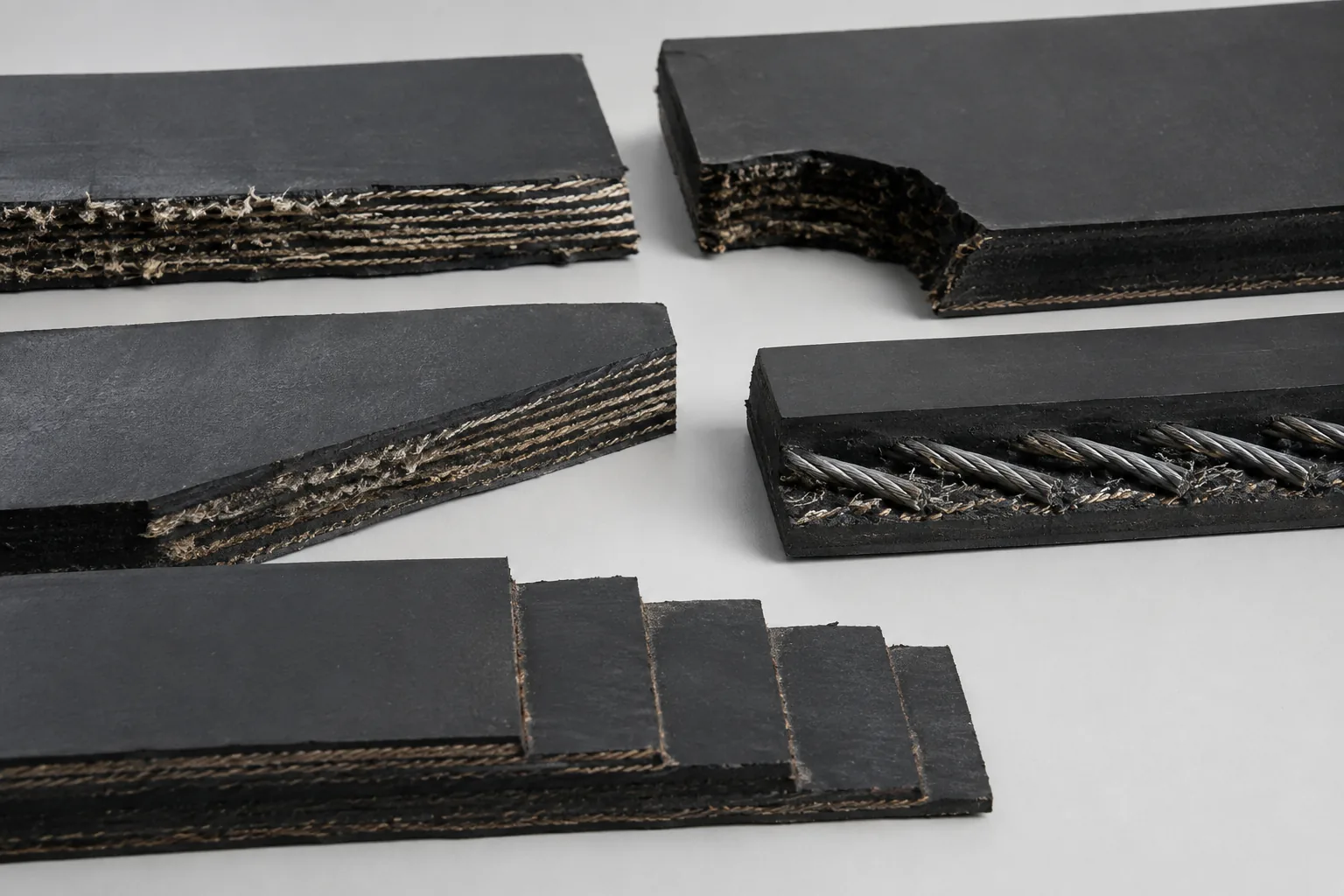
Conveyor belting combines thick rubber covers with fabric or steel reinforcement and cannot be treated as plain sheet rubber. Edge trimming and splice-end preparation depend on belt construction, reinforcement direction, support through thickness and the final joining method.
Updated
Where This Cutting Application Appears
Belt-width edge trimming
Removes irregular cover and reinforcement margins during fabrication or width conversion.
Splice-end preparation
Produces controlled ends before mechanical fastening, cold bonding or vulcanized splice preparation.
Repair-section removal
Separates damaged belt sections while preserving identifiable reinforcement and a usable preparation edge.
Edge Trimming And End Preparation process boundary
edge trimming and end preparation for rubber conveyor belting is a linked sequence: the output condition and datum from each operation become the controlled input for the next. It should not be evaluated as one generic cut or accepted only by the final dimension.
Edge Trimming And End Preparation setup checkpoint
For rubber conveyor belting, define the operation order, intermediate dimensions, registration transfer, material support, web or part handling and waste route for every stage of edge trimming and end preparation.
Edge Trimming And End Preparation acceptance checkpoint
Verify both intermediate and final results from edge trimming and end preparation, including dimensions, registration, edge or feature quality, material damage, waste separation and stable transfer between stages.
Define the Required Cut Result
- Straight edges through covers and reinforcement
- Minimal fabric fray or exposed steel-cord damage
- No large rubber chunks torn from the cover
- End geometry suitable for the specified splice route
Problems to Diagnose Before Changing the Knife
Fabric ply fraying
- Record ply count, weave and bias direction
- Support the belt close to the separation line
- Inspect whether the edge pushes cords before severing them
Rubber chunking
- Check cover hardness, temperature and aging
- Inspect tooth or edge damage
- Compare cutting direction against exposed reinforcement
Cut drift through thickness
- Measure belt thickness and cover asymmetry
- Check guide rigidity and side loading
- Mark entry and exit positions on the cut face
Uneven splice end
- Confirm the splice geometry and reference datum
- Check clamping over the full belt width
- Separate trimming error from later skiving work
Knife Forms That May Be Considered
| Possible knife form | When it may be considered | What must be confirmed |
|---|---|---|
| heavy straight knife | May suit rigid guillotine equipment that clamps and supports thick fabric-reinforced belt across its width. | Confirm the mounting dimensions, cutting motion and edge details from the conveyor belt fabrication equipment, an unworn sample or an approved drawing before manufacture. |
| powered circular cutter | May be used for guided trimming where rotary motion can traverse the reinforced section without excessive dragging. | Confirm the mounting dimensions, cutting motion and edge details from the conveyor belt trimming equipment, an unworn sample or an approved drawing before manufacture. |
| serrated knife | May aid progressive separation of compliant cover rubber, provided reinforcement fray and tooth marks are controlled. | Confirm the mounting dimensions, cutting motion and edge details from the conveyor belt cutting equipment, an unworn sample or an approved drawing before manufacture. |
Information to Send for Technical Review
You do not need to know the exact blade name. Send the available workpiece, machine, current-knife and cut-result information so the application can be reviewed against a drawing or sample.
- Belt fabrication equipment and cutting method
- Overall thickness and top/bottom cover gauges
- Fabric ply or steel-cord construction
- Belt width and required edge or splice geometry
- Clamp, table and backing support details
- Whether the belt is new, aged or repaired
- Photos of entry face, exit face and reinforcement damage
- Knife drawing, quantity, destination and schedule
Questions About This Cutting Application
Can fabric- and steel-cord belts use the same knife?
Do not assume so. Reinforcement material and spacing change the separation mechanism, edge load and acceptable damage.
Why does a thick belt cut wander?
An unsupported section, flexible guide, asymmetric cover or side load can deflect the edge through thickness. Inspect both faces.
Should the splice method be provided?
Yes. A square cutoff, bias end and stepped splice preparation have different reference and finish requirements.
Can an installed belt be used as the only reference?
Measurements and photos help, but confirm construction and tooling geometry from controlled records before manufacturing a replacement knife.
What defect sample is useful?
Provide a full-thickness cut section showing cover, reinforcement, entry side and exit side, with the cutting direction marked.
Related product and service information
- Slitting Sponge Rubber and Elastomer Foam - sponge rubber and elastomer foam sheets · roll slitting and sheet cutting
- Slitting Calendered Tire Innerliner Rubber Sheet - calendered tire innerliner rubber sheet · longitudinal slitting after calendering
- Slitting Spunbond Nonwoven Rolls - spunbond nonwoven rolls · longitudinal roll slitting
Request a Custom Cutting-Knife Review
Send the workpiece details, machine or holder information, current knife photos or sample, required quantity and examples of the present cut problem. Final dimensions, material, edge geometry and tolerances are confirmed from the approved requirements.