
Blade Application Guides / Application Guide / Electronic metal converting
Nickel-Clad Copper Strip Cut-to-Length Blades
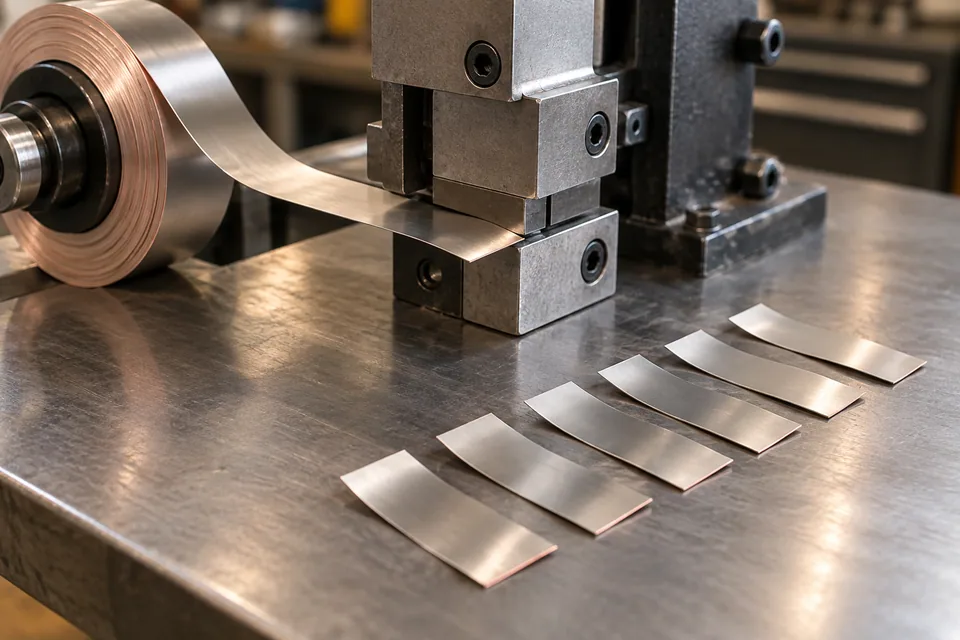
Chalco lists Ni/Cu and Ni/Cu/Ni battery-connection composites in coil and sheet form, while Raytron identifies nickel-clad copper strip as a bonded and rolled conductor form. Iwatani documents precision slitting of clad and copper foils for cylindrical battery leads. Together with Chalco’s coil and sheet supply formats, this supports a buyer-evaluated straight cut-to-length conversion of a specified layered strip; the cited Iwatani process is slitting, not transverse cutoff. None of the sources approves a particular tab geometry or welding method. This guide covers rectangular lengths from unassembled clad coil stock before a separate punching, bending or joining operation. It distinguishes metallurgical cladding from surface nickel plating: every transverse cut exposes the layer cross-section at two ends. End burr, delamination and nickel-face marking matter as much as measured length.
Updated
Where This Cutting Application Appears
Derive length from the battery connection drawing
Confirm whether the blank will later be bent, pierced or welded and which face is designed to meet the cell or lead. Identify one-sided versus two-sided nickel cladding, total gauge, source width and rolling direction. Add only the drawing’s handling and later-trim allowance.
Support the transverse shear stroke
Feed the strip against a registered stop while supporting it flat. Trial a matched blade pair on the actual clad temper and inspect the outgoing blank end together with the end left on the coil. A cut that pushes a nickel lip outward can interfere with electrode contact or make an exposed copper edge more vulnerable to damage.
Inspect each layered cut end
Check squareness, length, burr direction, copper smear, lifted nickel and particles under the buyer’s method. Compare early and late pieces for blade wear. Do not use a visual bond line alone as proof that the nickel and copper layers remain mechanically joined after bending or welding.
Package blanks for the next process
Stack with face orientation and source-coil lot visible, protecting nickel joining surfaces from scratches. The receiving team should trial forming and its specified resistance or laser weld, then measure electrical and mechanical performance. The cutter’s acceptance ends at the qualified blank specification.
Define the Required Cut Result
- Make straight clad-strip lengths to drawing.
- Keep both exposed layer ends sound and controlled.
- Protect nickel joining faces during pickup.
- Retain stack architecture and lot traceability.
Problems to Diagnose Before Changing the Knife
Nickel peels at a blank end
- Review blade support and cut direction.
- Compare source bond and the opposite end.
Burr points into a weld zone
- Inspect shear engagement and tooling wear.
- Mark nickel-face orientation on samples.
Blank length drifts
- Check feed slip and stop registration.
- Measure a run across coil positions.
Knife Forms That May Be Considered
| Possible knife form | When it may be considered | What must be confirmed |
|---|---|---|
| Supported transverse shear blades | For straight clad-metal battery lead blanks. | Confirm two-end layer integrity, burr, length and squareness. |
Information to Send for Technical Review
You do not need to know the exact blade name. Send the available workpiece, machine, current-knife and cut-result information so the application can be reviewed against a drawing or sample.
- Clad layer architecture and bond specification
- Total gauge, width, temper and coil lot
- Blank length and nickel-face orientation drawing
- Allowed end delamination, smear and burr
- Feed registration and full-width support
- End-face and surface inspection method
- Protective stack and packaging
- Final welding, electrical and bend tests
Questions About This Cutting Application
Why is this not ordinary plated copper?
The workpiece consists of bonded nickel and copper metal layers.
Are the two cut ends identical?
Not necessarily; shear direction can form different lips on the outgoing and remaining ends.
Can straight cutoff make a finished tab?
Only if the released part needs no later holes, bends or welding.
Does a smooth end guarantee weld quality?
No. The buyer must test its actual joint.
What should accompany the RFQ?
Send a stack cross-section, material certificate and lead drawing.
Public references and scope
These public sources provide material, cutting-method or safety context for this guide. Supplier pages describe their own materials or equipment; they do not establish a MEIRENTE blade specification or performance claim. Confirm the actual grade, machine setup and required cut with a drawing or sample.
Related product and service information
- Nickel-Clad Copper Strip Precision Blanking Blades - nickel-clad copper strip · precision blanking
- Rolled-Annealed Copper Foil Cut-to-Length Blades - rolled-annealed copper foil · cut to length
- Ultra-Thin Stainless-Steel Foil Cut-to-Length Blades - ultra-thin stainless-steel foil · cut to length
Request a Custom Cutting-Knife Review
Send the workpiece details, machine or holder information, current knife photos or sample, required quantity and examples of the present cut problem. Final dimensions, material, edge geometry and tolerances are confirmed from the approved requirements.