
Blade Application Guides / Application Guide / Paperboard converting
Recycled Grey Chipboard Profile-Cutting Blades
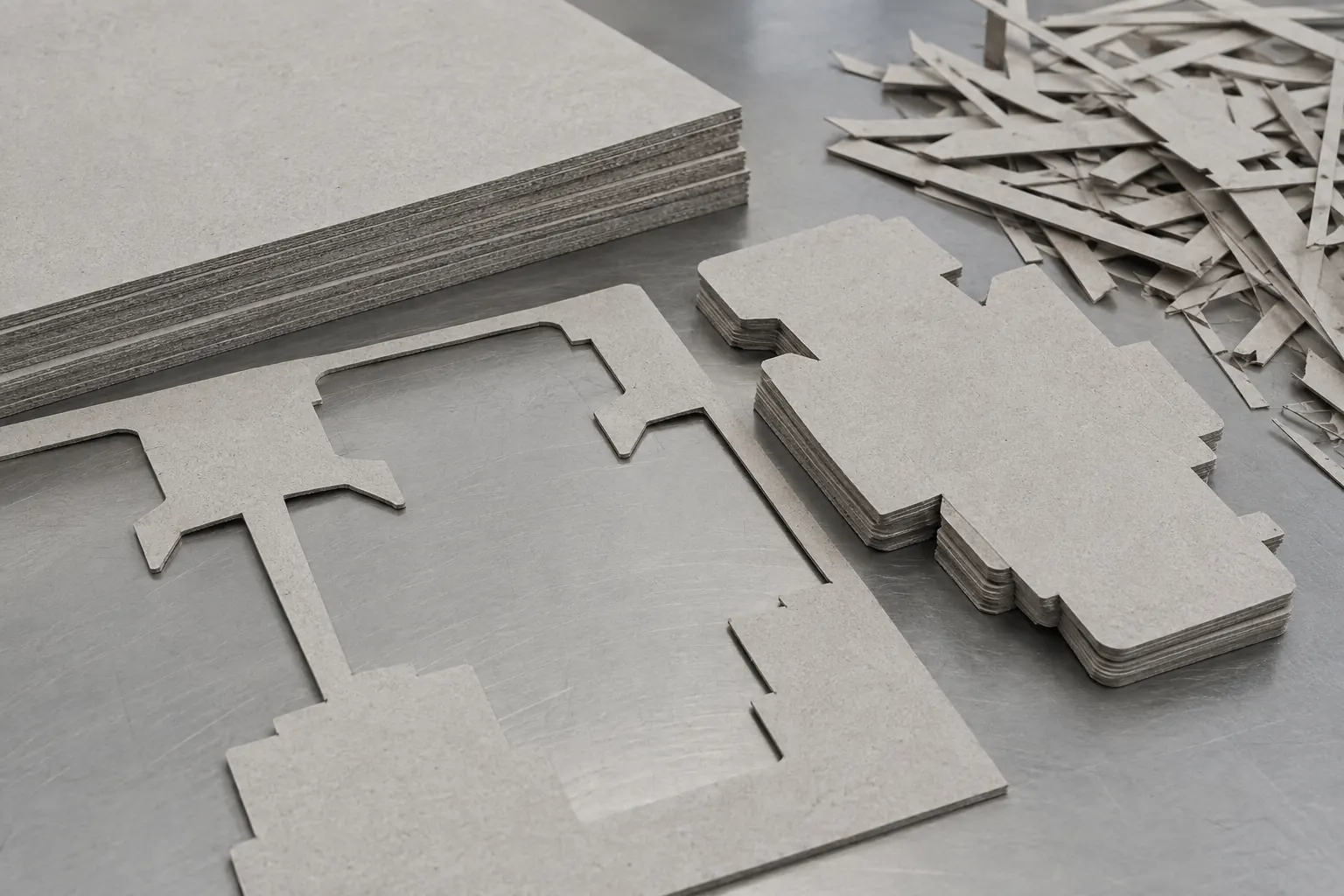
Profile cutting turns dense recycled greyboard into shaped inserts, supports and presentation components. Corners, narrow bridges and changes in cutting direction concentrate stress in the heterogeneous fiber structure, making part support and minimum feature geometry central to a technical review.
Updated
Where This Cutting Application Appears
Shaped rigid-box inserts
Creates fitted supports and presentation layers with declared outer profiles and openings.
Bookbinding corner forms
Cuts rounded, angled or notched cover-board components before wrapping.
Protective board partitions
Produces interlocking slots and contours for internal packaging structures.
Profile Cutting process boundary
Profile cutting follows the specified finished outline, including shaped or non-rectangular boundaries; it is distinct from straight sizing and narrow edge cleanup.
Profile Cutting setup checkpoint
Review the finished outline, inside and outside radii, start and stop points, material support near corners and the method used to remove shaped waste.
Profile Cutting acceptance checkpoint
Compare the complete profile to the drawing or template, including corners, holes, narrow features, edge condition and fit in the downstream assembly.
Define the Required Cut Result
- Profile dimensions matched to the approved drawing
- Clean corners with limited fiber breakout
- Narrow bridges and slots retained without crushing
- Scrap released without delaminating the finished part
Problems to Diagnose Before Changing the Knife
Outer corners break away
- Compare corner radius and fiber direction
- Inspect density and local inclusions
- Review support during cutting and scrap removal
Slots close after cutting
- Measure compression recovery
- Check slot width and board caliper
- Inspect whether fibers are displaced rather than separated
Profile dimensions differ between lots
- Record moisture, density and caliper by lot
- Use the same conditioning and measurement method
- Compare locating datum and feed behavior
Waste pulls fibers from the finished edge
- Review stripping direction and connected bridges
- Inspect tight radii and internal corners
- Compare support under waste and finished sections
Knife Forms That May Be Considered
| Possible knife form | When it may be considered | What must be confirmed |
|---|---|---|
| steel-rule profile die arrangement | May suit repeated greyboard profiles on compatible presses and cutting bases. | Confirm board build, profile, rule support, base, ejection and press interface from approved production information. |
| matched punch-and-die arrangement | May suit selected openings or slots requiring guided alignment and controlled support. | Confirm part datum, opening geometry, clearance, stroke, stripping and mounting; do not assume dimensions from a sample photograph. |
Information to Send for Technical Review
You do not need to know the exact blade name. Send the available workpiece, machine, current-knife and cut-result information so the application can be reviewed against a drawing or sample.
- Greyboard grade, caliper, density and moisture
- Finished profile drawing with tolerances
- Minimum radii, bridges, slots and openings
- Fiber direction and sheet presentation
- Press motion, cutting base and support
- Part location, ejection and scrap stripping method
- Accepted and rejected profiles from representative lots
- Production quantity and downstream wrapping or assembly test
Questions About This Cutting Application
Why are internal corners difficult in greyboard?
Stress concentrates where direction changes, and short recycled fibers can pull out if geometry and support are unsuitable.
Can a crushed slot recover to the correct width?
It may recover unevenly. Measure after conditioning and verify the actual interlocking or assembly function.
Is one material sample sufficient?
Representative lots are better because recycled furnish, density and moisture can vary.
Why does stripping affect edge quality?
Waste pulled across an incompletely separated edge can extract fibers or delaminate the finished profile.
What defines an acceptable profile?
Use dimensions, edge appearance and downstream fit or wrapping performance, not appearance alone.
Related product and service information
- Solid Bleached Sulfate Board Profile-Cutting Blades - solid bleached sulfate board · profile cutting
- Liquid Packaging Board Profile-Cutting Blades - liquid packaging board · profile cutting
- Honeycomb Paper Panel Profile-Cutting Blades - honeycomb paper panel · profile cutting
Request a Custom Cutting-Knife Review
Send the workpiece details, machine or holder information, current knife photos or sample, required quantity and examples of the present cut problem. Final dimensions, material, edge geometry and tolerances are confirmed from the approved requirements.