
Blade Application Guides / Application Guide / Paperboard converting
Honeycomb Paper Panel Profile-Cutting Blades
Profile cutting introduces curves, notches and openings into honeycomb paper panels for packaging and lightweight structures. Cellular support changes continuously around a contour, so the profile drawing must be reviewed with cell orientation, facing adhesion and the functional load path.
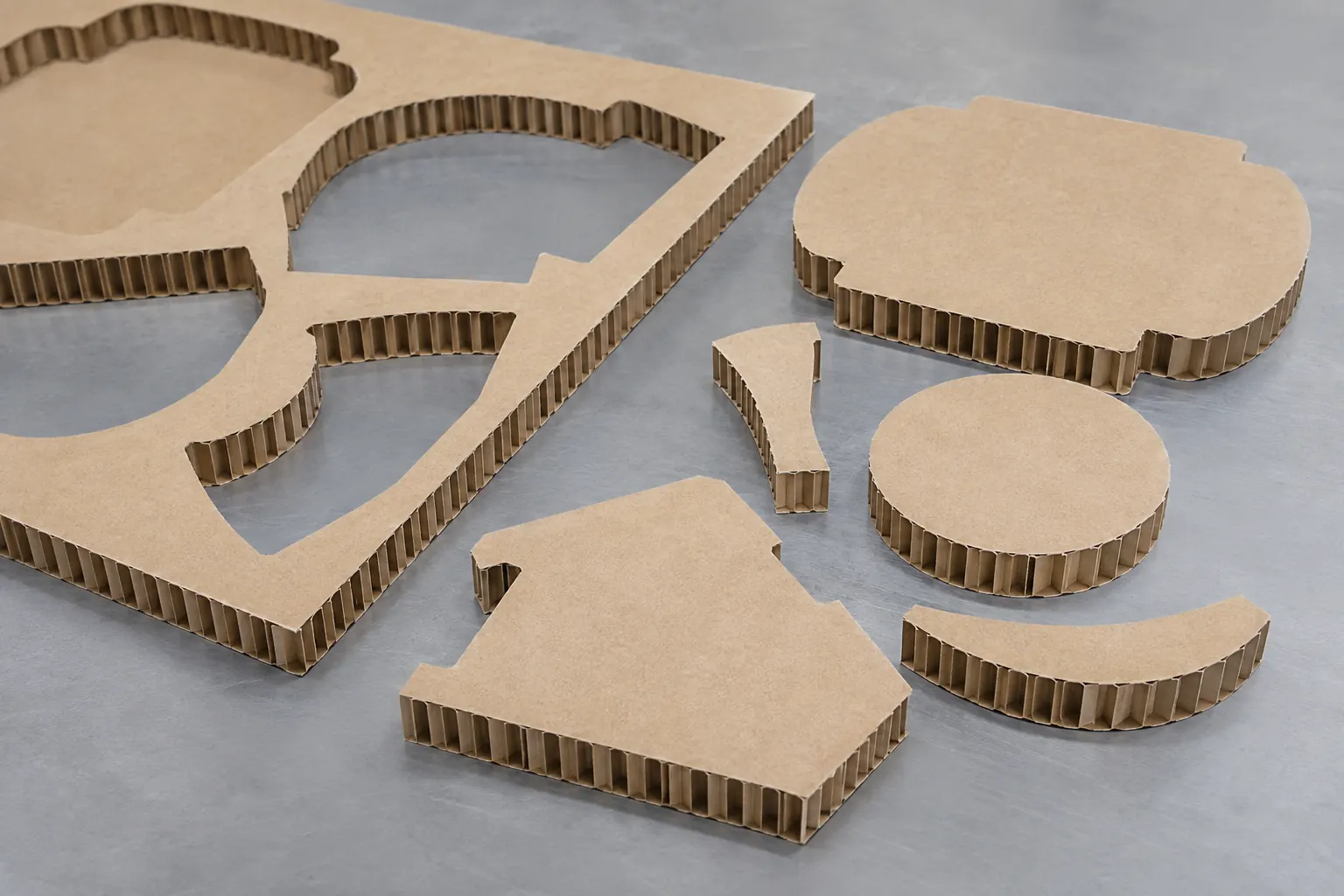
Where This Cutting Application Appears
Shaped protective inserts
Creates profiles that locate products or fit cartons while retaining cellular cushioning.
Notched structural components
Cuts interlocking or clearance features into lightweight paper-panel parts.
Display and furniture core shapes
Produces curved or apertured infill panels before finishing skins are applied.
Common Ways to Describe This Cutting Problem
- honeycomb paper panel profile-cutting blades
- paper honeycomb contour cutter
- cellular board shaped insert cutting
- honeycomb panel notch cutting knife
- paper core radius profile tooling
- protective honeycomb opening cutter
- honeycomb board curved edge defects
- custom die for honeycomb paper shapes
Define the Required Cut Result
- Contour matched to drawing and assembly datum
- Facings remain bonded around curves and openings
- Limited local cell collapse at corners and narrow sections
- Scrap removed without pulling core from the finished part
Problems to Diagnose Before Changing the Knife
Facing delaminates around an internal curve
- Map adhesive coverage and radius
- Inspect support beneath the curve
- Compare cutting direction with cell orientation
Cells tear from narrow profile sections
- Review bridge width and load direction
- Compare core density and panel thickness
- Inspect scrap-removal force
Opening size varies through panel thickness
- Measure both facings and core
- Review cutting-path guidance
- Check panel compression and flatness
Loose cell fragments remain inside openings
- Inspect adhesive nodes and incomplete walls
- Review ejection direction
- Define cleanliness requirements for the final use
Knife Forms That May Be Considered
| Possible knife form | When it may be considered | What must be confirmed |
|---|---|---|
| profile die-cutting arrangement | May suit repeated cellular-panel shapes when the press and support can accommodate full panel thickness. | Confirm profile, panel build, cutting base, support, ejection and press interface with trials and approved drawings. |
| matched profile punch arrangement | May suit selected openings where guided geometry and internal support are feasible. | Confirm clearance, support, datum, stroke, slug handling and mounting from the actual application. |
| guided serrated profile arrangement | May be considered for selected low-volume contours where the equipment provides controlled travel. | Confirm form and tooth geometry through material trials; no dimensions or pattern are assumed. |
Information to Send for Technical Review
You do not need to know the exact blade name. Send the available workpiece, machine, current-knife and cut-result information so the application can be reviewed against a drawing or sample.
- Facing paper and core construction
- Cell size, orientation, density and adhesive pattern
- Panel thickness and finished profile drawing
- Minimum radii, openings, bridges and tolerances
- Part datum, support and hold-down
- Cutting motion, mounting, ejection and scrap path
- Accepted profiles and delamination or crush samples
- Assembly, covering, cleanliness and load requirements
Questions About This Cutting Application
Why are profiles harder than straight panel cuts?
Support and cell-wall direction change around the contour, especially at internal corners and narrow bridges.
Can an opening be measured only on the top facing?
No. Compare both facings and the core because the cut can taper through thickness.
What causes facing delamination?
Adhesive coverage, unsupported bending, radius geometry and scrap removal can all load the facing-to-core bond.
Should loose internal fragments be specified?
Yes, particularly for clean packaging, visible openings or parts that will be laminated.
Can the finished profile identify the original cutting form?
Not reliably; the equipment interface, support, motion and approved process records are still needed.
Request a Custom Cutting-Knife Review
Send the workpiece details, machine or holder information, current knife photos or sample, required quantity and examples of the present cut problem. Final dimensions, material, edge geometry and tolerances are confirmed from the approved requirements.