
Blade Application Guides / Application Guide / Rubber compounding and mixing
Raw Rubber Bale Guillotine Cutting Blades for Compounding
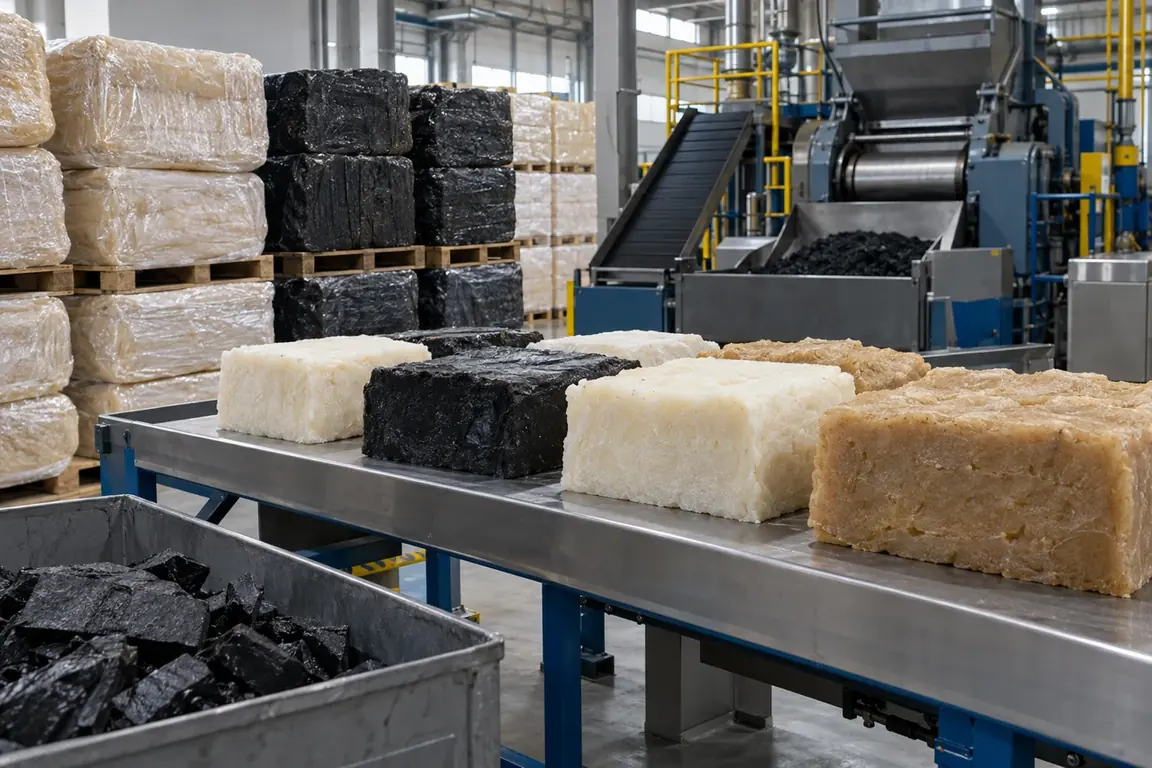
Raw rubber bale guillotine cutting blades portion dense natural or synthetic rubber before weighing, compounding and mixing. Unlike finished sheet conversion, the workpiece can be thick, resilient, tacky and variable with storage condition, so review should include bale dimensions, rubber family, temperature, portion objective, feed support, hold-down and the existing cutter interface.
Updated
Where This Cutting Application Appears
Natural rubber bale portioning
Dense bales are divided into portions for weighing and controlled mixing.
Synthetic rubber block preparation
Synthetic elastomer feedstock is cut before formulation or blending.
Mixed-feed compounding preparation
Approved rubber feedstocks are portioned to the plant recipe and handling sequence.
Hydraulic Guillotine Bale Cutting process boundary
Hydraulic guillotine bale cutting for Natural and synthetic raw rubber bales is planned around separation across the material flow or part axis to establish a controlled repeat length or finished end; it is not longitudinal width conversion, shaped contour production or particle-size reduction.
Hydraulic Guillotine Bale Cutting setup checkpoint
For Natural and synthetic raw rubber bales, confirm target length, datum or registration reference, feed indexing, support on both sides, cut timing and post-cut transfer.
Hydraulic Guillotine Bale Cutting acceptance checkpoint
For Natural and synthetic raw rubber bales, evaluate length distribution, squareness or cutoff angle, both cut faces, deformation, registration drift and stacking or discharge consistency.
Define the Required Cut Result
- Complete separation without repeated uncontrolled tearing.
- Consistent portions suitable for plant weighing and mixing.
- Controlled deformation and movement of resilient feedstock.
- Reduced sticking and carryover at cutting and support surfaces.
Problems to Diagnose Before Changing the Knife
The cut stalls or leaves a connected section
- Record rubber family, bale dimensions and temperature.
- Inspect where connection forms relative to support and travel.
- Review hydraulic motion, hold-down and full stroke with the machine provider.
Rubber sticks to the cutting component or support
- Identify tack variation by grade, storage and temperature.
- Map residue location and cycles before release changes.
- Review approved cleaning and handling without assuming a coating solution.
Bale compresses or moves before separation
- Confirm feed orientation, support and side guidance.
- Compare deformation for accepted and rejected cuts.
- Check support on both sides of the requested cut.
Portions vary too much for batch preparation
- Define how portions are positioned and weighed.
- Review bale variation and feed positioning before each stroke.
- Separate cutting error from feedstock variation and handling loss.
Knife Forms That May Be Considered
| Possible knife form | When it may be considered | What must be confirmed |
|---|---|---|
| Straight hydraulic guillotine knife arrangement | For machines driving a long edge through supported bale feedstock. | Existing drawing, mounting, stroke, bale envelope, support and safety documentation. |
| Angled shear-entry knife arrangement | When the original machine uses progressive rather than simultaneous entry. | OEM interface, angle, travel direction, support relationship and approved cut. |
| Replaceable upper-knife and bed-support set | When separation is controlled by coordinated moving and stationary components. | Matched drawings, clearances, fasteners, adjustment method and wear condition. |
Information to Send for Technical Review
You do not need to know the exact blade name. Send the available workpiece, machine, current-knife and cut-result information so the application can be reviewed against a drawing or sample.
- Rubber family, grade description and representative material.
- Bale dimensions, mass range, storage and cutting temperature.
- Required portion dimensions or weighing objective.
- Cutter manufacturer, model and safety documentation.
- Existing knife and mounting drawings or dimensioned samples.
- Stroke direction, support, hold-down and feed arrangement.
- Accepted and failed portions showing sticking and connections.
- Cycle expectation, cleaning method and trial quantity.
Questions About This Cutting Application
How does bale cutting differ from rubber sheet cutting?
It handles thick resilient feedstock before mixing and depends on stroke, support and condition.
Why should bale temperature be reported?
Temperature can change tack, deformation and cutting resistance.
Does cut length alone determine portion weight?
Not without bale dimensions, density variation, positioning and weighing method.
What should be checked when a bale remains connected?
Review material condition, connection location, support, full stroke and knife condition.
Can a replacement blade be made from a photograph?
No; a controlled drawing or dimensioned sample and machine interface are required.
Related product and service information
- Gasket Sheet Profile Cutting for Clean Bolt Holes - compressed gasket sheet · profile cutting
- Coated Paper Sheet Trimming Without Surface Damage - coated paper sheets · sheet trimming
- Tissue Log Cross Cutting and Compression Control - tissue logs · cross cutting
Request a Custom Cutting-Knife Review
Send the workpiece details, machine or holder information, current knife photos or sample, required quantity and examples of the present cut problem. Final dimensions, material, edge geometry and tolerances are confirmed from the approved requirements.