
Blade Application Guides / Application Guide / Protective textile converting
PTFE-Coated Fiberglass Cloth Shear Slitting Blades
PTFE-coated fiberglass cloth combines a glass-fiber reinforcement with a PTFE coating; some grades also have adhesive and a release liner. Shear slitting makes narrow tapes from the coated web. The edge can expose glass filaments or remove coating, so the supplied construction and intended coated face must be confirmed before knife setup.
Updated
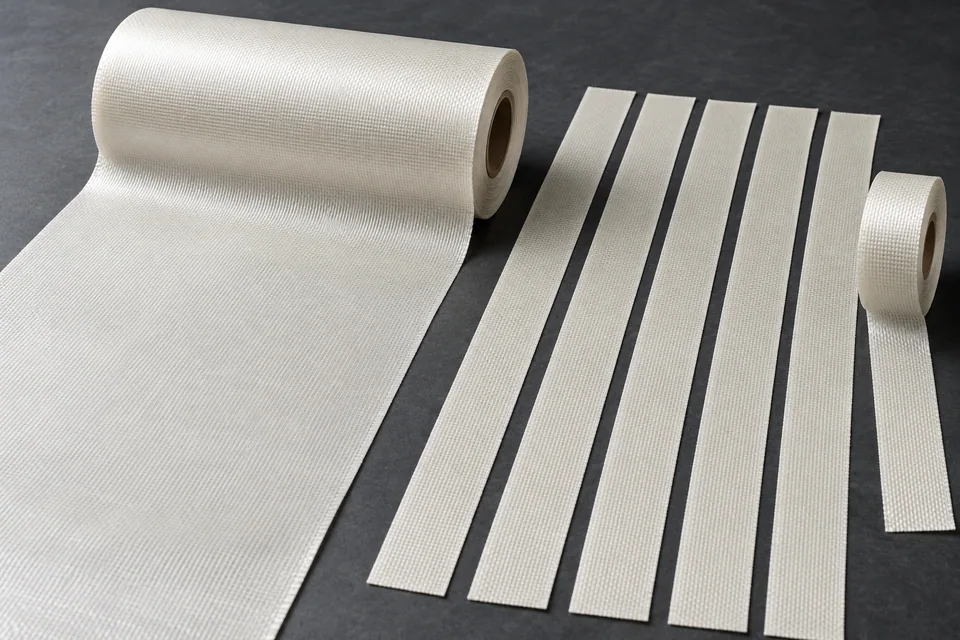
Where This Cutting Application Appears
Lay out the longitudinal lanes
Identify whether the PTFE-coated glass cloth arrives as bare coated fabric, pressure-sensitive tape or a construction with a release liner. The slit-lane plan must identify the coated face, parent width and finished widths. This distinction controls whether adhesive or liner behavior also needs a cutting acceptance check.
Check the paired knife setup
Use a trial to see whether the knife pair cuts the glass weave cleanly without dragging PTFE coating or any adhesive across the edge. Record blade condition, side clearance, overlap and contact with the coated face. A setting chosen for plain glass cloth may create coating pullback on this laminate.
Inspect both slit sides
Inspect newly slit edges for protruding glass filaments, coating recession, loose particles and adhesive stringing where adhesive is present. Check the opposite face as well as the knife-contact face, then measure width after winding because edge curl or transfer may develop during roll handling.
Follow winding and trim takeoff
Follow each lane through separators and rewind to detect blocking, face marks or liner displacement. Keep any supplied grade’s temperature and release claims tied to that grade; the buyer’s product specification decides which properties remain acceptable after conversion.
Material-specific acceptance
Inspect coating continuity to the new edge, loose glass yarns, adhesive stringing and liner integrity where present. Check for face-to-face blocking or transfer during winding. Do not copy a branded grade’s temperature or release claims to the buyer’s different cloth.
Define the Required Cut Result
- Meet each coated-cloth tape width on the supplied grade.
- Limit exposed glass yarns, PTFE pullback and loose particles.
- Inspect adhesive and liner behavior only when present in the stack.
- Avoid blocking or transfer on the coated face during winding.
Problems to Diagnose Before Changing the Knife
Glass yarn projects beyond PTFE
- Inspect both knife edges and the opposite cloth face.
- Check coating grade and side clearance.
PTFE coating recedes from the slit
- Compare coated-face orientation and blade contact.
- Inspect after winding for further pullback.
Adhesive strings transfer between lanes
- Confirm adhesive is present in this grade.
- Inspect blade deposit, liner support and rewind contact.
Finished rolls block or mark
- Check winding pressure and coated-face contact.
- Compare cut-zone and unwound-roll samples.
Knife Forms That May Be Considered
| Possible knife form | When it may be considered | What must be confirmed |
|---|---|---|
| Matched circular shear-slitter pair | For continuous longitudinal cutting on a compatible rotary line. | Confirm arbor fit, edge geometry, side clearance and overlap on the actual machine. |
| Circular edge-trim pair | When the line first removes an outside edge allowance. | Confirm trim width, collection path and retained-edge sample. |
Information to Send for Technical Review
You do not need to know the exact blade name. Send the available workpiece, machine, current-knife and cut-result information so the application can be reviewed against a drawing or sample.
- Glass weave, PTFE coating and any adhesive or liner
- Coated-face orientation and finished tape widths
- Allowed glass-fiber, coating and particle defects
- Knife pair, arbor and holder drawings
- Winding pressure and liner takeoff method
- Buyer grade-specific temperature or release requirements
- Accepted roll and rejected-edge samples
Questions About This Cutting Application
Does every PTFE-coated glass cloth have adhesive?
No. Identify whether the supplied grade is bare coated cloth, adhesive tape or liner-backed tape.
What defects matter at a new edge?
Inspect protruding glass filaments, PTFE coating pullback, loose particles and adhesive strings where adhesive exists.
Why inspect the opposite face?
A clean knife-contact face can conceal yarn pullout or coating displacement on the other side.
Can an SG26 grade claim be copied to another cloth?
No. Temperature, release and adhesive properties belong to the specified supplier grade.
What can winding reveal after slitting?
Look for blocking, face marks, liner movement and edge curl on the finished roll.
Public references and scope
These public sources provide material, cutting-method or safety context for this guide. Supplier pages describe their own materials or equipment; they do not establish a MEIRENTE blade specification or performance claim. Confirm the actual grade, machine setup and required cut with a drawing or sample.
Related product and service information
- Silicone-Coated Glass Fabric Shear Slitting Blades - silicone-coated glass fabric · shear slitting
- Ballistic UHMWPE Fabric Shear Slitting Blades - ballistic UHMWPE fabric · shear slitting
- Para-Aramid Prepreg Fabric Shear Slitting Blades - para-aramid prepreg fabric · shear slitting
Request a Custom Cutting-Knife Review
Send the workpiece details, machine or holder information, current knife photos or sample, required quantity and examples of the present cut problem. Final dimensions, material, edge geometry and tolerances are confirmed from the approved requirements.