
Blade Application Guides / Application Guide / Protective textile converting
Ballistic UHMWPE Fabric Shear Slitting Blades
Ballistic UHMWPE material can be woven fabric or a cross-plied unidirectional composite; the actual ply orientation and binder depend on the supplied grade. Shear slitting makes narrow continuous lanes for later layup or conversion. The edge must avoid pulled filaments and shifted plies, but a cut lane has no independent ballistic rating.
Updated
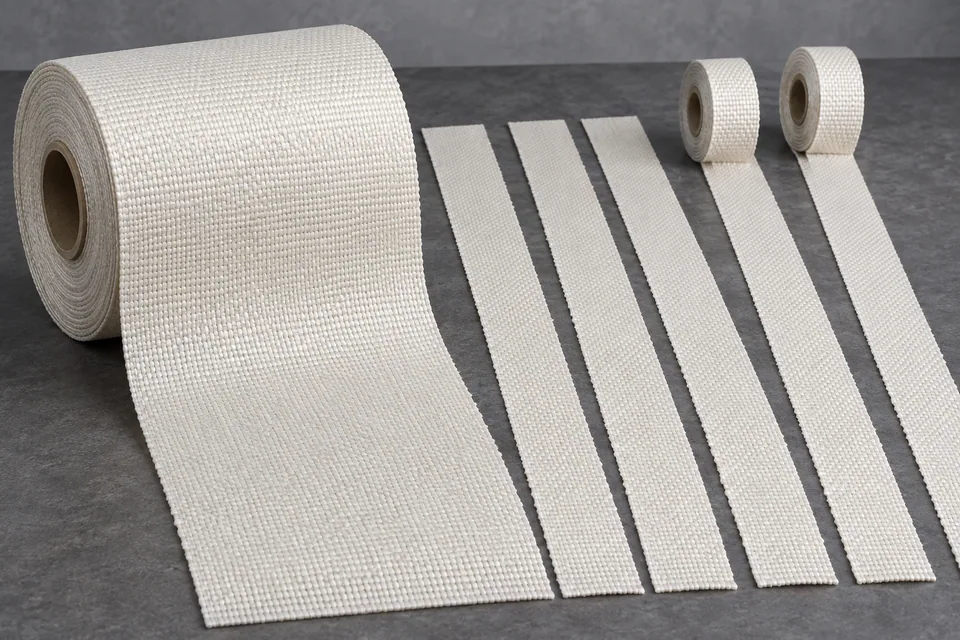
Where This Cutting Application Appears
Lay out the longitudinal lanes
Confirm whether the supplied UHMWPE stock is a woven fabric, a unidirectional sheet or a bonded multilayer before planning continuous longitudinal lanes. Mark fiber and ply orientation on the parent web and on every finished roll. The finished strip widths must match the downstream layup drawing, including any edge allowance.
Check the paired knife setup
A paired shear setup must sever high-strength filaments without pulling a ply across the nip. Compare edge condition from the actual supplied construction at each proposed knife setting; document blade pair, support, liner use, clearance and overlap. Do not transfer a setting from a coated textile simply because its thickness is similar.
Inspect both slit sides
Inspect both slit edges for filament bridging, loose fiber bundles, lifted films and local ply separation. Measure lane width after the material has relaxed under the buyer’s specified condition, and compare outer lanes with center lanes. Retain a marked sample that shows fiber direction and the exact rejected defect.
Follow winding and trim takeoff
Rewind each lane with the orientation and protection needed by the subsequent layup step. Watch for telescoping, wrinkles and edge abrasion rather than relying on the cut-zone view alone. Only the assembled protective article, tested under its own qualification program, can establish ballistic performance.
Material-specific acceptance
Record fiber or ply direction relative to each longitudinal slit. Inspect loose filaments, uncut strands and resin or film pullback on both edges. Package lanes to prevent wrinkles before layup. Only the finished protective article can be qualified for ballistic performance.
Define the Required Cut Result
- Meet the layup-width drawing for the supplied UHMWPE construction.
- Preserve fiber or ply orientation on each rewound lane.
- Limit bridged filaments, ply lift and film pullback at both edges.
- Avoid wrinkles and edge abrasion before downstream layup.
Problems to Diagnose Before Changing the Knife
UHMWPE filaments bridge lanes
- Inspect knife overlap and support on the actual architecture.
- Count bridges relative to the buyer criterion after lane separation.
UD ply shifts or film lifts
- Check fiber orientation, nip restraint and blade contact.
- Compare both faces before and after rewinding.
Lane width changes after relaxation
- Measure under the specified conditioning state.
- Compare outer and center lanes from the same roll.
Wound strip wrinkles before layup
- Check orientation, tension and separator contact.
- Retain a marked rejected sample for the layup owner.
Knife Forms That May Be Considered
| Possible knife form | When it may be considered | What must be confirmed |
|---|---|---|
| Matched circular shear-slitter pair | For continuous longitudinal cutting on a compatible rotary line. | Confirm arbor fit, edge geometry, side clearance and overlap on the actual machine. |
| Circular edge-trim pair | When the line first removes an outside edge allowance. | Confirm trim width, collection path and retained-edge sample. |
Information to Send for Technical Review
You do not need to know the exact blade name. Send the available workpiece, machine, current-knife and cut-result information so the application can be reviewed against a drawing or sample.
- Woven, UD or cross-plied UHMWPE construction
- Fiber/ply orientation and layup-width drawing
- Film or binder layer and liner details
- Allowed bridged filaments and ply separation
- Knife-pair, arbor and web-support drawings
- Width conditioning and sampling method
- Rewind protection and orientation labeling
Questions About This Cutting Application
Is ballistic UHMWPE always woven?
No. The supplied stock may be woven, unidirectional or cross-plied; identify its architecture before laying out slit lanes.
Why mark fiber or ply direction?
The downstream layup uses that orientation, so every rewound lane needs a traceable direction mark.
What is an uncut filament bridge?
A high-strength filament can remain across the nominal slit and pull neighboring plies when the lanes separate.
When should lane width be measured?
Use the buyer’s conditioning method after the material has relaxed, and sample outer and center lanes.
Does a slit lane carry a ballistic rating?
No. Only the finished protective article and its qualification tests establish performance.
Public references and scope
These public sources provide material, cutting-method or safety context for this guide. Supplier pages describe their own materials or equipment; they do not establish a MEIRENTE blade specification or performance claim. Confirm the actual grade, machine setup and required cut with a drawing or sample.
Related product and service information
- Para-Aramid Prepreg Fabric Shear Slitting Blades - para-aramid prepreg fabric · shear slitting
- PTFE-Coated Fiberglass Cloth Shear Slitting Blades - PTFE-coated fiberglass cloth · shear slitting
- Silicone-Coated Glass Fabric Shear Slitting Blades - silicone-coated glass fabric · shear slitting
Request a Custom Cutting-Knife Review
Send the workpiece details, machine or holder information, current knife photos or sample, required quantity and examples of the present cut problem. Final dimensions, material, edge geometry and tolerances are confirmed from the approved requirements.