
Blade Application Guides / Application Guide / Protective textile converting
Silicone-Coated Glass Fabric Shear Slitting Blades
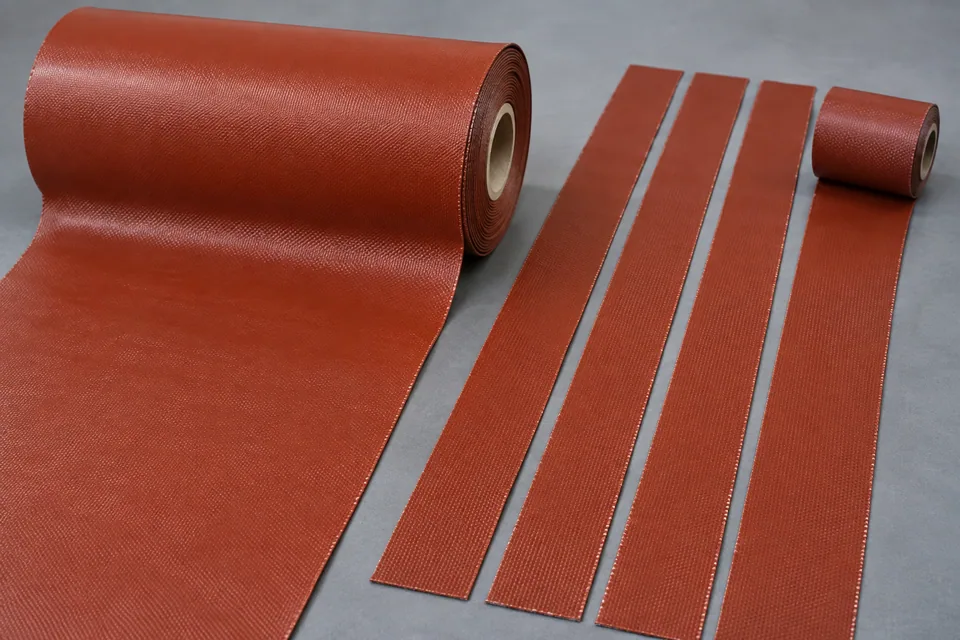
Silicone-coated glass fabric is a reinforced composite; coating thickness, face treatment and adhesive backing vary by product. Shear slitting produces continuous lanes while exposing glass yarns at the cut. A blade trial must distinguish glass-fiber pullout from silicone smearing and confirm whether the coated faces remain clean during winding.
Updated
Where This Cutting Application Appears
Lay out the longitudinal lanes
Confirm silicone coating type, coating side or sides, glass-fabric weave and any backing before setting the shear-slitting lanes. Record width and orientation relative to the weave, because a finished strip that is dimensionally correct may still expose reinforcement at the wrong edge for its intended assembly.
Check the paired knife setup
Watch for tacky silicone transfer, blade-face buildup and drag on the coated web in a short trial before approving the setup. Document knife pairing, edge support and actual material condition; a generic glass-cloth clearance does not establish a clean cut through this silicone-coated construction.
Inspect both slit sides
Measure lane width and inspect each new edge for glass filaments, coating recession and a smeared silicone lip. Compare early and late trial samples to detect coating accumulation at the knife. Note whether a defect first appears at the cut, a separator or the rewind contact point.
Follow winding and trim takeoff
Rewind with protected coated faces and check for blocking, edge build-up or pressure marks after normal storage. Do not infer heat, electrical or release performance from a neat slit edge; those properties belong to the material grade and the finished assembly’s qualification method.
Material-specific acceptance
Inspect both edges for protruding glass filaments, coating recession and tacky silicone transfer. Check the final roll for blocking, edge build-up and face marks. The material supplier’s electrical or heat-use properties apply to its specified grade, not automatically to a slit buyer product.
Define the Required Cut Result
- Meet the width drawing for the specified silicone-coated glass fabric.
- Limit glass-fiber projection and silicone smear on both edges.
- Check knife buildup and cut consistency through the trial.
- Protect coated faces from blocking and pressure marks on the finished roll.
Problems to Diagnose Before Changing the Knife
Glass filaments appear at the cut
- Inspect weave orientation and knife pairing.
- Compare both edges with an accepted grade sample.
Silicone builds up on the cutter
- Compare blade faces and edge samples over time.
- Check supplier coating and handling condition.
Coating smears or recedes
- Check support and engagement at the coated face.
- Compare early and late trial cuts.
Wound lanes block or show pressure marks
- Trace the first affected reel layer.
- Review winding tension and protected-face arrangement.
Knife Forms That May Be Considered
| Possible knife form | When it may be considered | What must be confirmed |
|---|---|---|
| Matched circular shear-slitter pair | For continuous longitudinal cutting on a compatible rotary line. | Confirm arbor fit, edge geometry, side clearance and overlap on the actual machine. |
| Circular edge-trim pair | When the line first removes an outside edge allowance. | Confirm trim width, collection path and retained-edge sample. |
Information to Send for Technical Review
You do not need to know the exact blade name. Send the available workpiece, machine, current-knife and cut-result information so the application can be reviewed against a drawing or sample.
- Glass weave and single- or double-side silicone coating
- Any adhesive or backing layer and coated-face identity
- Lane widths and weave orientation
- Allowed glass fibers, silicone smear and edge recession
- Knife pair, support and cleaning record
- Winding contact, blocking and face-mark criteria
- Accepted samples from early and late trial cuts
Questions About This Cutting Application
What construction must be identified before slitting?
Confirm glass weave, silicone coating on one or both faces, and any adhesive or backing.
How can silicone affect the knives?
The supplied coating can transfer or build up on the knife; compare early and late trial cuts.
What edge defects should be recorded?
Check exposed glass filaments, silicone smear or recession, and width on both slit sides.
Why check the finished roll?
Coated faces can block or mark under winding pressure even when the edge looks clean at the cut.
Are silicone and PTFE glass cloth interchangeable?
No. Coating response and layer construction differ; qualify the actual material grade.
Public references and scope
These public sources provide material, cutting-method or safety context for this guide. Supplier pages describe their own materials or equipment; they do not establish a MEIRENTE blade specification or performance claim. Confirm the actual grade, machine setup and required cut with a drawing or sample.
Related product and service information
- Bagasse Fiber Sheet Roll Slitting Blades - bagasse fiber sheet · roll slitting
- Ballistic UHMWPE Fabric Shear Slitting Blades - ballistic UHMWPE fabric · shear slitting
- Para-Aramid Prepreg Fabric Shear Slitting Blades - para-aramid prepreg fabric · shear slitting
Request a Custom Cutting-Knife Review
Send the workpiece details, machine or holder information, current knife photos or sample, required quantity and examples of the present cut problem. Final dimensions, material, edge geometry and tolerances are confirmed from the approved requirements.