
Blade Application Guides / Application Guide / Protective textile converting
PTFE-Coated Fiberglass Cloth Cross-Cutting Blades
DERFLEX describes PTFE-coated woven fiberglass available as roll stock and sheet-cut fabric. Chukoh and 3M show related glass-cloth/PTFE constructions that can be cut, though some of their examples add pressure-sensitive adhesive. This guide concerns the non-adhesive coated cloth variant unless the buyer specifies otherwise. Transverse cutting separates a length across the roll feed for later belt, release-sheet or lining fabrication; it is not longitudinal slitting and does not create a finished seamed belt.
Updated
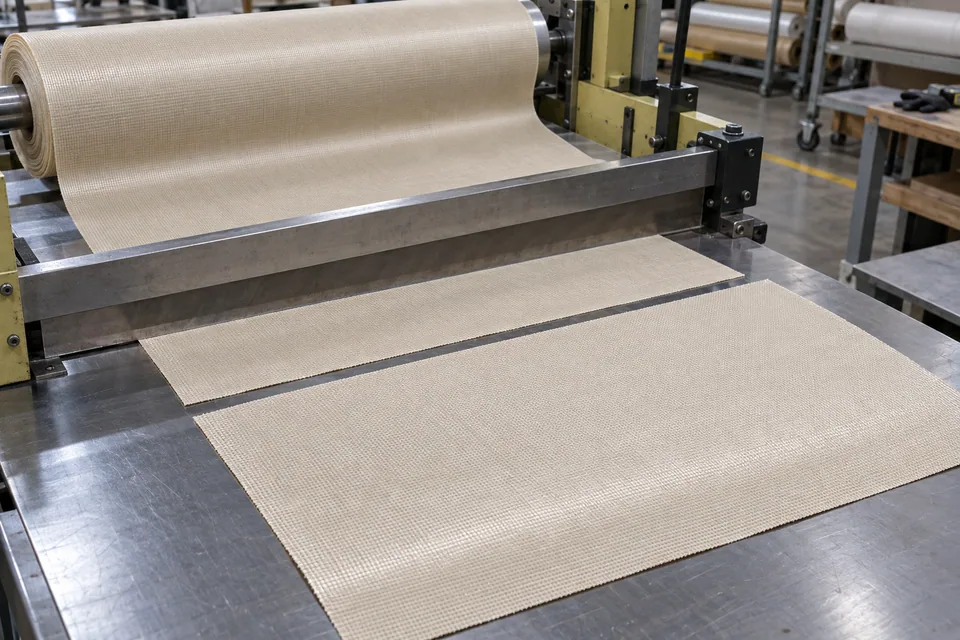
Where This Cutting Application Appears
Map weave and downstream use
Define blank length from the receiving fabricator’s sheet or belt plan. Mark warp and fill orientation and any coated face distinction. A later seam, heat-seal surface or belt splice may need extra margin, so obtain that allowance from the drawing rather than adding a generic amount. If the supplied product is actually adhesive tape, identify the liner and treat it as a different construction.
Feed the slippery cloth squarely
PTFE-coated surfaces release readily, so guide the roll without allowing one side to advance ahead of the other. Support the glass weave near the cut and trial a blade suitable for coated fibers; an incomplete fiber bridge can pull coating when the blank is lifted. Avoid assuming that a clean cut through PTFE alone means all glass yarns have separated.
Inspect both ends for exposed glass
Examine the new blank and parent-roll edges for glass yarn tails, coating chips, crushed coating and uneven squareness. Measure the blank after it rests flat, using warp direction as the feed datum. Record any coating loss near the intended seam or release face; an edge defect can be hidden if the cloth is immediately rolled again.
Deliver a fabrication blank
Package without sharp folds that could crack the coating. Mark grade, roll lot, length and fabric orientation. The downstream fabricator determines seam construction, heat-release performance and service life. A transverse cut report establishes only dimensions and edge integrity of the intermediate cloth blank.
Trial the coated fabric as a full stack
Use the same coating grade, weave and roll orientation as production rather than an uncoated glass-fiber sample. Cut several lengths and inspect each new end for white exposed yarns, loose glass and coating flakes. If a temporary overlay or liner is used to help feed, confirm it comes away without marking the release surface. Send an accepted blank through the intended later shaping or seam preparation so the converter can see whether the crosscut edge causes handling damage.
Define the Required Cut Result
- Create length-controlled non-adhesive coated-cloth blanks.
- Sever both PTFE coating and glass yarns cleanly.
- Maintain weave orientation and squareness.
- Keep coating chips away from later process surfaces.
Problems to Diagnose Before Changing the Knife
Glass fibers bridge after cutoff
- Check full-width tool support.
- Inspect underside yarns.
- Compare blade wear across repeated pieces.
Slippery web cuts out of square
- Review edge guides and differential feed.
- Measure against warp datum.
- Check hold-down before the blade stroke.
Coating flakes onto the release surface
- Inspect knife support and coating condition.
- Compare uncut-roll control.
- Check post-cut handling and packing.
Knife Forms That May Be Considered
| Possible knife form | When it may be considered | What must be confirmed |
|---|---|---|
| Guided transverse cloth cutter | For repeated roll-to-sheet cutoff on supported coated weave. | Verify complete glass-yarn severance. |
| Straight shear station | For flat blanks where the coated cloth can be held square. | Check coating chip and edge-fuzz condition. |
Information to Send for Technical Review
You do not need to know the exact blade name. Send the available workpiece, machine, current-knife and cut-result information so the application can be reviewed against a drawing or sample.
- Exact non-adhesive PTFE/glass grade
- Roll width, coating side and weave orientation
- Required blank length and seam allowance
- Glass-tail and coating-chip acceptance
- Downstream belt or lining fabrication plan
Questions About This Cutting Application
Is this the same as PTFE adhesive tape?
No. The primary case is non-adhesive coated cloth; tape adds adhesive and possibly liner.
Why check the glass fibers separately?
The polymer coat may part while some reinforcement yarns still bridge.
Does a blank become a finished belt?
No. Seaming and application testing remain downstream.
What direction is the crosscut?
It runs across the web to set length, not along it to set width.
Can a PTFE tape source define this cloth grade?
No. Adhesive tape and nonadhesive coated cloth require separate specifications.
Public references and scope
These public sources provide material, cutting-method or safety context for this guide. Supplier pages describe their own materials or equipment; they do not establish a MEIRENTE blade specification or performance claim. Confirm the actual grade, machine setup and required cut with a drawing or sample.
Related product and service information
- Silicone-Coated Glass Fabric Cross-Cutting Blades - silicone-coated glass fabric · transverse cutting
- Para-Aramid Prepreg Fabric Cross-Cutting Blades - para-aramid prepreg fabric · transverse cutting
- Ballistic UHMWPE Fabric Cross-Cutting Blades - ballistic UHMWPE fabric · transverse cutting
Request a Custom Cutting-Knife Review
Send the workpiece details, machine or holder information, current knife photos or sample, required quantity and examples of the present cut problem. Final dimensions, material, edge geometry and tolerances are confirmed from the approved requirements.